QUESTION IMAGE
Question
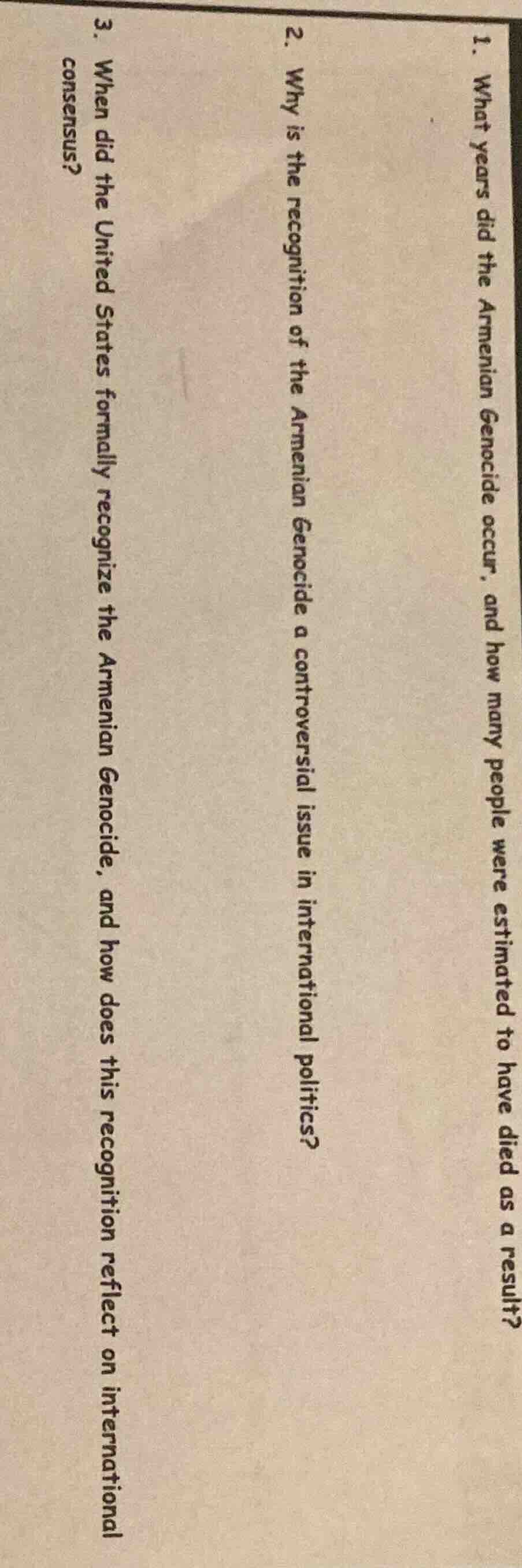
- what years did the armenian genocide occur, and how many people were estimated to have died as a result?
- why is the recognition of the armenian genocide a controversial issue in international politics?
- when did the united states formally recognize the armenian genocide, and how does this recognition reflect on international consensus?
Brief Explanations
- The Armenian Genocide was carried out by the Ottoman Empire during World War I, with established death toll estimates from scholarly consensus.
- Controversy stems from geopolitical alliances, historical denial by a key regional state, and competing national historical narratives.
- U.S. recognition came after decades of advocacy, and it reveals gaps in global agreement on historical atrocities due to political interests.

Snap & solve any problem in the app
Get step-by-step solutions on Sovi AI
Photo-based solutions with guided steps
Explore more problems and detailed explanations
- The Armenian Genocide occurred between 1915 and 1923. An estimated 1.5 million Armenian people died as a result.
- Recognition is controversial because:
- Turkey, the successor state to the Ottoman Empire, formally denies the event was a genocide, and uses its geopolitical influence (such as its role in NATO, regional military power, and economic ties) to pressure other states to avoid recognition.
- States often balance historical justice with their political and economic interests in maintaining positive relations with Turkey, leading to inconsistent international stances.
- The United States formally recognized the Armenian Genocide in 2021, when President Joe Biden issued a formal statement acknowledging it. This recognition reflects that international consensus on historical atrocities is often delayed and shaped by shifting political priorities; it took over a century for the U.S. to act, showing that geopolitical considerations can override historical acknowledgment for long periods, and that consensus can emerge when political barriers (like concerns about alienating Turkey) are deemed less pressing than upholding historical justice and responding to domestic advocacy.