QUESTION IMAGE
Question
what did you figure out?
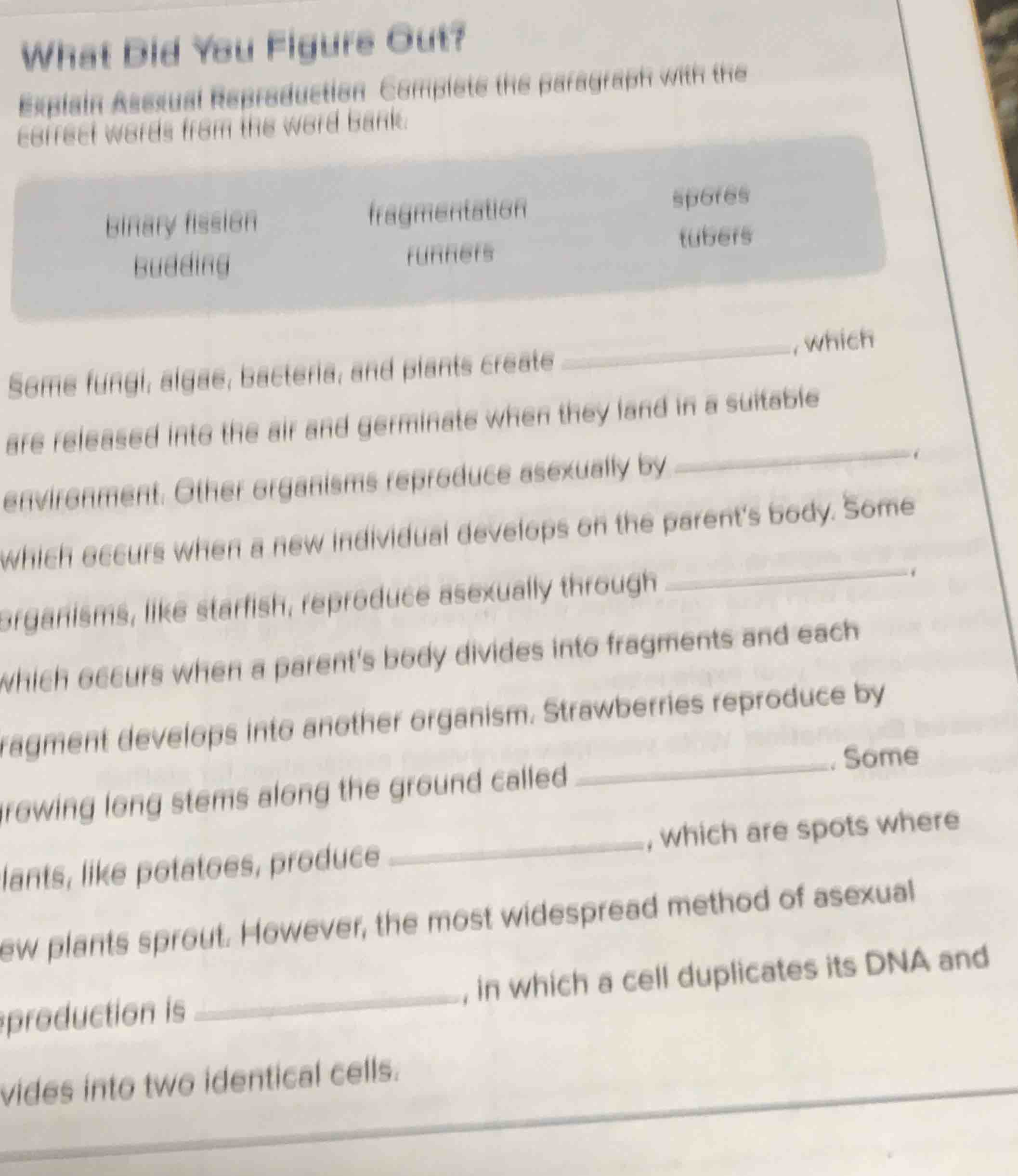
explain asexual reproduction complete the paragraph with the
eorrect words from the word bank.
binary fission fragmentation spores
budding runners tubers
some fungi, algae, bacteria, and plants create ________, which
are released into the air and germinate when they land in a suitable
environment. other organisms reproduce asexually by ________,
which occurs when a new individual develops on the parent’s body. some
organisms, like starfish, reproduce asexually through ________,
which occurs when a parent’s body divides into fragments and each
fragment develops into another organism. strawberries reproduce by
growing long stems along the ground called ________. some
plants, like potatoes, produce ________, which are spots where
new plants sprout. however, the most widespread method of asexual
reproduction is ________, in which a cell duplicates its dna and
divides into two identical cells.
- For the first blank: Fungi, algae, bacteria, and some plants release "spores" into the air for asexual reproduction, as spores are reproductive units that can germinate in suitable conditions.
- For the second blank: "Budding" is an asexual reproduction method where a new individual develops on the parent's body (e.g., yeast, hydra).
- For the third blank: Starfish reproduce asexually through "fragmentation", where the parent's body breaks into fragments, and each fragment grows into a new organism.
- For the fourth blank: Strawberries reproduce by sending out "runners" (horizontal stems) along the ground, which can develop into new plants.
- For the fifth blank: Potatoes produce "tubers", which are modified stems with buds that can sprout into new plants.
- For the sixth blank: The most widespread asexual reproduction method in unicellular organisms (like bacteria) is "binary fission", where a cell duplicates its DNA and divides into two identical cells.

Snap & solve any problem in the app
Get step-by-step solutions on Sovi AI
Photo-based solutions with guided steps
Explore more problems and detailed explanations
- spores
- budding
- fragmentation
- runners
- tubers
- binary fission