QUESTION IMAGE
Question
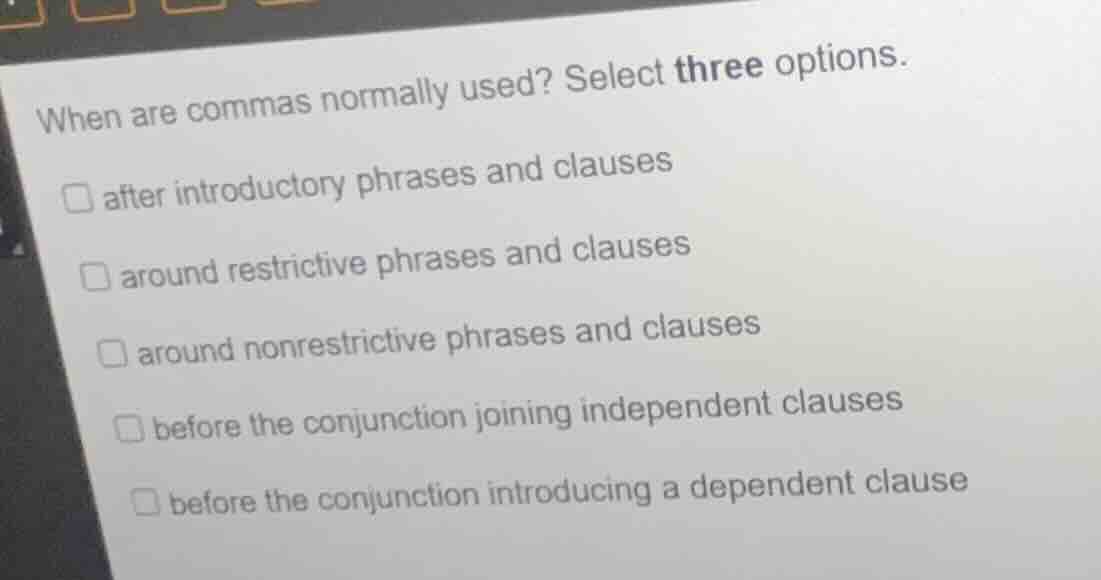
when are commas normally used? select three options.
□ after introductory phrases and clauses
□ around restrictive phrases and clauses
□ around nonrestrictive phrases and clauses
□ before the conjunction joining independent clauses
□ before the conjunction introducing a dependent clause
Brief Explanations
- Introductory phrases/clauses set context, so commas follow them to separate from the main clause.
- Nonrestrictive phrases/clauses add extra, non-essential info; commas set them apart from the core sentence.
- When a coordinating conjunction joins two independent clauses (complete sentences), a comma precedes the conjunction.
- Restrictive phrases/clauses are essential to define the noun, so they do not use surrounding commas.
- A comma is not needed before a conjunction introducing a dependent clause that follows an independent clause.

Snap & solve any problem in the app
Get step-by-step solutions on Sovi AI
Photo-based solutions with guided steps
Explore more problems and detailed explanations
- after introductory phrases and clauses
- around nonrestrictive phrases and clauses
- before the conjunction joining independent clauses