QUESTION IMAGE
Question
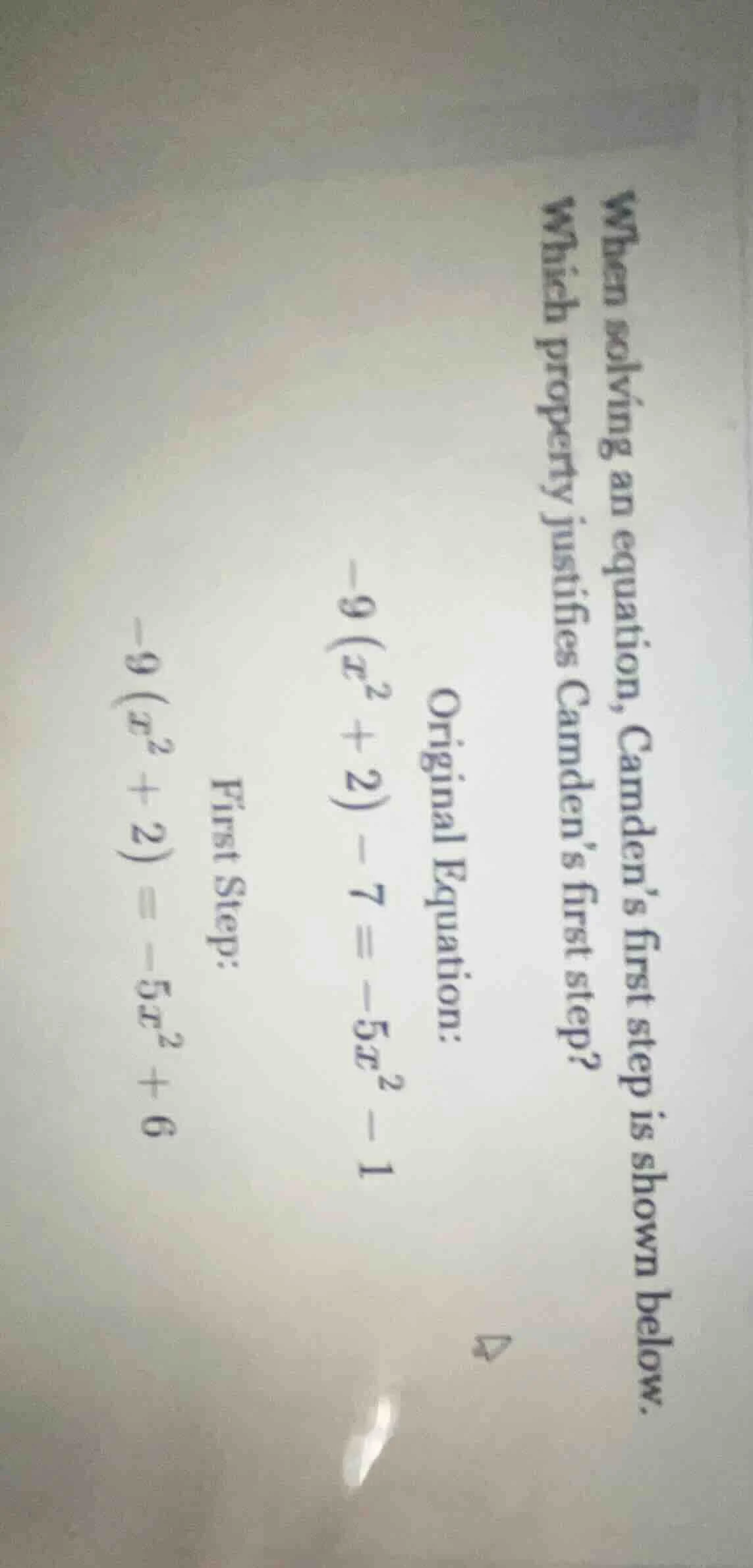
when solving an equation, camden’s first step is shown below. which property justifies camden’s first step?
original equation:
$-9(x^2 + 2) - 7 = -5x^2 - 1$
first step:
$-9(x^2 + 2) = -5x^2 + 6$
To determine the property justifying Camden’s first step, we analyze the transformation from the original equation to the first step:
Step 1: Identify the original and transformed equations
- Original Equation: \( -9(x^2 + 2) - 7 = -5x^2 - 1 \)
- First Step: \( -9(x^2 + 2) = -5x^2 + 6 \)
Step 2: Analyze the operation performed
To get from the original equation to the first step, we add 7 to both sides of the equation. This is justified by the Addition Property of Equality, which states that if \( a = b \), then \( a + c = b + c \) for any real number \( c \).
Applying this property:
- Start with \( -9(x^2 + 2) - 7 = -5x^2 - 1 \).
- Add \( 7 \) to both sides:
\( -9(x^2 + 2) - 7 + 7 = -5x^2 - 1 + 7 \).
- Simplify: \( -9(x^2 + 2) = -5x^2 + 6 \), which matches the first step.

Snap & solve any problem in the app
Get step-by-step solutions on Sovi AI
Photo-based solutions with guided steps
Explore more problems and detailed explanations
The property justifying Camden’s first step is the Addition Property of Equality (or "Addition Property" for short), as 7 is added to both sides of the equation to isolate \( -9(x^2 + 2) \).