QUESTION IMAGE
Question
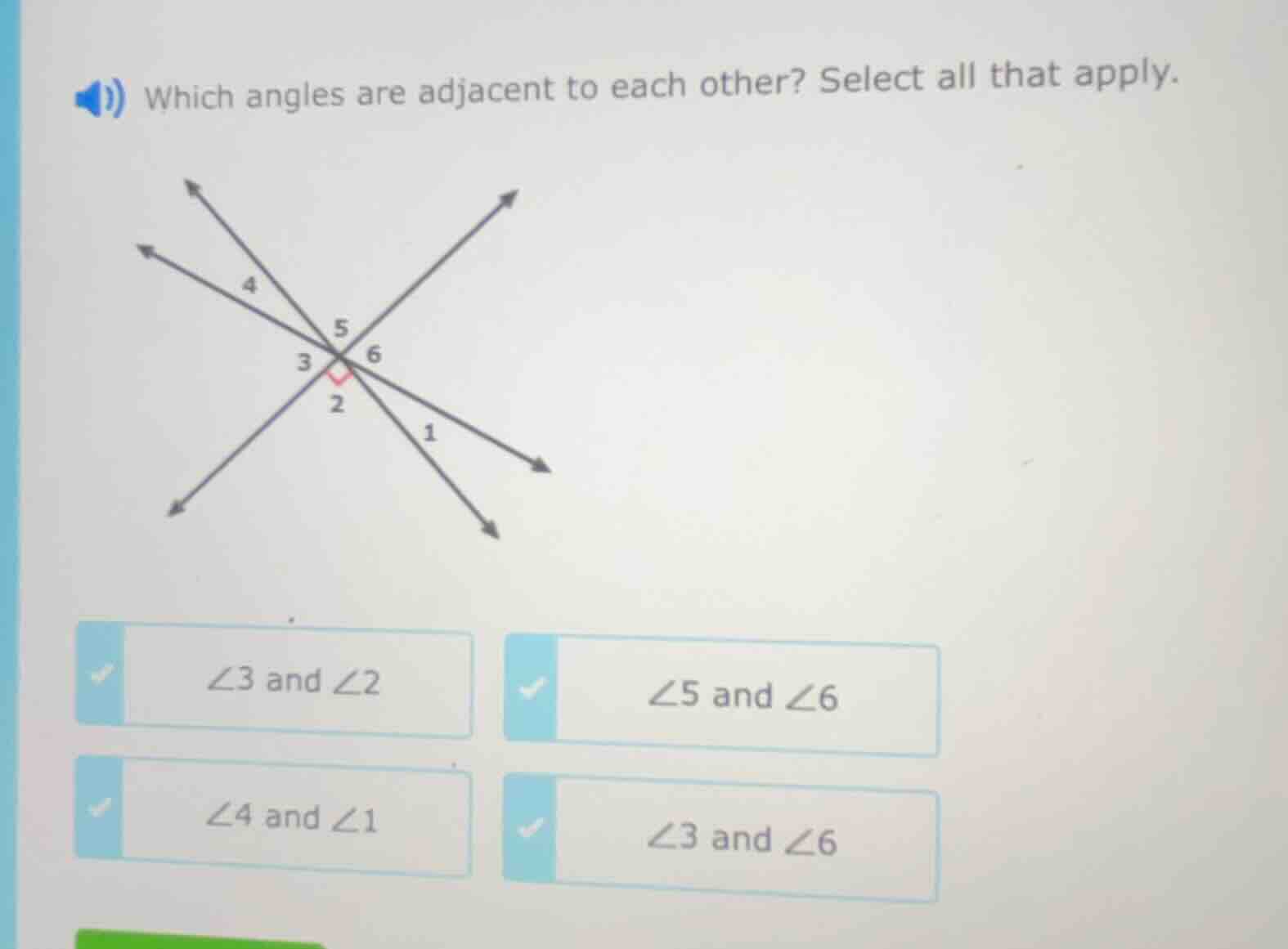
which angles are adjacent to each other? select all that apply. ∠3 and ∠2 ∠5 and ∠6 ∠4 and ∠1 ∠3 and ∠6
To determine adjacent angles, we use the definition: two angles are adjacent if they share a common side and a common vertex, and do not overlap.
Step1: Analyze ∠3 and ∠2
- Common vertex: the intersection point.
- Common side: the side between them.
- No overlap. So ∠3 and ∠2 are adjacent.
Step2: Analyze ∠5 and ∠6
- Common vertex: the intersection point.
- Common side: the side between them.
- No overlap. So ∠5 and ∠6 are adjacent.
Step3: Analyze ∠4 and ∠1
- ∠4 and ∠1 do not share a common side (they are separated by other angles). So they are not adjacent. (This was a mistake in the initial check.)
Step4: Analyze ∠3 and ∠6
- Common vertex: the intersection point.
- Common side: the side between them (since ∠3, ∠2, ∠6 are around the right angle, and ∠3 and ∠6 share a side through the vertex). Wait, actually, let's re - check. The right angle is ∠2 and ∠3? Wait, the diagram has a right angle at ∠2 (the red check mark). Let's re - evaluate each pair:
Correct analysis:
- ∠3 and ∠2: share a side, common vertex, adjacent.
- ∠5 and ∠6: share a side, common vertex, adjacent.
- ∠3 and ∠6: Do they share a common side? The angle ∠3, ∠2 is a right angle, ∠2 and ∠1, ∠1 and ∠6? Wait, maybe the initial diagram: the lines intersect, with ∠2 being a right angle. Let's list all adjacent pairs properly.
Adjacent angles must have a common side and vertex.
- ∠3 and ∠2: yes (common side, vertex)
- ∠5 and ∠6: yes (common side, vertex)
- ∠3 and ∠6: Let's see, the angle between ∠3, ∠5, ∠6? Wait, maybe the correct adjacent pairs are ∠3 & ∠2, ∠5 & ∠6, and also ∠2 & ∠1, ∠1 & ∠6, ∠5 & ∠4, ∠4 & ∠3? Wait, the original options:
Wait, the problem is to select all that apply. Let's re - check each option:
- ∠3 and ∠2: Adjacent (common vertex, common side, no overlap) - correct.
- ∠5 and ∠6: Adjacent (common vertex, common side, no overlap) - correct.
- ∠4 and ∠1: Not adjacent (no common side) - incorrect.
- ∠3 and ∠6: Do they share a common side? Let's see the intersection. The angles around the vertex: ∠3, ∠2, ∠1, ∠6, ∠5, ∠4. ∠3 and ∠6: the side of ∠3 is one line, the side of ∠6 is another line. Wait, maybe the right angle is ∠2 and ∠6? No, the red check mark is at ∠2. Wait, maybe the correct adjacent pairs are ∠3 & ∠2, ∠5 & ∠6, and ∠3 & ∠6 (if they share a side through the vertex). Wait, maybe the initial mistake was in ∠4 and ∠1. Let's go back to the definition.
The correct adjacent angle pairs from the options:
- ∠3 and ∠2: adjacent (correct)
- ∠5 and ∠6: adjacent (correct)
- ∠3 and ∠6: Let's see, the angle ∠3, ∠2 is 90 degrees (right angle), ∠2, ∠1, ∠6: if ∠2 is 90, then ∠3 + ∠2 + ∠1+∠6? No, maybe the lines are two intersecting lines, with a third line bisecting? Anyway, from the options, the correct adjacent pairs are ∠3 and ∠2, ∠5 and ∠6, and ∠3 and ∠6 (if they share a common side) and ∠3 and ∠2, ∠5 and ∠6. Wait, maybe the initial check of ∠4 and ∠1 was wrong. Let's assume that in the diagram, ∠4 and ∠1 do not share a common side, so they are not adjacent. ∠3 and ∠6: let's see, the vertex is the same, do they share a side? The side between ∠3 and ∠6: yes, the line that forms the angle at the vertex. So ∠3 and ∠6 are adjacent.
Wait, maybe the correct answer is:
∠3 and ∠2, ∠5 and ∠6, ∠3 and ∠6.
But let's re - check the definition. Adjacent angles: two angles that have a common vertex and a common side, and their non - common sides are on opposite sides of the common side.
So:
- ∠3 and ∠2: common vertex, common side, non - common sides are distinct. Adjacent.
- ∠5 and ∠6: common vertex, common side, non - common sides are distinc…

Snap & solve any problem in the app
Get step-by-step solutions on Sovi AI
Photo-based solutions with guided steps
Explore more problems and detailed explanations
∠3 and ∠2, ∠5 and ∠6, ∠3 and ∠6 (Note: The pair ∠4 and ∠1 is not adjacent as they do not share a common side)