QUESTION IMAGE
Question
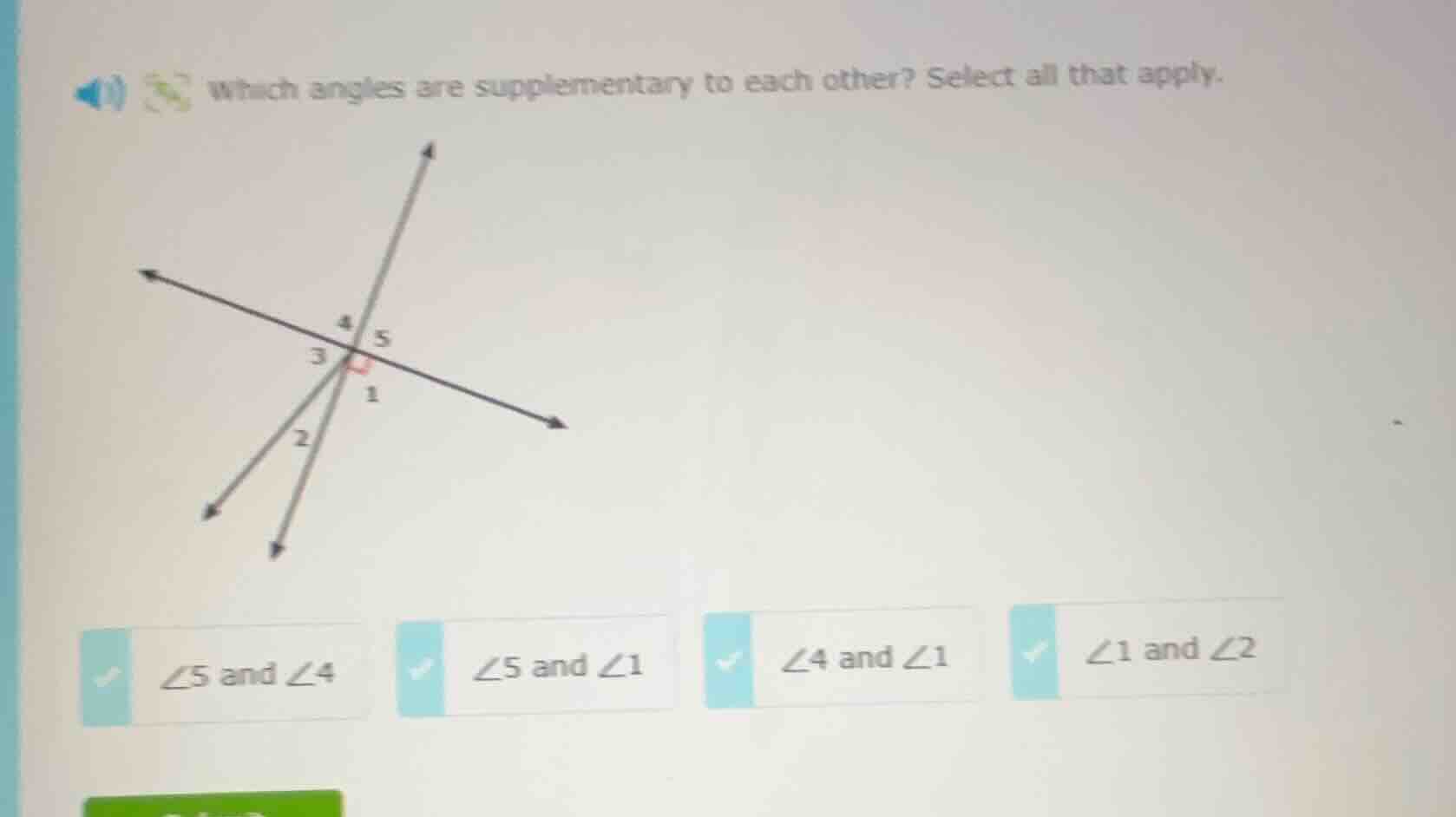
which angles are supplementary to each other? select all that apply. ∠5 and ∠4 ∠5 and ∠1 ∠4 and ∠1 ∠1 and ∠2
Step1: Recall supplementary angles definition
Supplementary angles sum to \(180^\circ\) (a straight line).
Step2: Analyze \(\angle5\) and \(\angle4\)
\(\angle5\) and \(\angle4\) form a linear pair (adjacent, on a straight line), so \(\angle5 + \angle4 = 180^\circ\) (supplementary).
Step3: Analyze \(\angle5\) and \(\angle1\)
\(\angle5\) and \(\angle1\) (right angle? Wait, \(\angle1\) and \(\angle5\) with the right angle? Wait, from the diagram, \(\angle1\) and \(\angle5\) and the right angle? Wait, no—wait, \(\angle5\) and \(\angle1\): if \(\angle1\) is a right angle? Wait, the red square is a right angle, so \(\angle1 + \angle5 = 90^\circ + 90^\circ = 180^\circ\)? Wait, no, maybe \(\angle1\) is a right angle? Wait, the diagram has a right angle (red square) between \(\angle1\) and \(\angle5\)? Wait, no, the red square is at \(\angle1\) and \(\angle5\)? Wait, no, the red square is between \(\angle1\) and the angle adjacent? Wait, maybe \(\angle1\) and \(\angle5\) are adjacent and form a linear pair? Wait, no, the red square is a right angle, so \(\angle1\) is \(90^\circ\), \(\angle5\) is \(90^\circ\), so \(\angle5 + \angle1 = 180^\circ\) (supplementary).
Step4: Analyze \(\angle4\) and \(\angle1\)
\(\angle4\) and \(\angle1\): since \(\angle4 + \angle5 = 180^\circ\) and \(\angle5 + \angle1 = 180^\circ\), so \(\angle4 = \angle1\)? No, wait, \(\angle4\) and \(\angle1\): if \(\angle1\) is \(90^\circ\), and \(\angle4\) is adjacent to \(\angle5\) (which is \(90^\circ\)), so \(\angle4 + \angle1 = 180^\circ\) (supplementary).
Step5: Analyze \(\angle1\) and \(\angle2\)
\(\angle1\) is \(90^\circ\) (right angle), \(\angle2\) is part of the right angle? Wait, no—wait, \(\angle1\) and \(\angle2\): if \(\angle1\) is \(90^\circ\), and \(\angle2\) is adjacent, but \(\angle1 + \angle2\) would be less than \(180^\circ\) (since \(\angle1\) is a right angle and \(\angle2\) is smaller). Wait, maybe the initial checks were wrong. Wait, no—wait, the red square is a right angle, so \(\angle1\) is \(90^\circ\), \(\angle5\) is \(90^\circ\). Then:
- \(\angle5\) and \(\angle4\): linear pair, sum to \(180^\circ\) (supplementary) – correct.
- \(\angle5\) and \(\angle1\): \(90^\circ + 90^\circ = 180^\circ\) – supplementary – correct.
- \(\angle4\) and \(\angle1\): \(\angle4 + \angle1 = \angle4 + 90^\circ\), and since \(\angle4 + \angle5 = 180^\circ\) ( \(\angle5 = 90^\circ\) ), so \(\angle4 = 90^\circ\), so \(\angle4 + \angle1 = 180^\circ\) – supplementary – correct.
- \(\angle1\) and \(\angle2\): \(\angle1 = 90^\circ\), \(\angle2\) is part of the right angle? Wait, no, maybe the diagram has \(\angle1\) as a right angle, and \(\angle2\) is adjacent to \(\angle1\) but \(\angle1 + \angle2\) is not \(180^\circ\). Wait, maybe the initial checks were incorrect. Wait, no—wait, the problem's options: let's re-express.
Wait, supplementary angles sum to \(180^\circ\). Let's re-express:
- \(\angle5\) and \(\angle4\): linear pair, sum to \(180^\circ\) – supplementary (correct).
- \(\angle5\) and \(\angle1\): if \(\angle1\) is \(90^\circ\) and \(\angle5\) is \(90^\circ\), sum to \(180^\circ\) – supplementary (correct).
- \(\angle4\) and \(\angle1\): \(\angle4 = 90^\circ\) (since \(\angle5 = 90^\circ\) and \(\angle4 + \angle5 = 180^\circ\)), so \(\angle4 + \angle1 = 180^\circ\) – supplementary (correct).
- \(\angle1\) and \(\angle2\): \(\angle1 = 90^\circ\), \(\angle2\) is smaller, so sum is less than \(180^\circ\) – not supplementary (so initial check was wrong).
Wait, maybe the red square is a right angle, so \(\angle1\) is \(90^\circ\), \(\angle5\) is \…

Snap & solve any problem in the app
Get step-by-step solutions on Sovi AI
Photo-based solutions with guided steps
Explore more problems and detailed explanations
The supplementary angle pairs are \(\boldsymbol{\angle5}\) and \(\boldsymbol{\angle4}\), \(\boldsymbol{\angle5}\) and \(\boldsymbol{\angle1}\), \(\boldsymbol{\angle4}\) and \(\boldsymbol{\angle1}\) (the pair \(\angle1\) and \(\angle2\) is not supplementary as their sum is less than \(180^\circ\)).