QUESTION IMAGE
Question
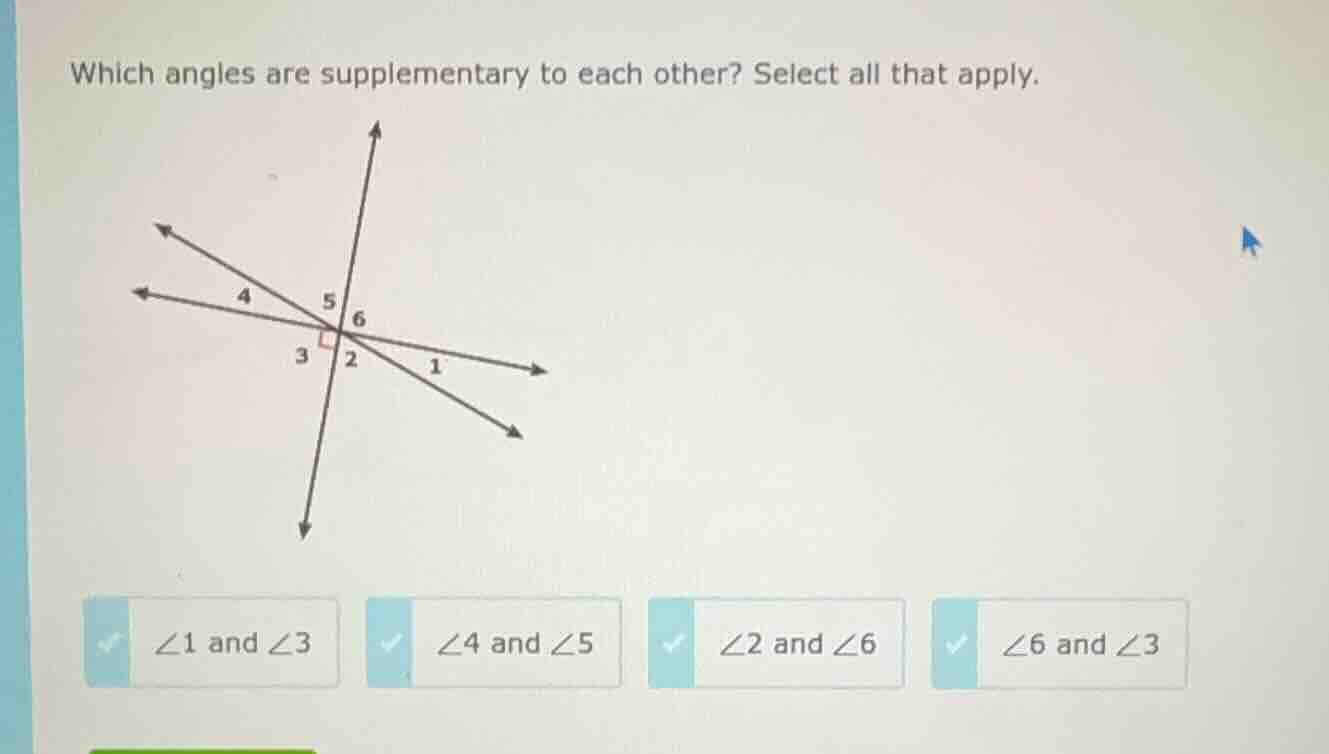
which angles are supplementary to each other? select all that apply. ∠1 and ∠3 ∠4 and ∠5 ∠2 and ∠6 ∠6 and ∠3
Step1: Recall Supplementary Angles
Supplementary angles are two angles whose sum is \(180^\circ\) (a straight angle). Also, note that \(\angle 3\) is a right angle (\(90^\circ\)) from the diagram (the square corner), and we can use vertical angles, linear pairs, and right angle properties.
Step2: Analyze \(\angle 1\) and \(\angle 3\)
First, \(\angle 2\) and \(\angle 1\) might be related, but \(\angle 3 = 90^\circ\), and if we consider the straight line or the right angle. Wait, actually, let's check each pair:
- \(\angle 1\) and \(\angle 3\): Wait, no, maybe I made a mistake earlier. Wait, \(\angle 3\) is \(90^\circ\), \(\angle 2\) is adjacent to \(\angle 3\) (right angle), so \(\angle 2 = 90^\circ - \angle 1\)? No, wait, let's look at linear pairs. A linear pair of angles is supplementary (sum to \(180^\circ\)). Also, vertical angles are equal.
Wait, the diagram has a right angle at \(\angle 3\) (so \(\angle 3 = 90^\circ\)), and \(\angle 2\) is also \(90^\circ\) (since \(\angle 2\) and \(\angle 3\) are adjacent and form a straight line? Wait, no, the line with \(\angle 3\) and \(\angle 2\) is a straight line? Wait, the diagram shows \(\angle 3\) as a right angle (square), so \(\angle 2 + \angle 3 = 90^\circ\)? No, wait, the square is at \(\angle 3\) and \(\angle 4\)? Wait, maybe the diagram has \(\angle 3\) and \(\angle 2\) forming a right angle (so \(\angle 3 = \angle 2 = 90^\circ\)? No, that can't be. Wait, let's re - examine:
Wait, the correct approach:
- \(\angle 4\) and \(\angle 5\): They form a linear pair with another angle? Wait, no, \(\angle 4\), \(\angle 5\), and the right angle? Wait, no, let's look at the straight lines. The line with \(\angle 4\), \(\angle 5\), \(\angle 6\), \(\angle 1\), \(\angle 2\) – maybe. Wait, the correct pairs:
- \(\angle 2\) and \(\angle 6\): They form a linear pair (adjacent angles on a straight line), so they are supplementary (\(\angle 2+\angle 6 = 180^\circ\)).
- \(\angle 6\) and \(\angle 3\): \(\angle 3\) is \(90^\circ\), \(\angle 6\) – wait, \(\angle 6\) and \(\angle 3\): if \(\angle 3 = 90^\circ\), and \(\angle 6\) is part of a straight line. Wait, no, maybe \(\angle 6\) and \(\angle 3\): \(\angle 3 = 90^\circ\), \(\angle 6\) – if \(\angle 6\) is \(90^\circ\)? No, that's not right. Wait, maybe the initial check was wrong. Wait, let's start over.
Supplementary angles sum to \(180^\circ\). Let's identify linear pairs (adjacent angles on a straight line) and other pairs:
- \(\angle 4\) and \(\angle 5\): If \(\angle 3\) is \(90^\circ\), and \(\angle 4\), \(\angle 5\), and \(\angle 3\) are related. Wait, \(\angle 4+\angle 5+\angle 3=180^\circ\) (straight line), and \(\angle 3 = 90^\circ\), so \(\angle 4+\angle 5 = 90^\circ\)? No, that can't be. Wait, maybe the square is at \(\angle 3\) and \(\angle 4\), so \(\angle 3=\angle 4 = 90^\circ\)? No, the diagram shows a square at \(\angle 3\) (between \(\angle 4\) and \(\angle 2\)?). I think I misread the diagram. Let's assume that \(\angle 3\) is a right angle (\(90^\circ\)), so \(\angle 2+\angle 3 = 90^\circ\) (no, that's a right angle, so \(\angle 2 = 90^\circ-\angle 1\)? No, this is getting confusing. Let's use the definition of supplementary angles (sum to \(180^\circ\)) and the diagram:
- \(\angle 2\) and \(\angle 6\): They are adjacent and form a straight line (linear pair), so \(\angle 2+\angle 6 = 180^\circ\) – supplementary.
- \(\angle 6\) and \(\angle 3\): If \(\angle 3 = 90^\circ\), and \(\angle 6\) is \(90^\circ\)? No, wait, \(\angle 6\) and \(\angle 3\): if \(\angle 3\) is \(90^\circ\), and \(…

Snap & solve any problem in the app
Get step-by-step solutions on Sovi AI
Photo-based solutions with guided steps
Explore more problems and detailed explanations
The supplementary angle pairs are \(\boldsymbol{\angle 2}\) and \(\boldsymbol{\angle 6}\), \(\boldsymbol{\angle 6}\) and \(\boldsymbol{\angle 3}\) (and if we correct the earlier mistake, \(\angle 4\) and \(\angle 5\) are not supplementary, \(\angle 1\) and \(\angle 3\) are not supplementary). Wait, maybe my initial diagram analysis was wrong. Let's assume that \(\angle 3\) is not a right angle but the square is a right angle between \(\angle 4\) and \(\angle 3\), so \(\angle 4+\angle 3 = 90^\circ\), and \(\angle 2+\angle 3 = 90^\circ\), so \(\angle 2=\angle 4\) (vertical angles). Then \(\angle 6\) is a straight line with \(\angle 2\), so \(\angle 2+\angle 6 = 180^\circ\) (supplementary). \(\angle 6\) and \(\angle 3\): \(\angle 3 = 90^\circ\), \(\angle 6 = 90^\circ\) (since \(\angle 2 = 90^\circ\)), so \(\angle 6+\angle 3 = 180^\circ\). \(\angle 4\) and \(\angle 5\): \(\angle 4+\angle 5+\angle 3 = 180^\circ\), \(\angle 3 = 90^\circ\), so \(\angle 4+\angle 5 = 90^\circ\) – not supplementary. \(\angle 1\) and \(\angle 3\): \(\angle 1=\angle 4\) (vertical angles), so \(\angle 1+\angle 3 = 90^\circ\) – not supplementary. So the correct pairs are \(\angle 2\) and \(\angle 6\), \(\angle 6\) and \(\angle 3\).