QUESTION IMAGE
Question
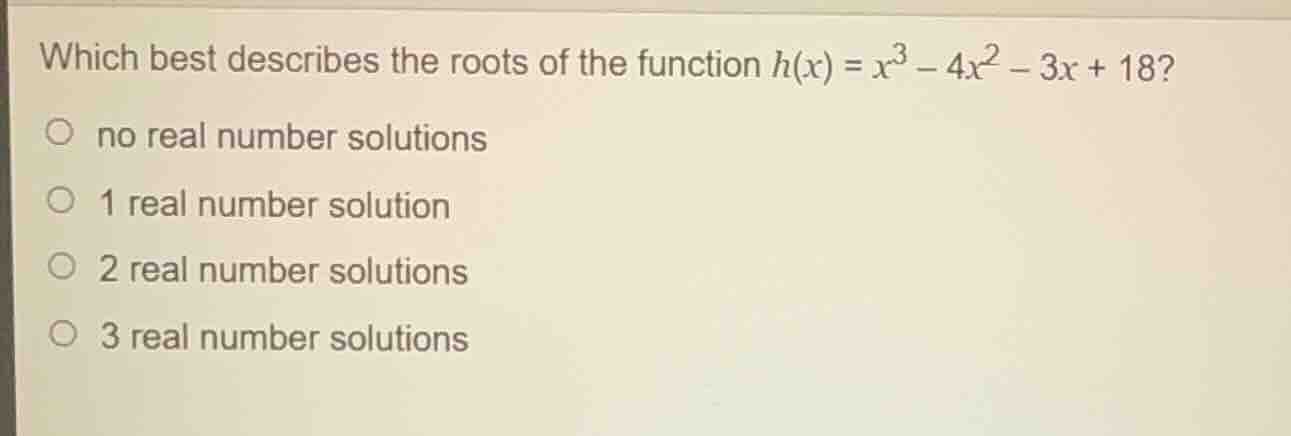
which best describes the roots of the function $h(x) = x^3 - 4x^2 - 3x + 18$?
no real number solutions
1 real number solution
2 real number solutions
3 real number solutions
Step1: Test possible rational roots
Using Rational Root Theorem, possible roots are factors of 18 over factors of 1: ±1, ±2, ±3, ±6, ±9, ±18.
Test \(x = -2\): \(h(-2)=(-2)^3 - 4(-2)^2 - 3(-2)+18=-8 - 16 + 6 + 18=0\). So \(x = -2\) is a root.
Step2: Factor the polynomial
Since \(x = -2\) is a root, \((x + 2)\) is a factor. Divide \(h(x)\) by \((x + 2)\) or use synthetic division.
Using synthetic division for \(x=-2\):
\[
\]
So \(h(x)=(x + 2)(x^2 - 6x + 9)\).
Step3: Factor the quadratic
Factor \(x^2 - 6x + 9=(x - 3)^2\). So \(h(x)=(x + 2)(x - 3)^2\).
Step4: Find all roots
Set \(h(x)=0\): \((x + 2)(x - 3)^2 = 0\). Roots are \(x=-2\) (with multiplicity 1) and \(x = 3\) (with multiplicity 2). All roots are real. So there are 3 real number solutions (counting multiplicity, but even without, two distinct real roots but one with multiplicity 2, total real roots when considering multiplicity or as distinct? Wait, the quadratic has a repeated real root. So total real roots: \(x=-2\), \(x = 3\), \(x = 3\). So three real number solutions (since multiplicity counts in the number of roots, or even as distinct, two distinct but one with multiplicity 2, so total real roots are three when considering that the quadratic has a real root (a repeated one). So the function has three real roots (one distinct, one repeated).

Snap & solve any problem in the app
Get step-by-step solutions on Sovi AI
Photo-based solutions with guided steps
Explore more problems and detailed explanations
3 real number solutions