QUESTION IMAGE
Question
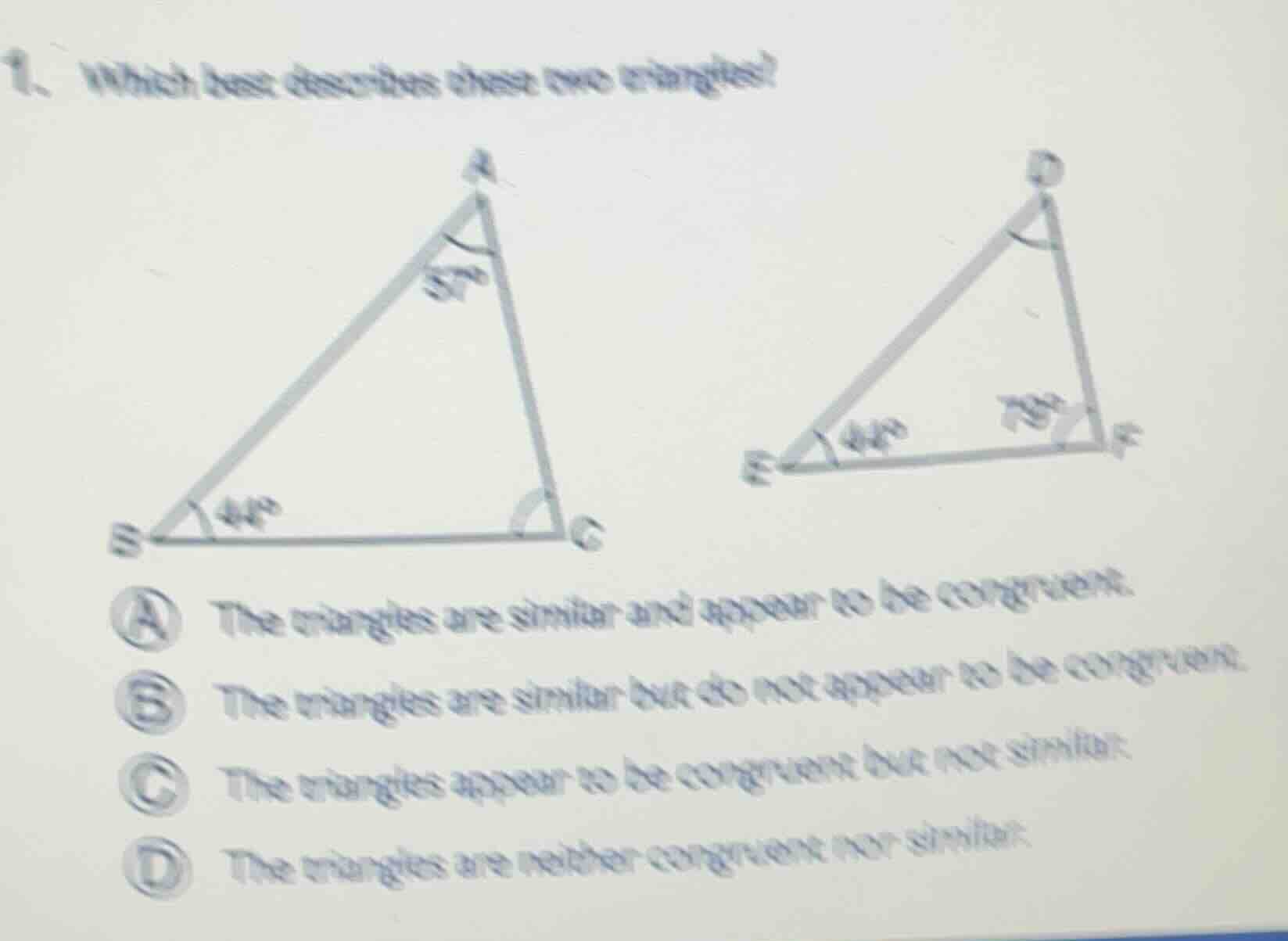
- which best describes these two triangles?
a the triangles are similar and appear to be congruent.
b the triangles are similar but do not appear to be congruent.
c the triangles appear to be congruent but not similar.
d the triangles are neither congruent nor similar.
Step1: Calculate angle C in triangle ABC
In triangle \(ABC\), the sum of interior angles is \(180^\circ\). Given \(\angle A = 61^\circ\) (wait, no, original angle at A: wait, the first triangle has angle at B as \(44^\circ\), angle at A as \(61^\circ\)? Wait no, let's recalculate. Wait, in triangle \(ABC\), angles are \(\angle B = 44^\circ\), \(\angle A = 61^\circ\)? Wait no, the first triangle: angle at B is \(44^\circ\), angle at A is \(61^\circ\)? Wait, no, let's do it properly. Wait, in triangle \(ABC\), sum of angles is \(180^\circ\). So \(\angle C = 180^\circ - 44^\circ - 61^\circ\)? Wait, no, the first triangle: angle at A is \(61^\circ\)? Wait, no, the first triangle: angle at B is \(44^\circ\), angle at A is \(61^\circ\)? Wait, no, the first triangle: angle at B is \(44^\circ\), angle at A is \(61^\circ\)? Wait, no, let's check the second triangle. In triangle \(DEF\), angle at E is \(44^\circ\), angle at F is \(75^\circ\), so angle at D is \(180 - 44 - 75 = 61^\circ\). Ah, right! So in triangle \(ABC\): angle at B is \(44^\circ\), angle at A: let's see, the first triangle: angle at A is \(61^\circ\) (since \(180 - 44 - 75 = 61\)? Wait no, wait the first triangle: angle at B is \(44^\circ\), angle at A: let's calculate \(\angle C\) in \(ABC\): \(\angle C = 180 - 44 - 61 = 75^\circ\)? Wait, no, let's do it again.
Wait, triangle \(ABC\): angles are \(\angle B = 44^\circ\), \(\angle A = 61^\circ\)? Wait, no, the first triangle: angle at A is marked as \(61^\circ\)? Wait, the image: first triangle, angle at B is \(44^\circ\), angle at A is \(61^\circ\)? Wait, no, the first triangle: angle at B is \(44^\circ\), angle at A is \(61^\circ\), so angle at C is \(180 - 44 - 61 = 75^\circ\). Then triangle \(DEF\): angle at E is \(44^\circ\), angle at F is \(75^\circ\), so angle at D is \(180 - 44 - 75 = 61^\circ\). So now, triangle \(ABC\) has angles \(44^\circ\), \(61^\circ\), \(75^\circ\); triangle \(DEF\) has angles \(44^\circ\), \(61^\circ\), \(75^\circ\). So the triangles have all corresponding angles equal, so they are similar (by AA similarity, since two angles equal). Now, do they appear congruent? Congruent means same size and shape. The triangles look different in size (the first triangle looks larger than the second), so they are similar but not congruent.
Step2: Analyze similarity and congruence
Since all corresponding angles are equal, the triangles are similar (AA similarity criterion). Now, congruent triangles must have all corresponding sides equal (same size), but these triangles look different in size (the first triangle appears larger), so they are similar but not congruent.

Snap & solve any problem in the app
Get step-by-step solutions on Sovi AI
Photo-based solutions with guided steps
Explore more problems and detailed explanations
B. The triangles are similar but do not appear to be congruent.