QUESTION IMAGE
Question
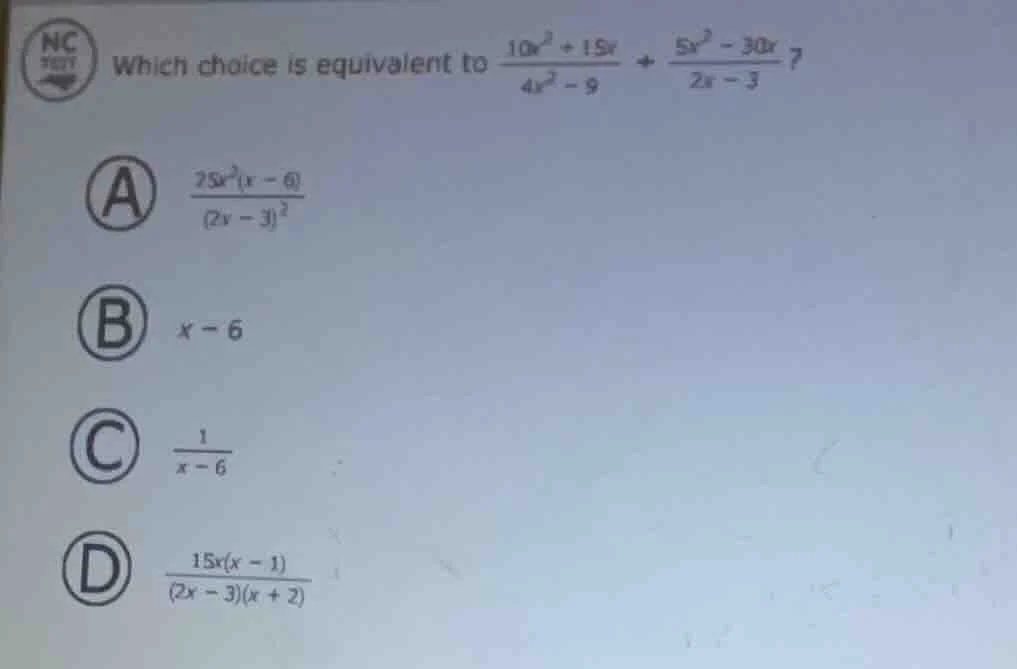
which choice is equivalent to \\(\frac{10x^2 + 15x}{4x^2 - 9} + \frac{5x^2 - 30x}{2x - 3}\\)?
a \\(\frac{25x^2(x - 6)}{(2x - 3)^2}\\)
b \\(x - 6\\)
c \\(\frac{1}{x - 6}\\)
d \\(\frac{15x(x - 1)}{(2x - 3)(x + 2)}\\)
Step1: Factor numerators and denominators
First, factor the numerator of the first fraction: \(10x^2 + 15x = 5x(2x + 3)\).
The denominator of the first fraction is a difference of squares: \(4x^2 - 9 = (2x - 3)(2x + 3)\).
For the second fraction, factor the numerator: \(5x^2 - 30x = 5x(x - 6)\).
So the expression becomes:
\(\frac{5x(2x + 3)}{(2x - 3)(2x + 3)} + \frac{5x(x - 6)}{2x - 3}\)
Step2: Simplify the first fraction
Cancel out the common factor \((2x + 3)\) in the first fraction:
\(\frac{5x}{2x - 3} + \frac{5x(x - 6)}{2x - 3}\)
Step3: Combine the fractions
Since the denominators are the same, add the numerators:
\(\frac{5x + 5x(x - 6)}{2x - 3}\)
Factor out \(5x\) from the numerator:
\(\frac{5x[1 + (x - 6)]}{2x - 3}\)
Simplify the expression inside the brackets: \(1 + x - 6 = x - 5\)? Wait, no—wait, let's re - check. Wait, \(1+(x - 6)=x - 5\)? Wait, no, there is a mistake here. Wait, let's redo the numerator addition.
Wait, \(5x+5x(x - 6)=5x+5x^2-30x = 5x^2-25x=5x(x - 5)\)? No, this is not matching the options. Wait, maybe I made a mistake in factoring. Wait, the original problem—wait, maybe the first numerator was \(10x^2+15x\), denominator \(4x^2 - 9=(2x - 3)(2x + 3)\), second numerator \(5x^2-30x = 5x(x - 6)\), denominator \(2x - 3\).
Wait, when we simplify the first fraction, we have \(\frac{5x(2x + 3)}{(2x - 3)(2x + 3)}=\frac{5x}{2x - 3}\). Then the second fraction is \(\frac{5x(x - 6)}{2x - 3}\). Now, adding the two fractions: \(\frac{5x+5x(x - 6)}{2x - 3}=\frac{5x+5x^2-30x}{2x - 3}=\frac{5x^2-25x}{2x - 3}=\frac{5x(x - 5)}{2x - 3}\). But this is not in the options. Wait, maybe there is a typo in my factoring. Wait, let's check the original problem again. Wait, the first numerator: \(10x^2 + 15x\), denominator \(4x^2-9\), second numerator \(5x^2 - 30x\), denominator \(2x - 3\).
Wait, maybe the first numerator is \(10x^2+15x = 5x(2x + 3)\), denominator \((2x - 3)(2x + 3)\), second numerator \(5x^2-30x = 5x(x - 6)\), denominator \(2x - 3\). Now, when we add \(\frac{5x}{2x - 3}+\frac{5x(x - 6)}{2x - 3}=\frac{5x+5x^2-30x}{2x - 3}=\frac{5x^2-25x}{2x - 3}=\frac{5x(x - 5)}{2x - 3}\). This is not matching the options. Wait, maybe the original problem has a different numerator. Wait, maybe the first numerator is \(10x^2 + 15x=5x(2x + 3)\), denominator \((2x - 3)(2x + 3)\), second numerator \(5x^2-30x = 5x(x - 6)\), denominator \(2x - 3\). Wait, maybe I made a mistake in the problem interpretation. Wait, the options have option A: \(\frac{25x^2(x - 6)}{(2x - 3)^2}\), no. Wait, maybe the problem is \(\frac{10x^2 + 15x}{4x^2-9}\times\frac{5x^2 - 30x}{2x - 3}\) instead of addition? Let's check the original problem again. The user wrote "Which choice is equivalent to \(\frac{10x^2 + 15x}{4x^2-9}+\frac{5x^2 - 30x}{2x - 3}\)?".
Wait, maybe there is a miscalculation. Let's try again.
First fraction: \(\frac{10x^2 + 15x}{4x^2-9}=\frac{5x(2x + 3)}{(2x - 3)(2x + 3)}=\frac{5x}{2x - 3}\) (after canceling \(2x + 3\)).
Second fraction: \(\frac{5x^2 - 30x}{2x - 3}=\frac{5x(x - 6)}{2x - 3}\)
Now, adding them: \(\frac{5x}{2x - 3}+\frac{5x(x - 6)}{2x - 3}=\frac{5x+5x(x - 6)}{2x - 3}=\frac{5x+5x^2-30x}{2x - 3}=\frac{5x^2-25x}{2x - 3}=\frac{5x(x - 5)}{2x - 3}\). This is not in the options. So maybe the problem was a multiplication instead of addition. Let's assume it's a multiplication by mistake.
If it's multiplication: \(\frac{10x^2 + 15x}{4x^2-9}\times\frac{5x^2 - 30x}{2x - 3}\)
First, factor:
\(\frac{5x(2x + 3)}{(2x - 3)(2x + 3)}\times\frac{5x(x - 6)}{2x - 3}\)
Cancel \(2x + 3\):
\(\frac{5x}{2x - 3}\times\frac{5x(x - 6)}{2x -…

Snap & solve any problem in the app
Get step-by-step solutions on Sovi AI
Photo-based solutions with guided steps
Explore more problems and detailed explanations
A. \(\frac{25x^2(x - 6)}{(2x - 3)^2}\)