QUESTION IMAGE
Question
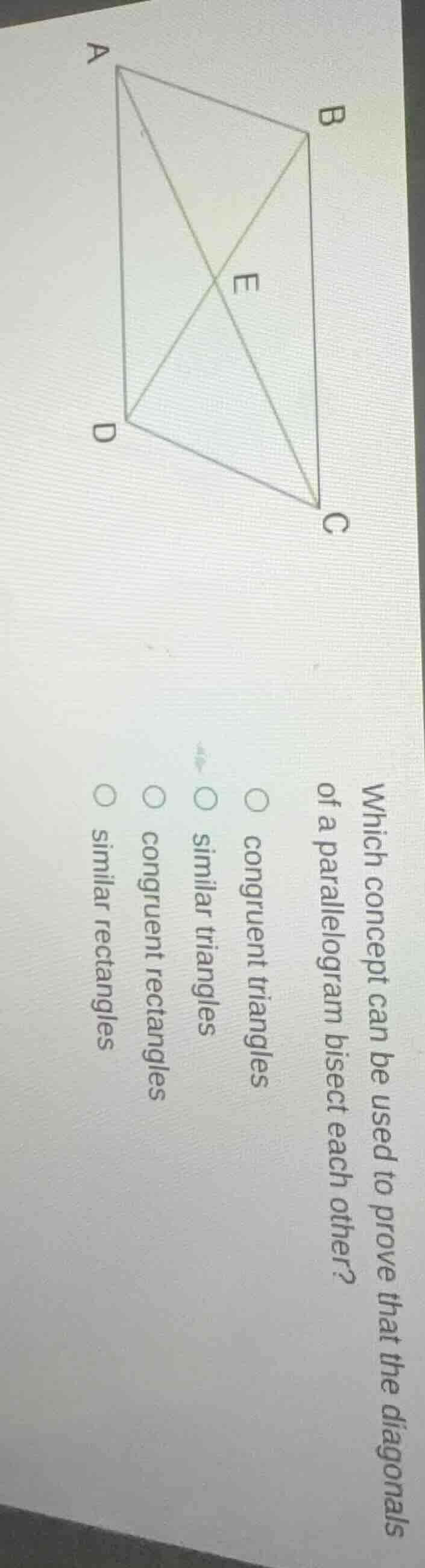
which concept can be used to prove that the diagonals of a parallelogram bisect each other?
○ congruent triangles
○ similar triangles
○ congruent rectangles
○ similar rectangles
To prove diagonals of a parallelogram bisect each other, we analyze triangles formed by diagonals (e.g., \(\triangle AEB\) and \(\triangle DEC\)). In a parallelogram, \(AB \parallel CD\) and \(AB = CD\). Alternate interior angles (\(\angle EAB=\angle ECD\), \(\angle EBA=\angle EDC\)) are equal. By ASA (Angle - Side - Angle) congruence criterion, \(\triangle AEB\cong\triangle DEC\). This gives \(AE = EC\) and \(BE = ED\), proving diagonals bisect each other. Options with rectangles are incorrect as the proof uses triangle congruence, not rectangle properties. Similar triangles have proportional sides, but here sides are equal (congruent), so congruent triangles are the right concept.

Snap & solve any problem in the app
Get step-by-step solutions on Sovi AI
Photo-based solutions with guided steps
Explore more problems and detailed explanations
A. congruent triangles