QUESTION IMAGE
Question
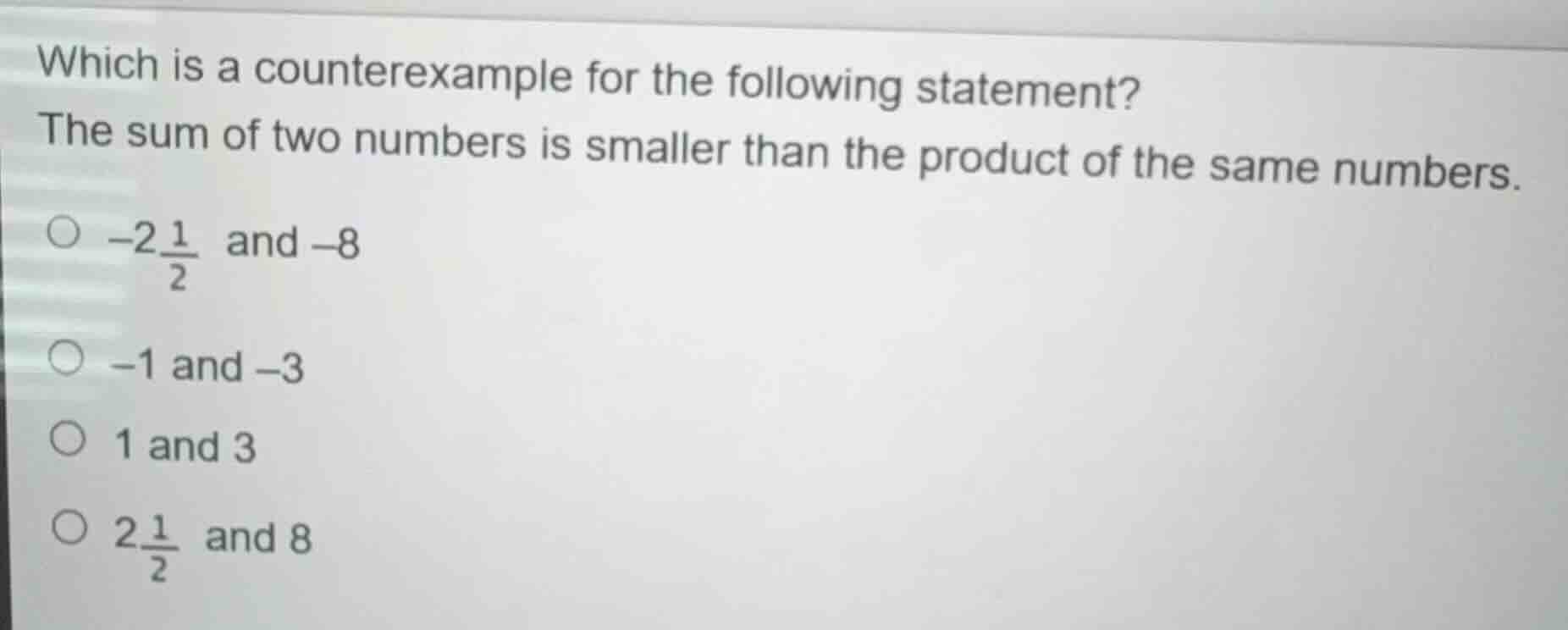
which is a counterexample for the following statement?
the sum of two numbers is smaller than the product of the same numbers.
$\boldsymbol{-2\frac{1}{2}}$ and $-8$
$-1$ and $-3$
$1$ and $3$
$\boldsymbol{2\frac{1}{2}}$ and $8$
Step1: Test first option: sum vs product
Sum: $-2\frac{1}{2} + (-8) = -\frac{5}{2} - 8 = -\frac{5}{2} - \frac{16}{2} = -\frac{21}{2} = -10.5$
Product: $-2\frac{1}{2} \times (-8) = \frac{5}{2} \times 8 = 20$
Check: $-10.5 < 20$ (follows the statement)
Step2: Test second option: sum vs product
Sum: $-1 + (-3) = -4$
Product: $(-1) \times (-3) = 3$
Check: $-4 < 3$ (follows the statement)
Step3: Test third option: sum vs product
Sum: $1 + 3 = 4$
Product: $1 \times 3 = 3$
Check: $4 > 3$ (violates the statement)
Step4: Verify fourth option (confirm)
Sum: $2\frac{1}{2} + 8 = \frac{5}{2} + 8 = \frac{5}{2} + \frac{16}{2} = \frac{21}{2} = 10.5$
Product: $2\frac{1}{2} \times 8 = \frac{5}{2} \times 8 = 20$
Check: $10.5 < 20$ (follows the statement)

Snap & solve any problem in the app
Get step-by-step solutions on Sovi AI
Photo-based solutions with guided steps
Explore more problems and detailed explanations
1 and 3