QUESTION IMAGE
Question
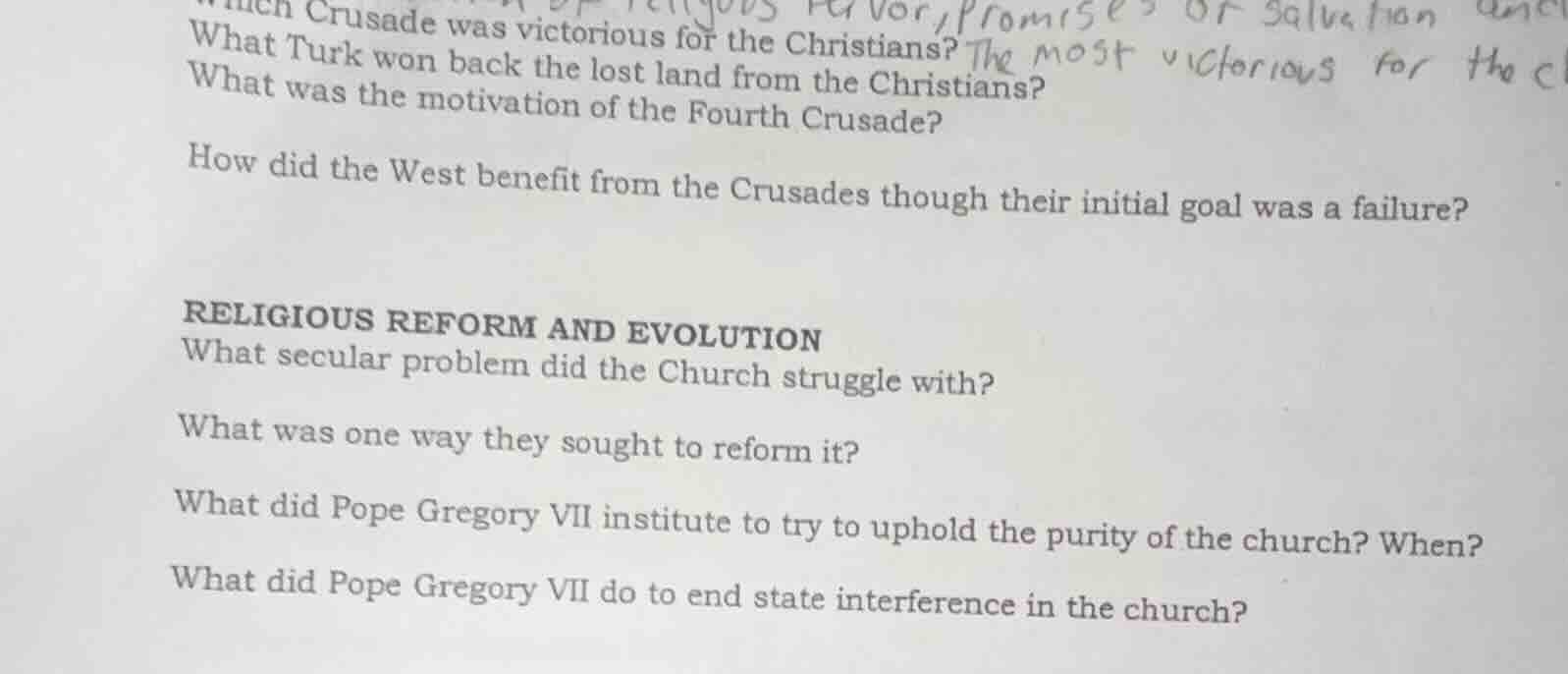
which crusade was victorious for the christians?
what turk won back the lost land from the christians?
what was the motivation of the fourth crusade?
how did the west benefit from the crusades though their initial goal was a failure?
religious reform and evolution
what secular problem did the church struggle with?
what was one way they sought to reform it?
what did pope gregory vii institute to try to uphold the purity of the church? when?
what did pope gregory vii do to end state interference in the church?
- Which Crusade was victorious for the Christians?
The First Crusade (1096-1099) successfully captured Jerusalem and established Christian states in the Levant, making it the most clearly victorious for Christians.
- What Turk won back the lost land from the Christians?
Saladin (Salah ad-Din Yusuf ibn Ayyub), a Kurdish Muslim leader who led the Ayyubid dynasty, retook Jerusalem and most Levantine territories from Christian Crusader states in the late 12th century.
- What was the motivation of the Fourth Crusade?
Officially, it was to recapture Jerusalem by first attacking Egypt, but it was diverted by financial and political deals, with participants motivated by plunder, political power, and fulfilling debts to Venetian merchants.
- How did the West benefit from the Crusades though their initial goal was a failure?
The Crusades opened trade routes to the East, bringing new goods (spices, silk) and knowledge (ancient Greek texts, advanced math/medicine) to Europe; they also stimulated economic growth in Italian city-states and reduced feudal power by weakening noble classes.
- What secular problem did the Church struggle with?
The Church faced widespread lay investiture, where secular rulers (kings, nobles) appointed church officials (bishops, abbots), undermining the Church's autonomy and leading to corrupt, unqualified clergy.
- What was one way they sought to reform it?
Church reformers called for the end of lay investiture and pushed for the appointment of qualified, pious clergy through church-only processes.
- What did Pope Gregory VII institute to try to uphold the purity of the church? When?
In 1073, Pope Gregory VII instituted the Gregorian Reforms, including strict celibacy requirements for clergy to eliminate corruption and restore spiritual purity.
- What did Pope Gregory VII do to end state interference in the church?
He issued the Dictatus Papae (1075), asserting papal supremacy over secular rulers, and excommunicated Holy Roman Emperor Henry IV to challenge his right to appoint church officials, sparking the Investiture Controversy which eventually limited secular control over church appointments.

Snap & solve any problem in the app
Get step-by-step solutions on Sovi AI
Photo-based solutions with guided steps
Explore more problems and detailed explanations
- The First Crusade (1096-1099)
- Saladin (Salah ad-Din Yusuf ibn Ayyub)
- Officially to recapture Jerusalem via Egypt; diverted by plunder, political deals, and debt repayment to Venice
- Gained new trade goods, access to classical knowledge, stimulated European economic growth, and weakened feudalism
- Lay investiture (secular rulers appointing church officials) and corrupt, unqualified clergy
- Pushed to end lay investiture and enforce clergy celibacy
- The Gregorian Reforms (including mandatory clergy celibacy) in 1073
- Issued the Dictatus Papae asserting papal supremacy and excommunicated Holy Roman Emperor Henry IV to challenge lay investiture