QUESTION IMAGE
Question
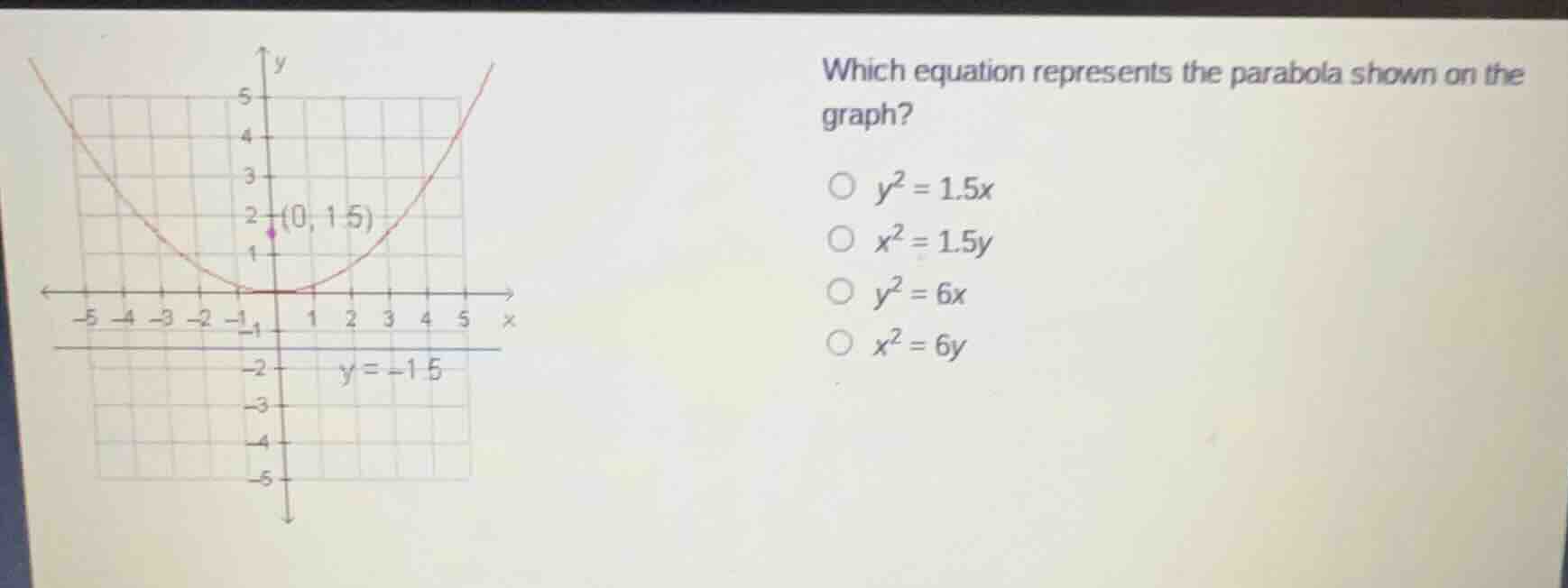
which equation represents the parabola shown on the graph?\\(\bigcirc\\ y^2 = 1.5x\\)\\(\bigcirc\\ x^2 = 1.5y\\)\\(\bigcirc\\ y^2 = 6x\\)\\(\bigcirc\\ x^2 = 6y\\)
Step1: Determine the parabola's orientation
The parabola opens upwards, so its standard form is \(x^{2}=4py\) (opens up/down), not \(y^{2}=4px\) (opens left/right). So we can eliminate options with \(y^{2}\) (first and third options).
Step2: Test the point \((0, 1.5)\) or use the standard form
The standard form for upward - opening parabola is \(x^{2}=4py\). Let's use the point \((x = 0,y=1.5)\) is not helpful. Let's take a general point. Alternatively, let's check the remaining options: \(x^{2}=1.5y\) and \(x^{2}=6y\).
Let's consider the vertex at \((0,0)\). For the parabola \(x^{2}=4py\), if we take a point on the parabola. Let's assume the parabola \(x^{2}=1.5y\), when \(y = 1.5\), \(x^{2}=1.5\times1.5=2.25\), \(x=\pm1.5\)? Wait, no, the point \((0,1.5)\) is on the graph? Wait, the graph has a point \((0,1.5)\)? Wait, no, the graph's vertex is at the origin, and it opens upwards. Let's use the standard form. The general equation of a parabola opening upwards with vertex at the origin is \(x^{2}=4py\).
If we look at the option \(x^{2}=1.5y\), then \(4p = 1.5\), \(p=\frac{1.5}{4}=0.375\). For the option \(x^{2}=6y\), \(4p = 6\), \(p = 1.5\).
Wait, let's take a point on the parabola. Let's suppose \(x = 3\), for \(x^{2}=6y\), \(y=\frac{x^{2}}{6}=\frac{9}{6}=1.5\). Wait, no, the point \((3,1.5)\) would be on \(x^{2}=6y\)? Wait, no, the graph shows that when \(y = 1.5\), what is \(x\)? Wait, the original graph: let's re - examine. The parabola \(x^{2}=1.5y\): when \(y = 1.5\), \(x^{2}=1.5\times1.5 = 2.25\), \(x=\pm1.5\). The parabola \(x^{2}=6y\): when \(y = 1.5\), \(x^{2}=6\times1.5 = 9\), \(x=\pm3\).
Wait, maybe I made a mistake. Let's check the options again. The two options with \(x^{2}\) are \(x^{2}=1.5y\) and \(x^{2}=6y\).
Wait, the graph: the parabola passes through a point. Let's assume that when \(y = 1.5\), what is \(x\)? Wait, the option \(x^{2}=1.5y\): if \(y = 1.5\), \(x^{2}=1.5\times1.5 = 2.25\), \(x=\pm1.5\). The option \(x^{2}=6y\): if \(y = 1.5\), \(x^{2}=6\times1.5=9\), \(x = \pm3\).
Looking at the graph, the parabola at \(y = 1.5\) seems to have \(x\) - values such that \(x^{2}=1.5y\) is more appropriate? Wait, no, let's check the equation \(x^{2}=1.5y\). Let's take \(x = 3\), then \(y=\frac{x^{2}}{1.5}=\frac{9}{1.5}=6\), which is too big. Wait, maybe I messed up the orientation. Wait, the parabola in the graph opens upwards, so it's a function of \(x\) in terms of \(y\), \(x^{2}=ky\), \(k>0\).
Wait, the correct way: let's check the options. The first option \(y^{2}=1.5x\) opens to the right, third option \(y^{2}=6x\) opens to the right. So we eliminate them. Now between \(x^{2}=1.5y\) and \(x^{2}=6y\).
Let's take the vertex at \((0,0)\). For the parabola \(x^{2}=1.5y\), when \(x = 3\), \(y=\frac{9}{1.5}=6\), which is too high. For \(x^{2}=1.5y\), when \(x = 1.5\), \(y=\frac{(1.5)^{2}}{1.5}=1.5\). Wait, the point \((1.5,1.5)\): does it lie on the graph? The graph shows that at \(y = 1.5\), the \(x\) - value is around \(\pm1.5\)? Wait, no, the graph's grid: each square is 1 unit. The parabola at \(y = 1.5\) (which is \(y=\frac{3}{2}\)): if \(x^{2}=1.5y\), then \(x^{2}=1.5\times\frac{3}{2}=\frac{4.5}{2}=2.25\), \(x=\pm1.5\). Which seems to match the graph (since the parabola passes near \(x=\pm1.5\) when \(y = 1.5\))? Wait, no, the option \(x^{2}=6y\): when \(y = 1.5\), \(x^{2}=9\), \(x=\pm3\), which is too far. So the correct equation is \(x^{2}=1.5y\)? Wait, no, wait the option \(x^{2}=6y\): \(4p = 6\), \(p = 1.5\), and \(x^{2}=1.5y\) has \(4p=1.5\), \(p = 0.375\).
Wait, maybe I made a mistake in the…

Snap & solve any problem in the app
Get step-by-step solutions on Sovi AI
Photo-based solutions with guided steps
Explore more problems and detailed explanations
\(x^{2}=6y\) (the fourth option: \(x^{2}=6y\))