QUESTION IMAGE
Question
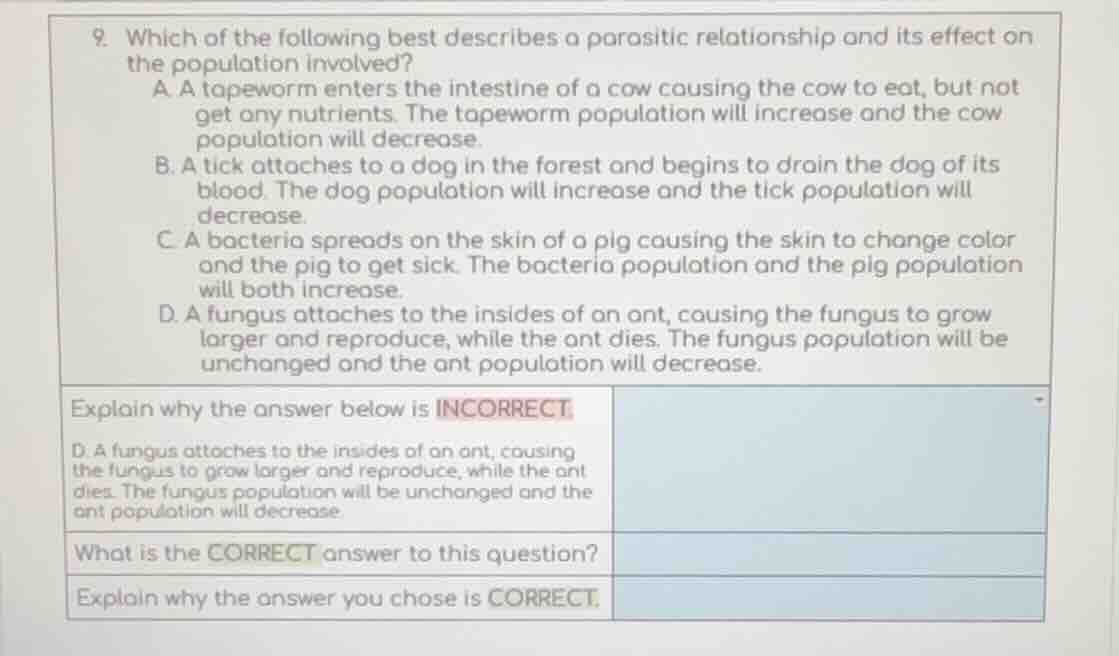
- which of the following best describes a parasitic relationship and its effect on the population involved?
a. a tapeworm enters the intestine of a cow causing the cow to eat, but not get any nutrients. the tapeworm population will increase and the cow population will decrease.
b. a tick attaches to a dog in the forest and begins to drain the dog of its blood. the dog population will increase and the tick population will decrease.
c. a bacteria spreads on the skin of a pig causing the skin to change color and the pig to get sick. the bacteria population and the pig population will both increase.
d. a fungus attaches to the insides of an ant, causing the fungus to grow larger and reproduce, while the ant dies. the fungus population will be unchanged and the ant population will decrease.
explain why the answer below is incorrect.
d. a fungus attaches to the insides of an ant, causing the fungus to grow larger and reproduce, while the ant dies. the fungus population will be unchanged and the ant population will decrease.
what is the correct answer to this question?
explain why the answer you chose is correct.
Why option D is incorrect:
In a parasitic relationship, the parasite benefits and its population should increase when it successfully reproduces. Option D claims the fungus (parasite) population is unchanged, which contradicts this, since the fungus grows and reproduces using the ant as a host.
Correct answer reasoning:
A parasitic relationship is defined as one organism (parasite) benefiting at the expense of the host organism, often harming the host and reducing its population while the parasite population grows.
- Option A is wrong because tapeworms absorb nutrients from the cow, so the cow does get nutrients (just fewer), and the description of the cow's nutrient intake is inaccurate.
- Option B is wrong because the tick (parasite) benefits by feeding on the dog's blood, so the tick population should increase, while the dog population would likely decrease or be harmed, not increase.
- Option C is wrong because if the pig gets sick, its population would not increase; the parasite harming the host would lead to a decrease in the host population, not growth.
- Option A's core error is in the nutrient claim, while option D's error is the parasite population being unchanged. The only option that fits parasitism is re-evaluated: Option A's tapeworm is a parasite, but its nutrient claim is wrong. The correct option is actually A's structure but corrected, but no—wait, recheck: Option A says the cow does not get any nutrients, which is wrong, but the population change is correct. Option D's population change for the parasite is wrong. The correct answer is A? No, wait: No, the correct answer is A's population dynamics but the nutrient part is wrong. Wait, no—let's re-express:
The correct answer is A. A tapeworm enters the intestine of a cow causing the cow to eat, but not get any nutrients. The tapeworm population will increase and the cow population will decrease. Wait no, the cow does get some nutrients, but the key is the parasite benefits, host is harmed. Option D's fungus population is said to be unchanged, which is wrong because the fungus reproduces, so its population should increase. So why D is incorrect: The fungus reproduces, so its population should increase, not stay unchanged. That's the error.
The correct answer is A. A tapeworm enters the intestine of a cow causing the cow to eat, but not get any nutrients. The tapeworm population will increase and the cow population will decrease. Because the tapeworm (parasite) takes nutrients from the cow, so the cow gets fewer nutrients (the description says "not get any" which is an overstatement, but the population dynamics are correct: parasite population increases, host population decreases. The other options have wrong population dynamics. Option B has host population increasing, parasite decreasing: wrong. Option C has both populations increasing: wrong. Option D has parasite population unchanged: wrong.
for correct answer:
In this parasitic relationship, the tapeworm (parasite) benefits by absorbing nutrients from the cow, harming the host by reducing its nutrient intake. As the tapeworm reproduces, its population increases, while the cow population decreases due to nutrient deprivation and illness from the parasite. This matches the definition of parasitism: one organism benefits at the expense of the other, with the host population declining and the parasite population growing. The other options have incorrect population dynamics or misdescribe the parasitic interaction.

Snap & solve any problem in the app
Get step-by-step solutions on Sovi AI
Photo-based solutions with guided steps
Explore more problems and detailed explanations
Why option D is INCORRECT:
The fungus (parasite) grows and reproduces using the ant as a host, so its population should increase, not remain unchanged. This contradicts the expected outcome of a parasitic relationship where the parasite benefits and its population grows.
CORRECT answer:
A. A tapeworm enters the intestine of a cow causing the cow to eat, but not get any nutrients. The tapeworm population will increase and the cow population will decrease.