QUESTION IMAGE
Question
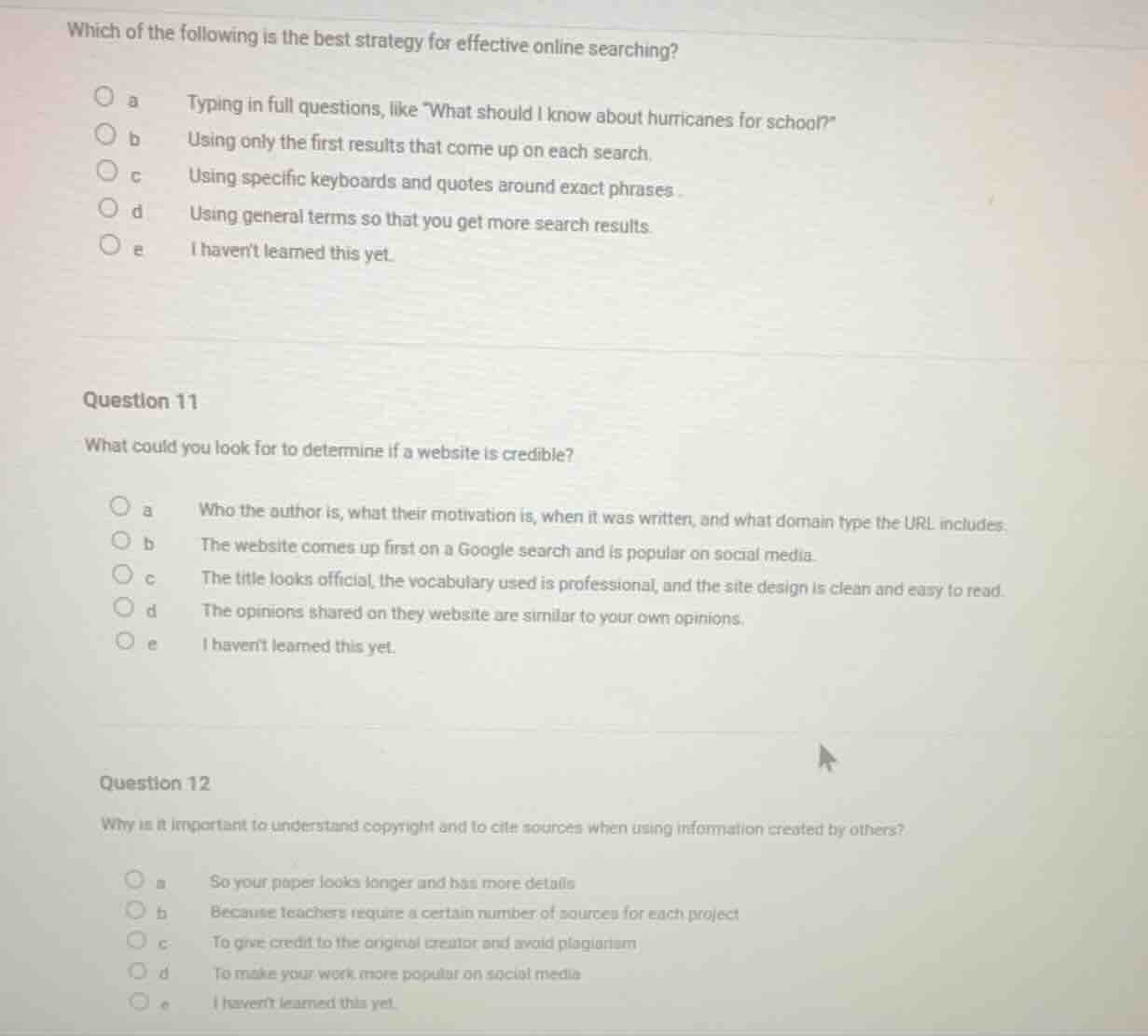
which of the following is the best strategy for effective online searching?
a typing in full questions, like \what should i know about hurricanes for school?\
b using only the first results that come up on each search.
c using specific keyboards and quotes around exact phrases
d using general terms so that you get more search results.
e i havent learned this yet.
question 11
what could you look for to determine if a website is credible?
a who the author is, what their motivation is, when it was written, and what domain type the url includes.
b the website comes up first on a google search and is popular on social media.
c the title looks official, the vocabulary used is professional, and the site design is clean and easy to read.
d the opinions shared on they website are similar to your own opinions.
e i havent learned this yet.
question 12
why is it important to understand copyright and to cite sources when using information created by others?
a so your paper looks longer and has more details
b because teachers require a certain number of sources for each project
c to give credit to the original creator and avoid plagiarism
d to make your work more popular on social media
e i havent learned this yet.
Question (about effective online searching)
- Option a: Typing full questions can lead to less relevant results as search engines may not parse natural language questions optimally.
- Option b: Using only first results limits exploration; later results might be relevant too.
- Option c: Specific keywords and quotes for exact phrases help narrow down and get precise results, which is a good online search strategy.
- Option d: General terms give too many irrelevant results, making it hard to find what's needed.
- Option e: Not applicable as the question is about known strategies.
- Option a: Author’s identity, motivation, publication date, and URL domain (e.g., .edu, .gov) are key factors in assessing credibility (authority, timeliness, domain reliability).
- Option b: Popularity on social media or being first in search doesn’t ensure credibility (could be biased or unvetted).
- Option c: Visual design and professional vocabulary don’t guarantee factual accuracy or credibility.
- Option d: Agreeing with opinions doesn’t relate to credibility (credibility is about accuracy, not personal agreement).
- Option e: Not applicable as the concept of website credibility is teachable.
- Option a: Citing sources isn’t about making papers longer; it’s about giving credit.
- Option b: Teachers’ requirements are a secondary reason; the primary is ethical and legal (giving credit, avoiding plagiarism).
- Option c: Citing sources gives credit to original creators and prevents plagiarism, which is the core purpose of copyright understanding and citation.
- Option d: Citing sources doesn’t relate to social media popularity.
- Option e: Not applicable as the concept of copyright and plagiarism is a standard academic topic.

Snap & solve any problem in the app
Get step-by-step solutions on Sovi AI
Photo-based solutions with guided steps
Explore more problems and detailed explanations
c. Using specific keyboards and quotes around exact phrases