QUESTION IMAGE
Question
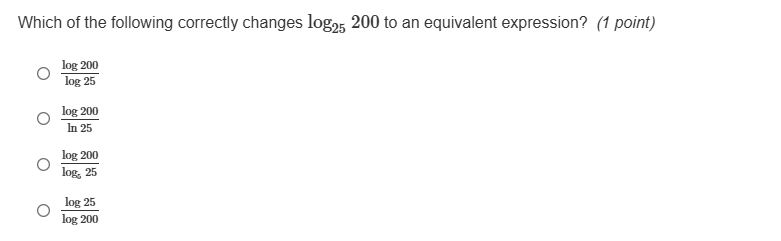
which of the following correctly changes \\(\log_{25} 200\\) to an equivalent expression? (1 point)\
\\(\frac{\log 200}{\log 25}\\)\
\\(\frac{\ln 200}{\ln 25}\\)\
\\(\frac{\log_8 200}{\log_8 25}\\)\
\\(\frac{\log 25}{\log 200}\\)
Step1: Recall Change of Base Formula
The change of base formula for logarithms states that for any positive numbers \(a\), \(b\), and \(c\) (where \(a
eq1\) and \(c
eq1\)), \(\log_{a}b=\frac{\log_{c}b}{\log_{c}a}\). This formula can be used with common logarithms (base 10, denoted as \(\log\)) or natural logarithms (base \(e\), denoted as \(\ln\)).
Step2: Apply the Formula to \(\log_{25}200\)
Using the change of base formula, if we take \(c = 10\) (common logarithm) or \(c=e\) (natural logarithm), we get:
- For common logarithm (base 10): \(\log_{25}200=\frac{\log200}{\log25}\)
- For natural logarithm (base \(e\)): \(\log_{25}200=\frac{\ln200}{\ln25}\)
Now let's analyze each option:
- Option 1: \(\frac{\log200}{\log25}\) matches the change of base formula with base 10.
- Option 2: \(\frac{\ln200}{\ln25}\) matches the change of base formula with base \(e\).
- Option 3: \(\frac{\log200}{\log_{8}25}\) does not follow the change of base formula (the denominator should be \(\log_{c}25\) where \(c\) is the same as in the numerator's \(\log_{c}200\)).
- Option 4: \(\frac{\log25}{\log200}\) is the reciprocal of the correct change of base formula.

Snap & solve any problem in the app
Get step-by-step solutions on Sovi AI
Photo-based solutions with guided steps
Explore more problems and detailed explanations
A. \(\frac{\log200}{\log25}\), B. \(\frac{\ln200}{\ln25}\) (assuming the options are labeled as: A. \(\frac{\log200}{\log25}\), B. \(\frac{\ln200}{\ln25}\), C. \(\frac{\log200}{\log_{8}25}\), D. \(\frac{\log25}{\log200}\))