QUESTION IMAGE
Question
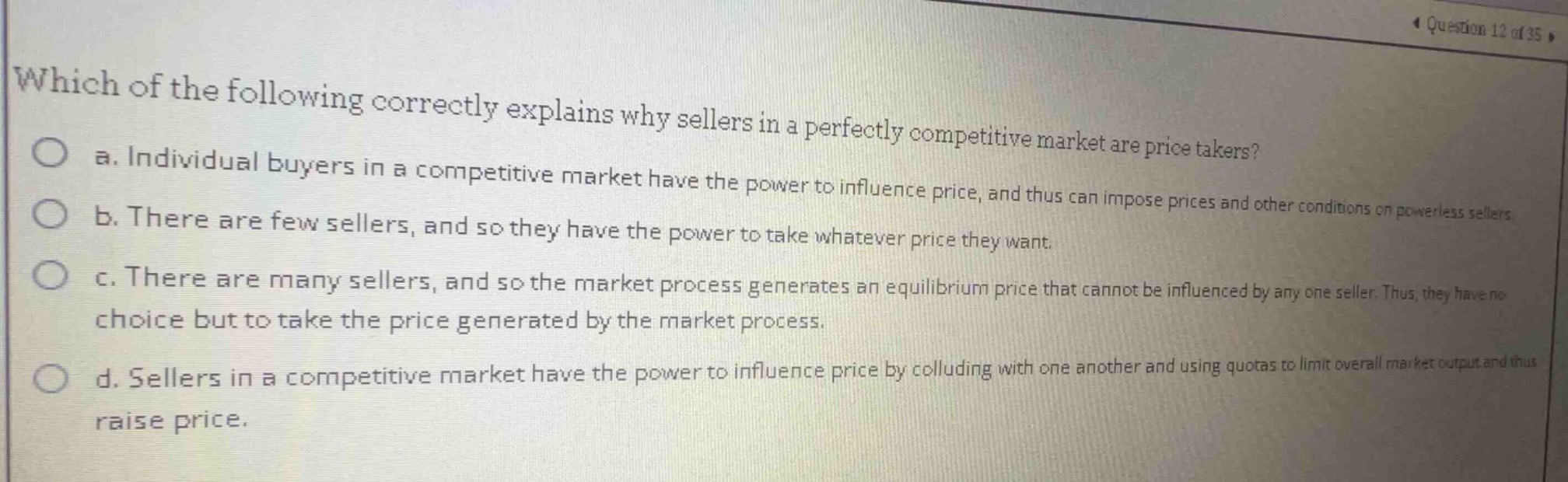
which of the following correctly explains why sellers in a perfectly competitive market are price takers?
a. individual buyers in a competitive market have the power to influence price, and thus can impose prices and other conditions on powerless sellers.
b. there are few sellers, and so they have the power to take whatever price they want.
c. there are many sellers, and so the market process generates an equilibrium price that cannot be influenced by any one seller. thus, they have no choice but to take the price generated by the market process.
d. sellers in a competitive market have the power to influence price by colluding with one another and using quotas to limit overall market output and thus raise price.
In a perfectly competitive market, a key characteristic is a large number of small sellers, each with an insignificant share of the total market. No single seller can affect the market equilibrium price, as their output is negligible compared to the overall market. Sellers must accept the market-determined price, making them price takers. Option a is incorrect because buyers are also price takers and cannot impose prices. Option b is wrong as perfectly competitive markets have many, not few, sellers. Option d is incorrect because collusion is impossible in a perfectly competitive market due to the large number of independent sellers.

Snap & solve any problem in the app
Get step-by-step solutions on Sovi AI
Photo-based solutions with guided steps
Explore more problems and detailed explanations
c. There are many sellers, and so the market process generates an equilibrium price that cannot be influenced by any one seller. Thus, they have no choice but to take the price generated by the market process.