QUESTION IMAGE
Question
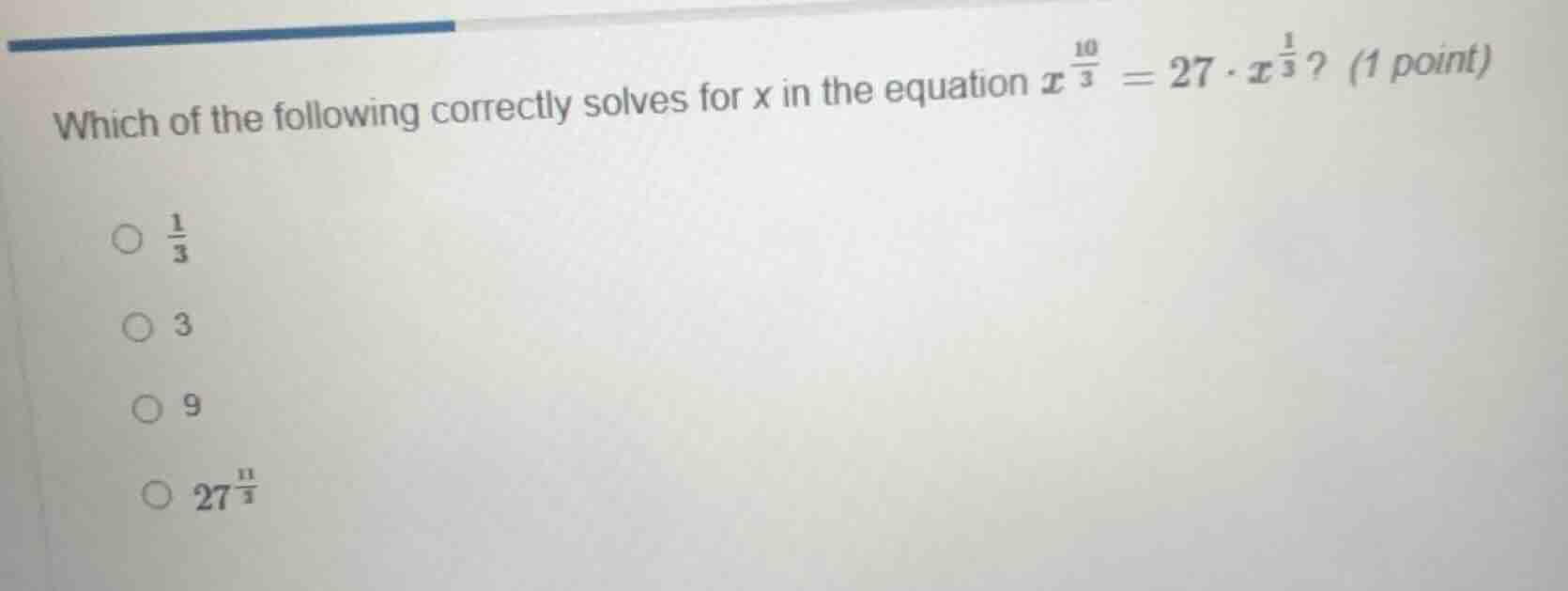
which of the following correctly solves for x in the equation ( x^{\frac{10}{3}} = 27 cdot x^{\frac{1}{3}} )? (1 point)
( \frac{1}{3} )
( 3 )
( 9 )
( 27^{\frac{11}{3}} )
Step1: Divide both sides by \( x^{\frac{1}{3}} \)
We start with the equation \( x^{\frac{10}{3}} = 27 \cdot x^{\frac{1}{3}} \). If we divide both sides by \( x^{\frac{1}{3}} \) (assuming \( x
eq0 \), we can check \( x = 0 \) later, but \( 0^{\frac{10}{3}}=0 \) and \( 27\cdot0^{\frac{1}{3}} = 0 \), but let's see the other solutions first), we use the exponent rule \( \frac{a^m}{a^n}=a^{m - n} \). So \( \frac{x^{\frac{10}{3}}}{x^{\frac{1}{3}}}=x^{\frac{10}{3}-\frac{1}{3}}=x^{3} \) and the right side becomes \( 27 \). So we get \( x^{3}=27 \).
Step2: Solve for \( x \)
We know that \( 3^{3}=27 \), so taking the cube root of both sides (or recognizing the cube), we find that \( x = \sqrt[3]{27}=3 \). We can also check \( x = 0 \), plugging into the original equation: \( 0^{\frac{10}{3}}=0 \) and \( 27\cdot0^{\frac{1}{3}} = 0 \), but the options don't have \( 0 \), and \( x = 3 \) is one of the options. So the solution is \( x = 3 \).

Snap & solve any problem in the app
Get step-by-step solutions on Sovi AI
Photo-based solutions with guided steps
Explore more problems and detailed explanations
\( 3 \) (corresponding to the option "3")