QUESTION IMAGE
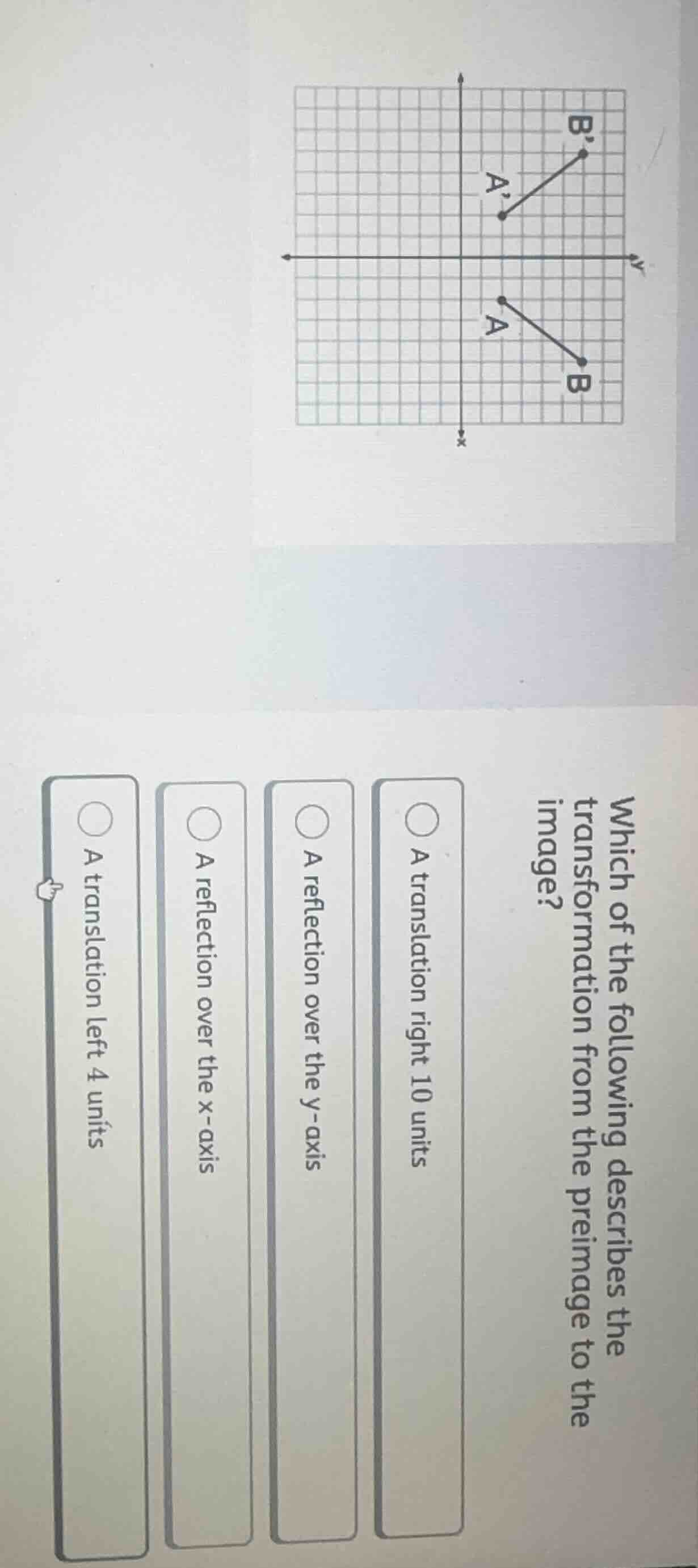
Question
which of the following describes the transformation from the preimage to the image? a translation right 10 units a reflection over the y - axis a reflection over the x - axis a translation left 4 units
To determine the transformation, we analyze the coordinates (or positions) of points \( A, B \) and their images \( A', B' \). A reflection over the \( x \)-axis would invert the \( y \)-coordinate sign, but here the vertical position change suggests a reflection over the \( x \)-axis? Wait, no—wait, looking at the graph, the preimage ( \( A, B \)) and image ( \( A', B' \)): a reflection over the \( x \)-axis flips the figure over the horizontal axis. Let's check the \( y \)-coordinates: if \( A \) is below the \( x \)-axis (or at some \( y \)-value) and \( A' \) is above, but actually, the correct transformation here—wait, no, let's re-express. Wait, the options: "A reflection over the \( x \)-axis"—when you reflect over the \( x \)-axis, the rule is \( (x, y) \to (x, -y) \). Looking at the graph, the preimage \( A \) and \( B \) are below the \( x \)-axis? Wait, no, the axes: the \( x \)-axis is horizontal, \( y \)-axis vertical. Wait, the image \( A' \) and \( B' \) are above the \( x \)-axis, and preimage \( A, B \) are below? Wait, no, maybe I got the axes reversed. Wait, the graph: the \( y \)-axis is horizontal? No, standard coordinate system: \( x \)-axis horizontal (left-right), \( y \)-axis vertical (up-down). Wait, the labels: the \( y \)-axis is horizontal? No, that's a typo? Wait, no, the graph has the \( x \)-axis vertical? No, that's a mistake in the graph? Wait, no, the user's graph: the horizontal axis is labeled \( y \), vertical \( x \)? That's non - standard, but maybe it's a typo, and the horizontal is \( x \), vertical \( y \). Wait, regardless, the key is the transformation. Let's check the options:
- "A translation right 10 units": translation would move horizontally, but the figure's vertical position changes.
- "A reflection over the \( y \)-axis": flips over vertical axis, but the figure's vertical position changes.
- "A reflection over the \( x \)-axis": flips over horizontal axis, changing the \( y \)-coordinate sign.
- "A translation left 4 units": horizontal move.
Looking at the graph, the preimage ( \( A, B \)) and image ( \( A', B' \)): the vertical flip (over horizontal axis, \( x \)-axis) would make the figure go from below to above (or vice - versa) the horizontal axis. So the correct transformation is a reflection over the \( x \)-axis? Wait, no—wait, the option "A reflection over the \( x \)-axis" is one of the choices. Wait, let's re - evaluate. Wait, the preimage \( A, B \) are below the \( x \)-axis (assuming \( x \)-axis is horizontal), and image \( A', B' \) are above: that's a reflection over the \( x \)-axis (since reflecting over \( x \)-axis inverts \( y \)-coordinate). So the correct option is "A reflection over the \( x \)-axis". Wait, but let's check the options again: the options are:
- A translation right 10 units
- A reflection over the \( y \)-axis
- A reflection over the \( x \)-axis
- A translation left 4 units
So the correct transformation is a reflection over the \( x \)-axis, so the option is "A reflection over the \( x \)-axis". Wait, no—wait, maybe I made a mistake. Wait, the user's graph: the \( x \)-axis is vertical, \( y \)-axis horizontal (non - standard). So reflecting over the \( x \)-axis (vertical axis) would be a vertical flip, but no. Wait, regardless, the key is that among the options, the reflection over the \( x \)-axis is the one that matches the vertical flip of the figure. So the correct answer is the option "A reflection over the \( x \)-axis".

Snap & solve any problem in the app
Get step-by-step solutions on Sovi AI
Photo-based solutions with guided steps
Explore more problems and detailed explanations
A reflection over the x - axis (the option with "A reflection over the x - axis")