QUESTION IMAGE
Question
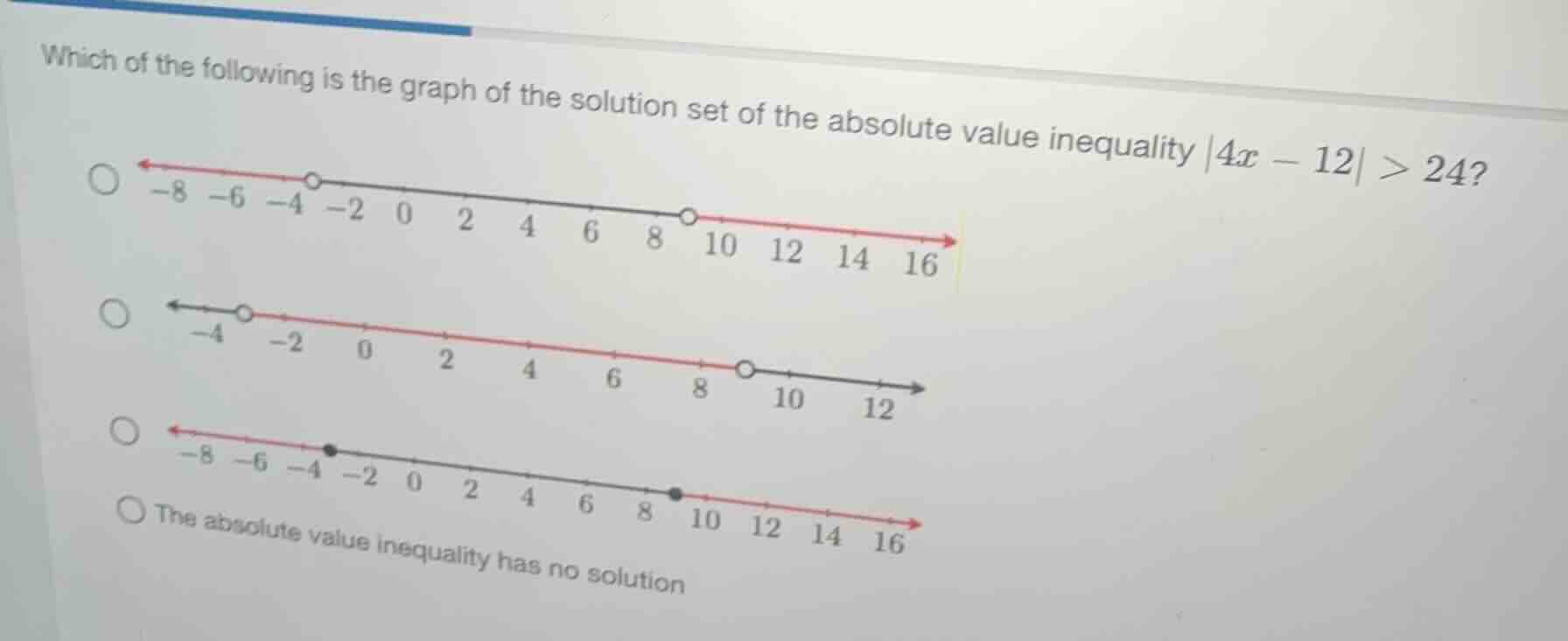
which of the following is the graph of the solution set of the absolute value inequality |4x - 12| > 24?
-8 -6 -4 -2 0 2 4 6 8 10 12 14 16
-4 -2 0 2 4 6 8 10 12
-8 -6 -4 -2 0 2 4 6 8 10 12 14 16
the absolute value inequality has no solution
Step1: Solve the absolute value inequality
The absolute value inequality \(|4x - 12|>24\) can be split into two separate inequalities:
\(4x - 12>24\) or \(4x - 12 < - 24\)
Step2: Solve \(4x - 12>24\)
Add 12 to both sides:
\(4x-12 + 12>24 + 12\)
\(4x>36\)
Divide both sides by 4:
\(x > \frac{36}{4}=9\)
Step3: Solve \(4x - 12 < - 24\)
Add 12 to both sides:
\(4x-12 + 12 < - 24+12\)
\(4x < - 12\)
Divide both sides by 4:
\(x < \frac{-12}{4}=-3\)
So the solution set is \(x < - 3\) or \(x>9\). Now we analyze the number lines:
- The first number line has open circles at - 4 and 9? Wait, no, let's re - check. Wait, when we solved \(x < - 3\) and \(x>9\). Let's look at the first option: the left part is a red line going to the left from an open circle (let's check the value: if the open circle is at - 3? Wait, no, maybe I misread. Wait, the first number line: the left red line is from - 8 to an open circle, and the right red line is from an open circle (let's calculate the value for the right part: when \(x > 9\), the open circle should be at 9? Wait, the first number line's right open circle is at 9? Wait, the first number line: the left side, when \(x < - 3\), the open circle should be at - 3? Wait, maybe the first number line has an open circle at - 3? Wait, no, let's re - check the first number line's markings: the left open circle is at - 4? Wait, no, my mistake in calculation. Wait, \(4x-12 < - 24\) gives \(4x < - 12\), so \(x < - 3\). And \(4x - 12>24\) gives \(4x>36\), so \(x > 9\). So the solution is \(x < - 3\) or \(x>9\). Now let's check the number lines:
- The first number line: left red line (for \(x < - 3\)) and right red line (for \(x>9\)) with open circles (since the inequality is strict, \(>\) and \(<\), not \(\geq\) or \(\leq\)) at \(x=-3\) (wait, no, maybe the open circle is at - 3? Wait, the first number line: the left open circle, let's see the x - values. The first number line has an open circle at - 3? Wait, maybe the first number line's left open circle is at - 3 and right open circle is at 9. Wait, the first option's number line: the left part is a red line from - 8 to an open circle (let's assume the open circle is at - 3) and the right part is a red line from an open circle (at 9) to 16. Wait, maybe I made a mistake in the initial reading of the number lines. But according to our solution \(x < - 3\) or \(x>9\), the correct number line should have an open circle at - 3 (for \(x < - 3\)) and an open circle at 9 (for \(x>9\)), with the left part ( \(x < - 3\)) shaded to the left of - 3 and the right part ( \(x>9\)) shaded to the right of 9. Looking at the first number line, it seems to match: left red (for \(x < - 3\)) and right red (for \(x>9\)) with open circles. The second number line has open circles at - 4 and 9? No, the second number line's right open circle is at 9? Wait, no, the second number line's right open circle is at 9? Wait, no, the second number line's right open circle is at 9? Wait, no, the second number line's markings are - 4, - 2, 0, 2, 4, 6, 8, 10, 12. The right open circle is at 9? No, the second number line's right open circle is at 9? Wait, no, the second number line's right open circle is at 9? I think the first number line is the correct one because it represents \(x < - 3\) (left of - 3, open circle) and \(x>9\) (right of 9, open circle).

Snap & solve any problem in the app
Get step-by-step solutions on Sovi AI
Photo-based solutions with guided steps
Explore more problems and detailed explanations
The first number line (the one with left red line from - 8 to an open circle and right red line from an open circle to 16, with open circles, representing \(x < - 3\) or \(x>9\))