QUESTION IMAGE
Question
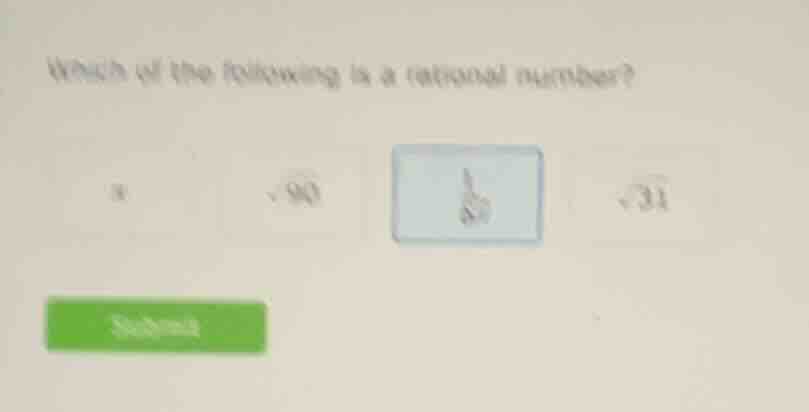
which of the following is a rational number?\
\\( \pi \\) \\( \sqrt{90} \\) \\( \frac{1}{80} \\) \\( \sqrt{21} \\)
Step1: Recall the definition of a rational number
A rational number is a number that can be expressed as the quotient or fraction $\frac{p}{q}$ of two integers, where $q
eq 0$. It can also be a terminating or repeating decimal, or an integer (since integers can be written as $\frac{n}{1}$ where $n$ is an integer).
Step2: Analyze each option
- For $\pi$: $\pi$ is an irrational number. Its decimal expansion is non - terminating and non - repeating ($\pi\approx3.1415926535\cdots$), so it cannot be expressed as a fraction of two integers.
- For $\sqrt{90}$: Simplify $\sqrt{90}=\sqrt{9\times10} = 3\sqrt{10}$. Since $\sqrt{10}$ is irrational (its decimal expansion is non - terminating and non - repeating), $3\sqrt{10}$ is also irrational.
- For $\frac{1}{80}$: $\frac{1}{80}$ is a fraction of two integers (1 and 80, where $80
eq0$). By the definition of a rational number, $\frac{1}{80}$ is a rational number.
- For $\sqrt{24}$: Simplify $\sqrt{24}=\sqrt{4\times6}=2\sqrt{6}$. Since $\sqrt{6}$ is irrational, $2\sqrt{6}$ is also irrational.

Snap & solve any problem in the app
Get step-by-step solutions on Sovi AI
Photo-based solutions with guided steps
Explore more problems and detailed explanations
$\frac{1}{80}$