QUESTION IMAGE
Question
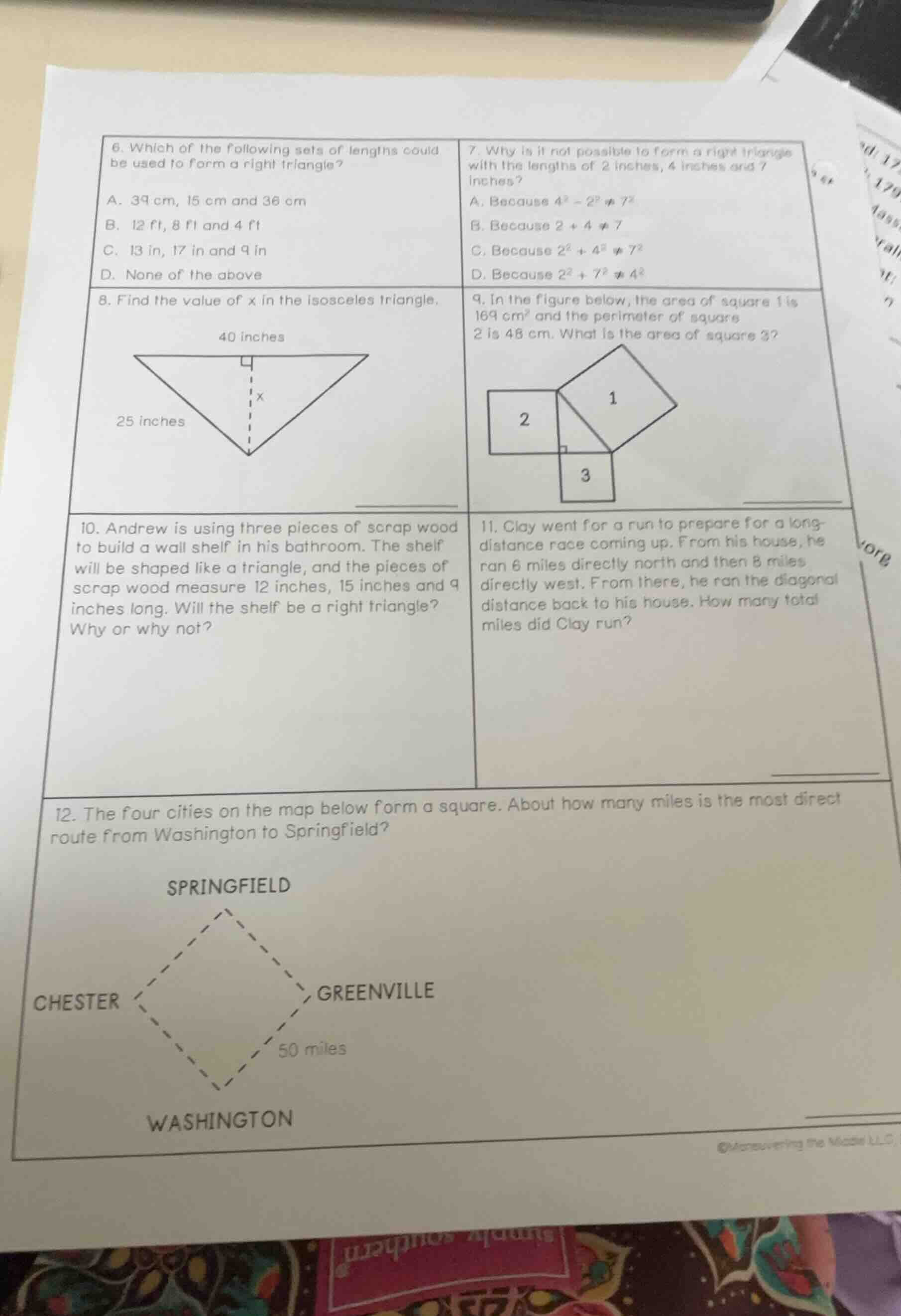
- which of the following sets of lengths could be used to form a right triangle?
a. 39 cm, 15 cm and 36 cm
b. 12 ft, 8 ft and 4 ft
c. 13 in, 17 in and 9 in
d. none of the above
- why is it not possible to form a right triangle with the lengths of 2 inches, 4 inches and 7 inches?
a. because $4^2 - 2^2 \
eq 7^2$
b. because $2 + 4 \
eq 7$
c. because $2^2 + 4^2 \
eq 7^2$
d. because $2^2 + 7^2 \
eq 4^2$
- find the value of x in the isosceles triangle.
image of an isosceles triangle with base 40 inches and equal sides 25 inches, and height x
- in the figure below, the area of square 1 is 169 $cm^2$ and the perimeter of square 2 is 48 cm. what is the area of square 3?
image of three squares forming a right triangle configuration, square 1, square 2, square 3
- andrew is using three pieces of scrap wood to build a wall shelf in his bathroom. the shelf will be shaped like a triangle, and the pieces of scrap wood measure 12 inches, 15 inches and 9 inches long. will the shelf be a right triangle? why or why not?
- clay went for a run to prepare for a long - distance race coming up. from his house, he ran 6 miles directly north and then 8 miles directly west. from there, he ran the diagonal distance back to his house. how many total miles did clay run?
- the four cities on the map below form a square. about how many miles is the most direct route from washington to springfield?
image of a square with vertices chester, springfield, greenville, washington, and the side between greenville and washington is 50 miles
Step1: Check Pythagorean theorem for Q6
For a right triangle, $a^2 + b^2 = c^2$ (c is longest side).
- Option A: $15^2 + 36^2 = 225 + 1296 = 1521$, $39^2 = 1521$. So $15^2 + 36^2 = 39^2$.
- Option B: $4^2 + 8^2 = 16 + 64 = 80$, $12^2 = 144$. $80
eq 144$.
- Option C: $9^2 + 13^2 = 81 + 169 = 250$, $17^2 = 289$. $250
eq 289$.
Step2: Verify right triangle condition for Q7
Right triangle needs $a^2 + b^2 = c^2$. Longest side is 7.
Check $2^2 + 4^2 = 4 + 16 = 20$, $7^2 = 49$. $20
eq 49$, so $2^2 + 4^2
eq 7^2$.
Step3: Calculate height x for Q8
Split isosceles triangle into 2 right triangles. Base of each right triangle: $\frac{40}{2}=20$ inches.
Use Pythagorean theorem: $x^2 + 20^2 = 25^2$
$x^2 = 25^2 - 20^2 = 625 - 400 = 225$
$x = \sqrt{225} = 15$ inches.
Step4: Find side lengths for Q9
- Square 1: Area $=169 \text{ cm}^2$, so side $s_1 = \sqrt{169} = 13$ cm.
- Square 2: Perimeter $=48$ cm, so side $s_2 = \frac{48}{4}=12$ cm.
By Pythagorean theorem, side of square 3: $s_3^2 + s_2^2 = s_1^2$
$s_3^2 = 13^2 - 12^2 = 169 - 144 = 25$
Area of square 3: $s_3^2 = 25 \text{ cm}^2$.
Step5: Check right triangle for Q10
Longest side is 15 inches.
$9^2 + 12^2 = 81 + 144 = 225$, $15^2 = 225$. So $9^2 + 12^2 = 15^2$.
Step6: Calculate total miles for Q11
First find diagonal distance: $d = \sqrt{6^2 + 8^2} = \sqrt{36 + 64} = \sqrt{100} = 10$ miles.
Total distance: $6 + 8 + 10 = 24$ miles.
Step7: Find diagonal of square for Q12
Square side is 50 miles. Diagonal $d = 50\sqrt{2} \approx 50 \times 1.414 = 70.7$ miles, ~71 miles.

Snap & solve any problem in the app
Get step-by-step solutions on Sovi AI
Photo-based solutions with guided steps
Explore more problems and detailed explanations
- A. 39 cm, 15 cm and 36 cm
- C. Because $2^2 + 4^2
eq 7^2$
- 15 inches
- $25 \text{ cm}^2$
- Yes, because $9^2 + 12^2 = 15^2$, which satisfies the Pythagorean theorem.
- 24 miles
- Approximately 71 miles (or $50\sqrt{2}$ miles)