QUESTION IMAGE
Question
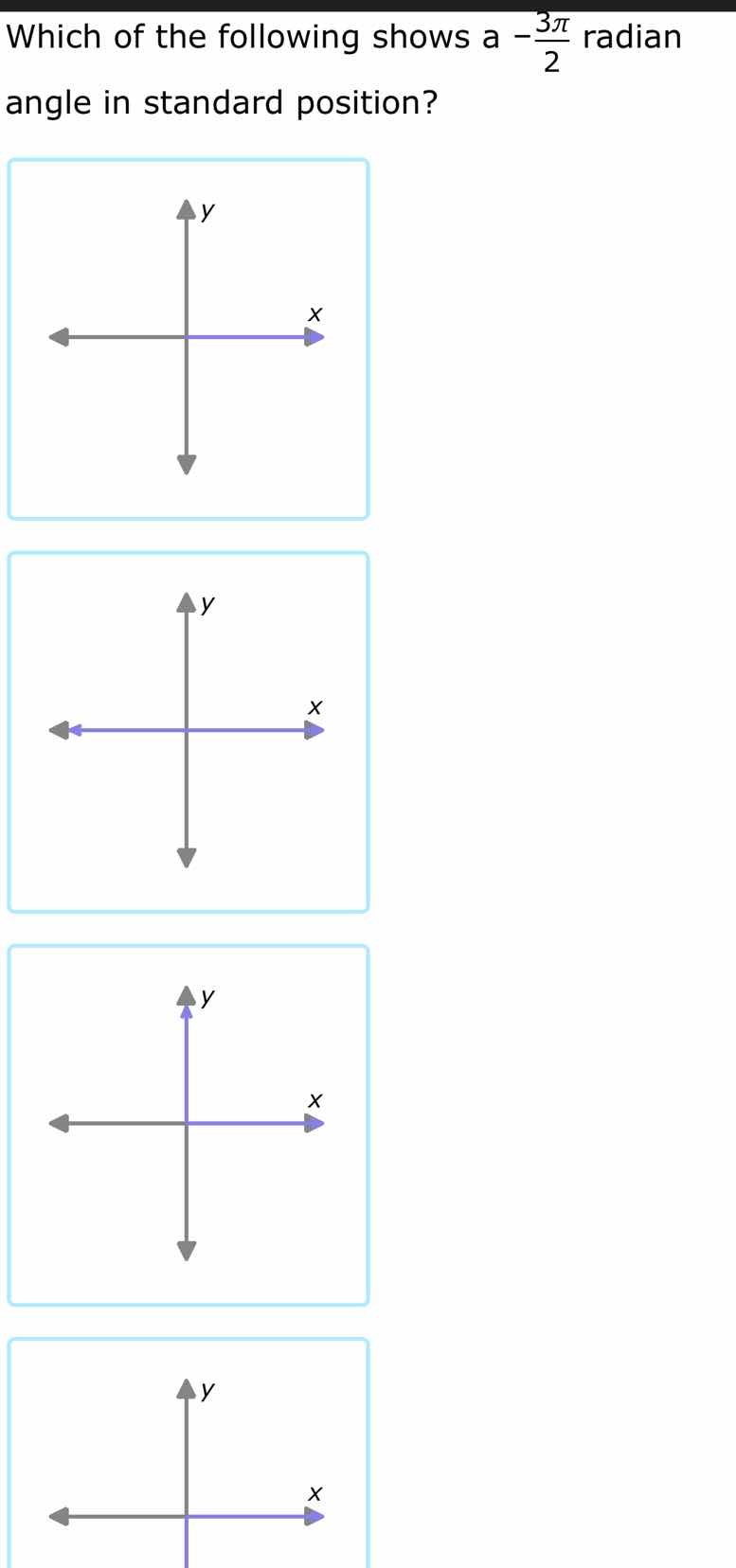
which of the following shows a $-\frac{3pi}{2}$ radian angle in standard position? four coordinate plane figures are shown, each with x and y axes, and a purple ray indicating an angle. the first has a purple ray along the positive x - axis. the second has a purple ray along the negative x - axis. the third has a purple ray along the positive y - axis. the fourth has a purple ray along the negative y - axis.
Step 1: Recall the direction of negative angles
Negative angles are measured clockwise from the positive x - axis. The angle of \(-\frac{3\pi}{2}\) radians: we know that \(\pi\) radians is \(180^{\circ}\), so \(\frac{3\pi}{2}\) radians is \(270^{\circ}\). A negative angle of \(-\frac{3\pi}{2}\) radians means we rotate \(270^{\circ}\) clockwise from the positive x - axis.
Step 2: Analyze the rotation
Rotating \(270^{\circ}\) clockwise from the positive x - axis:
- Rotating \(90^{\circ}\) clockwise from positive x - axis takes us to positive y - axis (since \(90^{\circ}\) clockwise: positive x→positive y? Wait, no. Wait, standard position: positive x - axis is the initial side. Clockwise rotation:
- \(90^{\circ}\) (or \(\frac{\pi}{2}\) radians) clockwise: initial side (positive x) → positive y - axis? No, wait, clockwise: positive x to positive y is counter - clockwise \(90^{\circ}\). Clockwise \(90^{\circ}\) from positive x is positive y? No, no. Let's think in terms of radians. The unit circle: positive x - axis is \(0\) radians. Moving clockwise:
- \( \frac{\pi}{2}\) radians clockwise: we reach the positive y - axis? Wait, no. Wait, the angle of \( \theta=-\frac{\pi}{2}\) radians (clockwise \(90^{\circ}\)) has its terminal side on the positive y - axis? Wait, no. Wait, when \(\theta = \frac{\pi}{2}\) (counter - clockwise \(90^{\circ}\)), terminal side is positive y - axis. When \(\theta=-\frac{\pi}{2}\) (clockwise \(90^{\circ}\)), terminal side is positive y - axis? No, that's not right. Wait, let's use the formula for coterminal angles. The coterminal angle of \(-\frac{3\pi}{2}\) can be found by adding \(2\pi\) (since the period of the angle function is \(2\pi\)). So \(-\frac{3\pi}{2}+ 2\pi=\frac{\pi}{2}\) radians. Wait, \(\frac{\pi}{2}\) radians is \(90^{\circ}\) counter - clockwise, but our angle is \(-\frac{3\pi}{2}\) radians. Wait, maybe I made a mistake. Let's calculate the rotation:
The measure of an angle in standard position: initial side is positive x - axis. For \(\theta=-\frac{3\pi}{2}\), we rotate clockwise \(\frac{3\pi}{2}\) radians.
- One full rotation is \(2\pi\) radians. \(\frac{3\pi}{2}\) radians clockwise:
- Let's break down \(\frac{3\pi}{2}\) radians into \(\pi+\frac{\pi}{2}\) radians.
- Rotating \(\pi\) radians clockwise from positive x - axis: we reach negative x - axis. Then rotating an additional \(\frac{\pi}{2}\) radians clockwise from negative x - axis: negative x - axis to positive y - axis (because clockwise \(\frac{\pi}{2}\) from negative x: negative x→positive y). Wait, no. Let's use the coterminal angle. The coterminal angle of \(-\frac{3\pi}{2}\) is \(-\frac{3\pi}{2}+2\pi=\frac{\pi}{2}\) radians. Wait, \(\frac{\pi}{2}\) radians is \(90^{\circ}\) counter - clockwise, but our angle is \(-\frac{3\pi}{2}\) radians. Wait, maybe I messed up the direction. Wait, the angle \(-\frac{3\pi}{2}\) radians: the terminal side. Let's think about the reference angle. The absolute value of \(-\frac{3\pi}{2}\) is \(\frac{3\pi}{2}\), and \(\frac{3\pi}{2}\) is more than \(\pi\) (which is \(180^{\circ}\)). The coterminal angle is found by adding \(2\pi\) to \(-\frac{3\pi}{2}\): \(-\frac{3\pi}{2}+2\pi=\frac{\pi}{2}\) radians. So the terminal side of \(-\frac{3\pi}{2}\) radians is the same as the terminal side of \(\frac{\pi}{2}\) radians, which is the positive y - axis. Wait, no, that can't be. Wait, no, \(-\frac{3\pi}{2}\) radians: let's calculate the rotation step by step.
- Start at positive x - axis (initial side).
- Rotate clockwise \(\pi\) radians ( \(180^{\circ}\)): we reach negative x - axis.
-…

Snap & solve any problem in the app
Get step-by-step solutions on Sovi AI
Photo-based solutions with guided steps
Explore more problems and detailed explanations
The figure with the purple line along the positive y - axis (the third figure in the given set of figures).