QUESTION IMAGE
Question
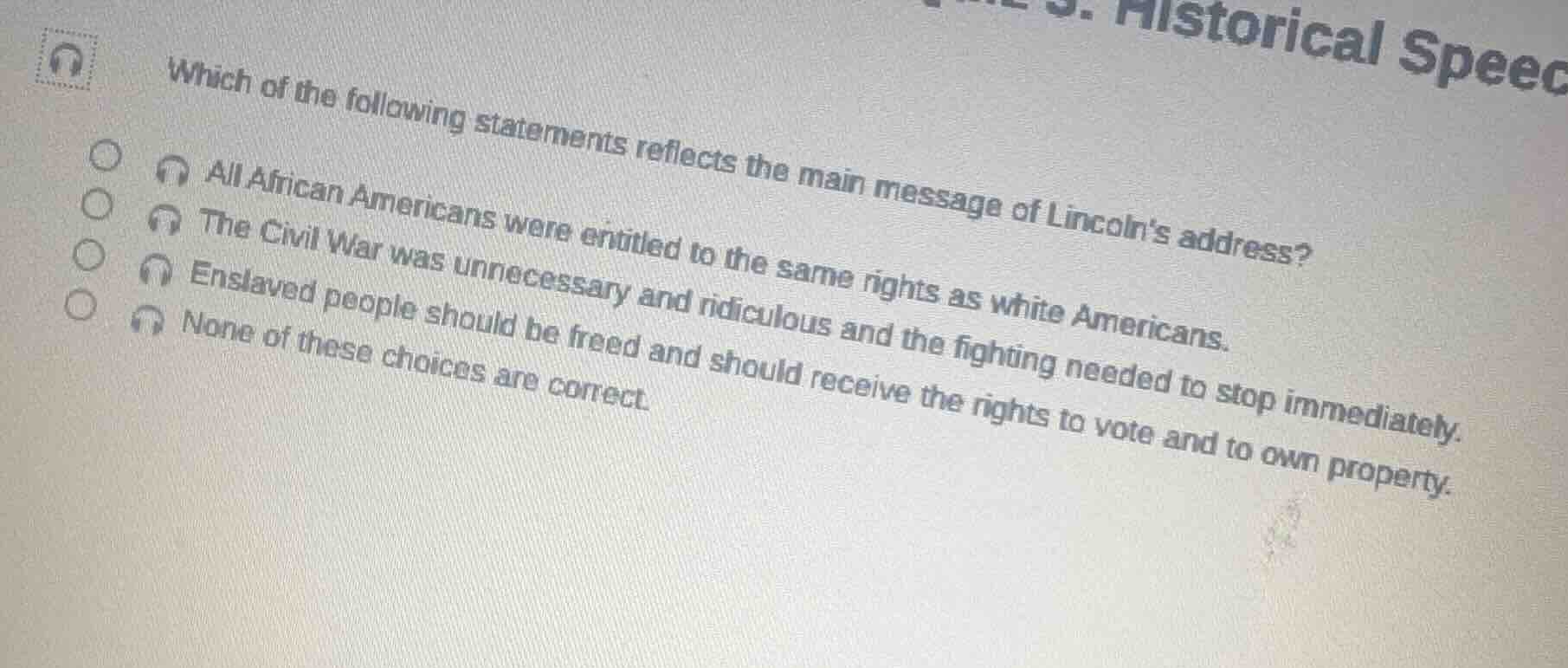
which of the following statements reflects the main message of lincolns address? all african americans were entitled to the same rights as white americans. the civil war was unnecessary and ridiculous and the fighting needed to stop immediately. enslaved people should be freed and should receive the rights to vote and to own property. none of these choices are correct.
Lincoln's addresses (like the Emancipation Proclamation - related or Gettysburg Address - related context) focused on freedom for enslaved people, but the options here: The first option's “all rights same as white Americans” was not Lincoln’s main message (he was more about emancipation first, full equality later). The second option is wrong as the Civil War was about preserving the Union and ending slavery, not “unnecessary”. The third option: Lincoln’s efforts (like Emancipation) aimed at freeing enslaved people, and while voting/property rights evolution came later, the core of his address (e.g., Gettysburg’s call for a new birth of freedom, or Emancipation) centered on freeing enslaved people and moving toward rights. But wait, actually, re - evaluating: Lincoln’s main message in addresses (e.g., Gettysburg) was about the Union, equality under the nation’s founding principles, and the Civil War’s purpose to end slavery and preserve the Union. But among the options, the third option says “Enslaved people should be freed and should receive the rights to vote and to own property” – however, Lincoln’s immediate focus was emancipation, and voting/property rights for all African Americans (including formerly enslaved) were not his direct main message in the same breath. Wait, no, the other options are clearly wrong. The first option: Lincoln’s time didn’t have “all rights same as white” as a main message (he was for emancipation, and equality was a longer struggle). The second option is wrong (Civil War was necessary to end slavery and preserve Union). So the correct answer is the third option? Wait, no, maybe I made a mistake. Wait, the fourth option is “None of these choices are correct.” Wait, let's re - analyze:
- “All African Americans were entitled to the same rights as white Americans” – Lincoln’s views evolved, but in his addresses (like Gettysburg), he spoke of “all men are created equal” in the context of the nation’s founding, but legal equality (same rights) was not the immediate main message of his address (e.g., Gettysburg was about the war’s purpose, the Union, and a new birth of freedom for the enslaved). So this is not the main message.
- “The Civil War was unnecessary and ridiculous and the fighting needed to stop immediately” – Lincoln believed the Civil War was necessary to preserve the Union and end slavery, so this is wrong.
- “Enslaved people should be freed and should receive the rights to vote and to own property” – Lincoln’s Emancipation Proclamation freed enslaved people, but the right to vote and own property for them was not a main message of his address (e.g., Gettysburg Address was about the war, the Union, and the sacrifice of soldiers, with the idea that the nation should have a new birth of freedom – which includes emancipation, but specific rights like voting/property for all formerly enslaved were not the main message here). However, the other options are wrong, but maybe the fourth option is correct? Wait, no, maybe I messed up. Wait, the question is about “the main message of Lincoln’s address” – let's assume it's the Gettysburg Address or the Emancipation - related. Wait, the third option: freeing enslaved people was a main message, and while voting/property rights were not his direct main message, the other options are clearly wrong. But maybe the correct answer is the fourth option? No, let's check again.
Wait, the first option: Lincoln didn't advocate for all rights same as white Americans in his address (he was for emancipation, and the idea of equality under the law was a broader goal,…

Snap & solve any problem in the app
Get step-by-step solutions on Sovi AI
Photo-based solutions with guided steps
Explore more problems and detailed explanations
D. None of these choices are correct.