QUESTION IMAGE
Question
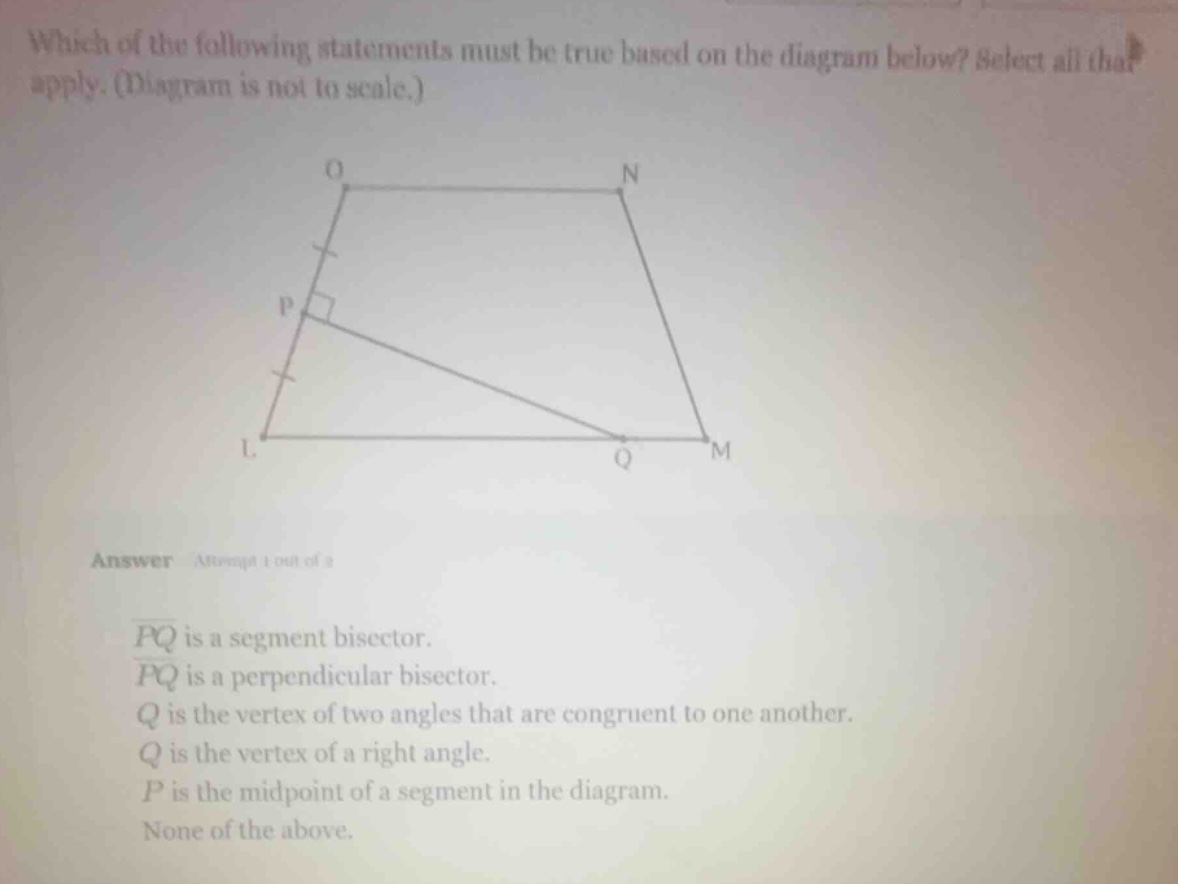
which of the following statements must be true based on the diagram below? select all that apply. (diagram is not to scale.)
answer attempt 1 out of 2
$overline{pq}$ is a segment bisector.
$overline{pq}$ is a perpendicular bisector.
$q$ is the vertex of two angles that are congruent to one another.
$q$ is the vertex of a right angle.
$p$ is the midpoint of a segment in the diagram.
none of the above.
Brief Explanations
- $\overline{PQ}$ is a segment bisector: A segment bisector divides a segment into two equal parts. The diagram shows $P$ splits $\overline{OL}$ into two congruent segments, but $\overline{PQ}$ does not bisect $\overline{LM}$ (no marks show $Q$ is the midpoint of $\overline{LM}$), so this is false.
- $\overline{PQ}$ is a perpendicular bisector: A perpendicular bisector must be perpendicular to a segment and bisect it. While $\overline{PQ} \perp \overline{OL}$, we only know it bisects $\overline{OL}$, but the definition requires it bisect the segment it is perpendicular to. However, the key issue is that we cannot confirm it bisects $\overline{LM}$, and for it to be a perpendicular bisector of $\overline{OL}$, the diagram only shows it is perpendicular and hits the midpoint of $\overline{OL}$, but the term "perpendicular bisector" typically refers to bisecting the segment it intersects at a right angle. But even so, we cannot confirm it bisects any other segment, so this is false.
- $Q$ is the vertex of two congruent angles: There are no markings or properties shown to indicate any angles at $Q$ are congruent, so this is false.
- $Q$ is the vertex of a right angle: The only right angle marked is at $P$, not $Q$, so this is false.
- $P$ is the midpoint of a segment in the diagram: The two congruent segment marks on $\overline{OL}$ show $P$ divides $\overline{OL}$ into two equal parts, so $P$ is the midpoint of $\overline{OL}$, making this true.

Snap & solve any problem in the app
Get step-by-step solutions on Sovi AI
Photo-based solutions with guided steps
Explore more problems and detailed explanations
$P$ is the midpoint of a segment in the diagram.