QUESTION IMAGE
Question
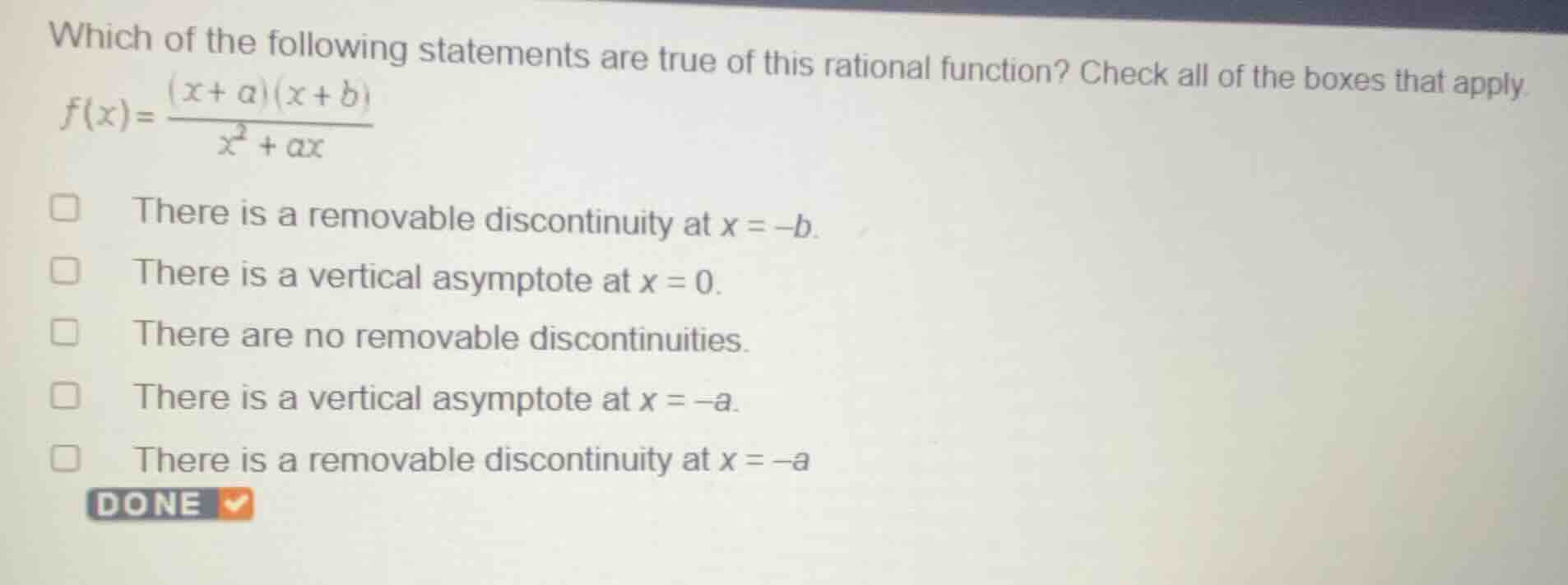
which of the following statements are true of this rational function? check all of the boxes that apply.
$f(x)=\frac{(x + a)(x + b)}{x^2 + ax}$
- there is a removable discontinuity at $x = -b$.
- there is a vertical asymptote at $x = 0$.
- there are no removable discontinuities.
- there is a vertical asymptote at $x = -a$.
- there is a removable discontinuity at $x = -a$
Step1: Factor denominator
Factor the quadratic in the denominator:
$x^2 + ax = x(x + a)$
Step2: Simplify the function
Rewrite the function with factored denominator, then cancel common terms (assuming $x
eq -a$):
$f(x)=\frac{(x+a)(x+b)}{x(x+a)}=\frac{x+b}{x}$
Step3: Identify discontinuities
- Removable discontinuity: Occurs at $x=-a$ (the canceled common factor makes this a hole, not an asymptote).
- Vertical asymptote: Occurs at $x=0$ (this value makes the simplified denominator 0 and is not canceled).
- $x=-b$ is not a discontinuity of the original function (it does not make the original denominator 0).

Snap & solve any problem in the app
Get step-by-step solutions on Sovi AI
Photo-based solutions with guided steps
Explore more problems and detailed explanations
- There is a vertical asymptote at $x = 0$.
- There is a removable discontinuity at $x = -a$