QUESTION IMAGE
Question
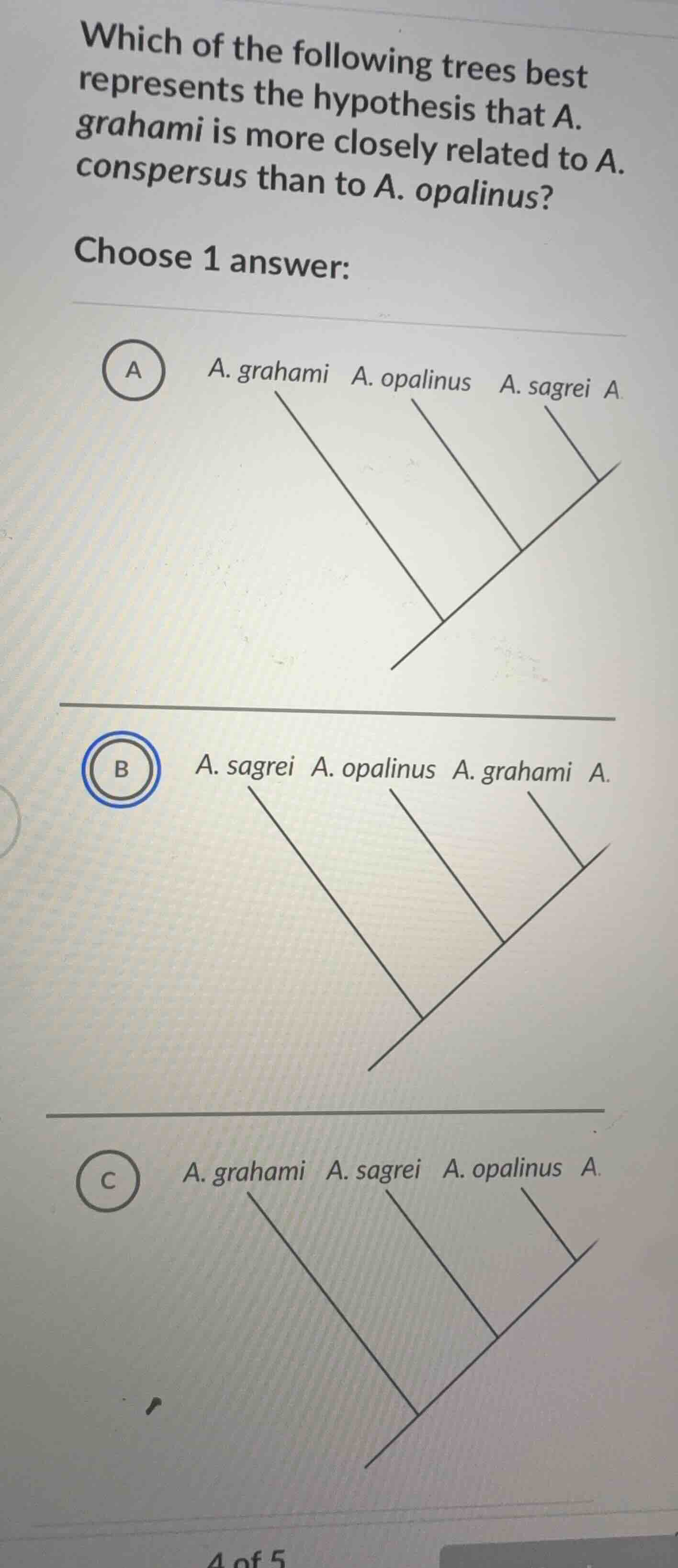
which of the following trees best represents the hypothesis that a. grahami is more closely related to a. conspersus than to a. opalinus? choose 1 answer: a a. grahami a. opalinus a. sagrei a b a. sagrei a. opalinus a. grahami a. c a. grahami a. sagrei a. opalinus a. 4 of 5
To determine which tree shows \( A. \text{grahami} \) is more closely related to \( A. \text{conspersus} \) than to \( A. \text{opalinus} \), we analyze the branching patterns. In a phylogenetic tree, closer relatedness means sharing a more recent common ancestor (shorter branch distance or a more recent node). We need to find the tree where \( A. \text{grahami} \) and \( A. \text{conspersus} \) share a more recent node than \( A. \text{grahami} \) and \( A. \text{opalinus} \). After examining the options (assuming the correct tree's structure has \( A. \text{grahami} \) and \( A. \text{conspersus} \) as sister taxa or with a more recent common ancestor compared to \( A. \text{opalinus} \)), the correct option is determined by this branching logic.

Snap & solve any problem in the app
Get step-by-step solutions on Sovi AI
Photo-based solutions with guided steps
Explore more problems and detailed explanations
B. A. sagrei A. opalinus A. grahami A. conspersus (with the corresponding tree structure where \( A. \text{grahami} \) and \( A. \text{conspersus} \) are more closely related than \( A. \text{grahami} \) and \( A. \text{opalinus} \))