QUESTION IMAGE
Question
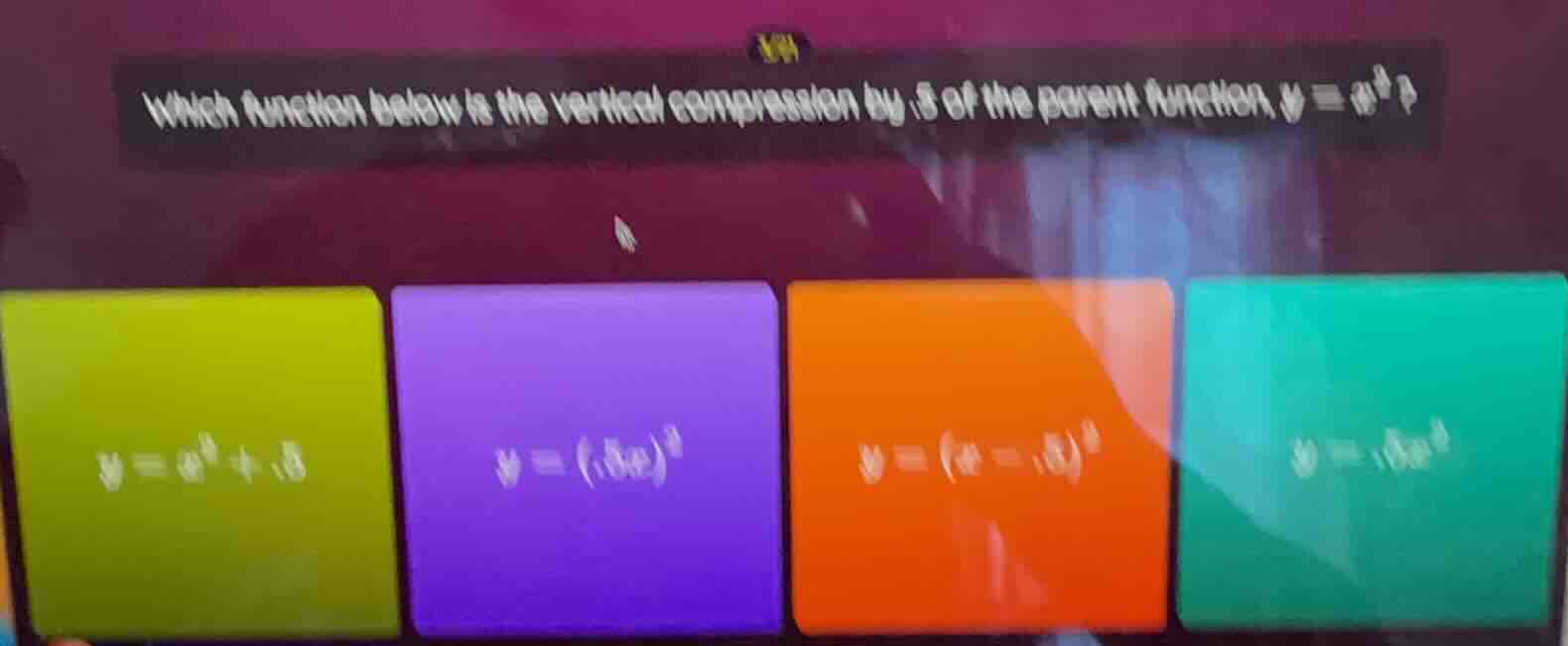
which function below is the vertical compression by.5 of the parent function ( y = x^2 )?
( y = x^2 +.5 )
( y = (.5x)^2 )
( y = (x -.5)^2 )
( y =.5x^2 )
Step1: Recall Vertical Compression Rule
For a function \( y = f(x) \), a vertical compression by a factor \( a \) (where \( 0 < a < 1 \)) transforms the function to \( y = a \cdot f(x) \). Here, the parent function is \( y = x^2 \), and we need a vertical compression by \( 0.5 \) (I assume ".5" is 0.5). So we multiply the parent function by \( 0.5 \).
Step2: Apply the Rule to Parent Function
The parent function is \( y = x^2 \). Applying vertical compression by \( 0.5 \), we get \( y = 0.5x^2 \) (which is \( y =.5x^2 \) as in the options). Let's analyze other options:
- \( y = x^2 +.5 \): This is a vertical shift up, not compression.
- \( y = (.5x)^2 \): This is a horizontal compression, not vertical.
- \( y = (x -.5)^2 \): This is a horizontal shift right, not compression.

Snap & solve any problem in the app
Get step-by-step solutions on Sovi AI
Photo-based solutions with guided steps
Explore more problems and detailed explanations
\( y =.5x^2 \) (the fourth option, assuming the options are in order: first yellow, second purple, third orange, fourth teal)