QUESTION IMAGE
Question
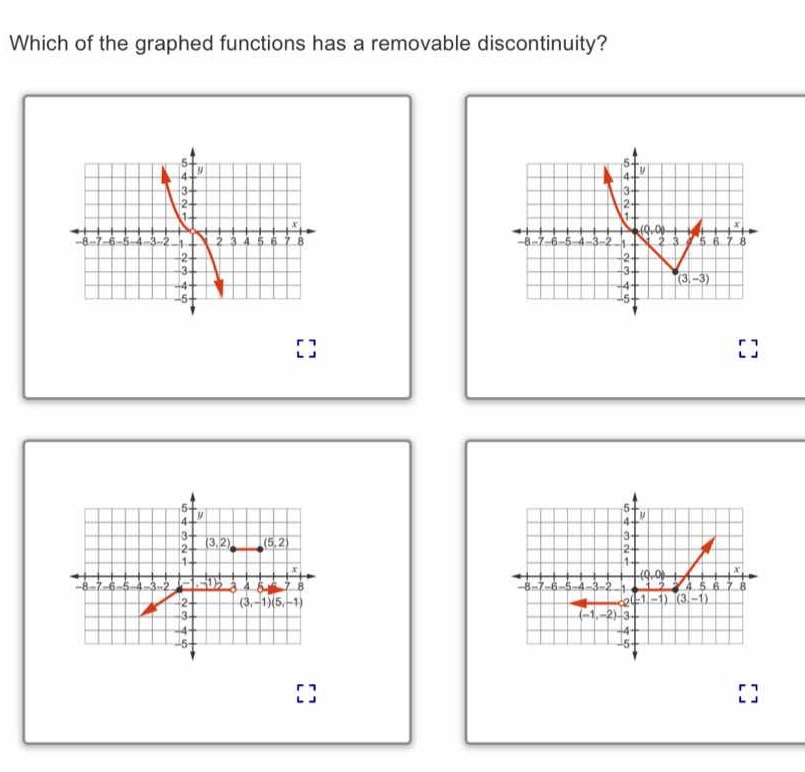
which of the graphed functions has a removable discontinuity?
Step1: Define removable discontinuity
A removable discontinuity occurs when a function has a hole at a point (the limit exists at that point, but the function either is undefined there or has a value that doesn't match the limit; the two sides of the point approach the same y-value).
Step2: Analyze each graph
- Top-left graph: Shows an infinite/non-removable discontinuity (the function approaches +∞ and -∞ on either side of the break, no matching limit).
- Top-right graph: Shows a jump discontinuity (the two sides of the break approach different finite y-values, no matching limit).
- Bottom-left graph: At \(x=3\), the left and right sides of the graph approach the same y-value (1), but the function has a hole at \((3,1)\) and defined points at \((3,2)\) and \((3,-1)\). The limit at \(x=3\) exists, so this is a removable discontinuity.
- Bottom-right graph: Shows a jump discontinuity (the two sides of the break approach different finite y-values, no matching limit).

Snap & solve any problem in the app
Get step-by-step solutions on Sovi AI
Photo-based solutions with guided steps
Explore more problems and detailed explanations
The bottom-left graphed function (with points \((3,2)\), \((5,2)\), \((3,-1)\), \((5,-1)\) and a hole at \((3,1)\)) has a removable discontinuity.