QUESTION IMAGE
Question
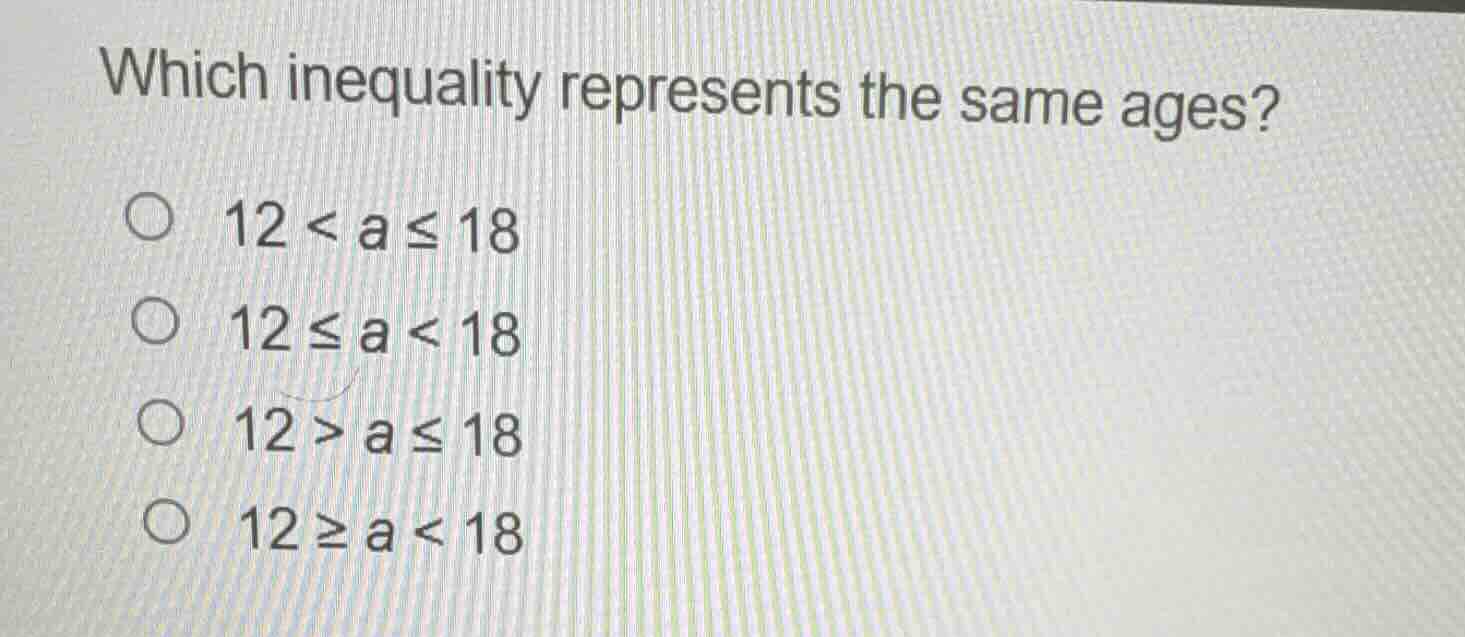
which inequality represents the same ages?
○ 12 < a ≤ 18
○ 12 ≤ a < 18
○ 12 > a ≤ 18
○ 12 ≥ a < 18
Step1: Analyze each inequality's meaning
- For \(12 < a \leq 18\): \(a\) is greater than 12 and less than or equal to 18.
- For \(12 \leq a < 18\): \(a\) is greater than or equal to 12 and less than 18.
- For \(12 > a \leq 18\): This is a contradiction because \(a\) can't be both less than 12 and less than or equal to 18 in a way that makes sense for ages (since \(12 > a\) and \(a \leq 18\) would mean \(a < 12\) and \(a \leq 18\), but the combination is ill - formed for representing a range of ages in a typical context).
- For \(12 \geq a < 18\): This is also a contradiction as \(a\) can't be both less than or equal to 12 and less than 18 in a way that represents a single range of ages (it combines two different types of inequalities in a non - standard way for age ranges).
Step2: Determine the correct inequality for ages
If we are talking about a range of ages, for example, ages from 12 (inclusive) up to but not including 18, the inequality \(12 \leq a < 18\) is the correct one. If we consider ages greater than 12 and up to 18 (inclusive), \(12 < a \leq 18\) is also a valid range, but usually, when we talk about age ranges like for teenagers (12 - 17) or a range that includes 12 and goes up to 17, \(12 \leq a < 18\) is more common. The other two options have contradictory inequality signs.

Snap & solve any problem in the app
Get step-by-step solutions on Sovi AI
Photo-based solutions with guided steps
Explore more problems and detailed explanations
B. \(12 \leq a < 18\) (assuming the options are labeled as A: \(12 < a \leq 18\), B: \(12 \leq a < 18\), C: \(12 > a \leq 18\), D: \(12 \geq a < 18\))