QUESTION IMAGE
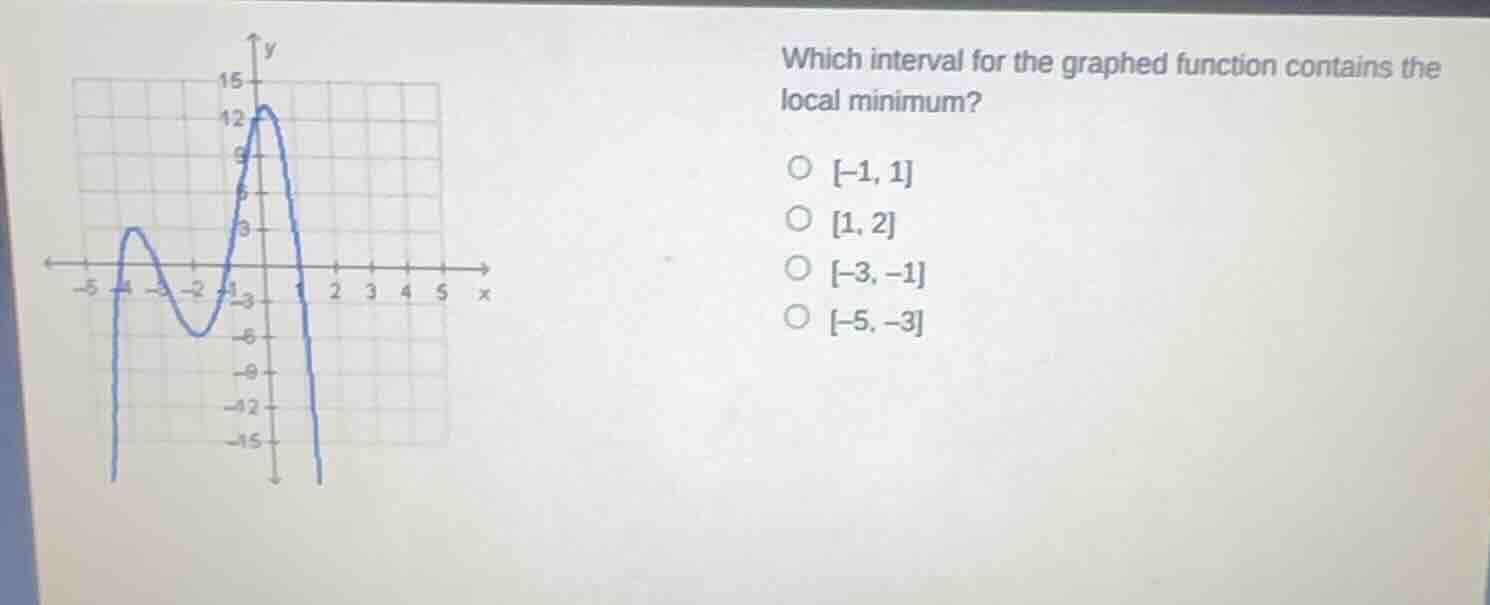
Question
which interval for the graphed function contains the local minimum?\
\\(\boldsymbol{-1, 1}\\)\
\\(\boldsymbol{1, 2}\\)\
\\(\boldsymbol{-3, -1}\\)\
\\(\boldsymbol{-5, -3}\\)
Step1: Recall local minimum definition
A local minimum is a point where the function changes from decreasing to increasing (or has a "valley" in the graph). We analyze each interval:
Step2: Analyze \([-1, 1]\)
In \([-1, 1]\), the function rises from \(x=-1\) to \(x = 0\) (peak) then falls, no local min here.
Step3: Analyze \([1, 2]\)
In \([1, 2]\), the function is decreasing (from \(x = 1\) downwards), no local min (needs a "valley" or change from decreasing to increasing).
Step4: Analyze \([-3, -1]\)
In \([-3, -1]\), looking at the graph: from \(x=-3\) to \(x=-1\), the function has a "valley" (local min) here? Wait, no—wait, let's check the other intervals. Wait, \([-5, -3]\): at \(x=-5\) to \(x=-3\), the function rises from a low to a peak at \(x=-4\)? No, wait the left part: from \(x=-5\) to \(x=-4\), it rises (peak at \(x=-4\)), then from \(x=-4\) to \(x=-3\)? Wait no, the graph: between \(x=-5\) and \(x=-3\), there's a peak at \(x=-4\), then it goes down? Wait no, the local min is in \([-3, -1]\)? Wait no, let's re - examine. Wait, the interval \([-3, -1]\): from \(x=-3\) (which is near \(y=-6\) or so) to \(x=-1\). Wait, no, the correct interval: a local minimum is a point where the function changes from decreasing to increasing. Let's check each interval:
- For \([-5, -3]\): The function at \(x=-5\) is low, rises to \(x=-4\) (a peak), then falls? No, that's a peak, not a min.
- For \([-3, -1]\): The function at \(x=-3\) (around \(y=-6\) maybe) then goes to a low (local min) and then rises? Wait, no, looking at the graph, between \(x=-3\) and \(x=-1\), is there a local min? Wait, the graph has a local min between \(x=-3\) and \(x=-1\)? Wait, no, let's check the options again. Wait, the interval \([-3, -1]\): let's see the behavior. The function in \([-5, -3]\): at \(x=-5\), it's going up to \(x=-4\) (peak), then down? No, that's a peak. In \([-3, -1]\): the function comes from a low (after \(x=-4\))? Wait, maybe I made a mistake. Wait, the local minimum is a point where the function has a "valley" (the lowest point in that interval compared to its neighbors). Let's check each interval:
- \([-1, 1]\): The function is increasing from \(x=-1\) to \(x = 0\) (peak) then decreasing, so no local min (it's a peak here).
- \([1, 2]\): The function is decreasing, so no local min (needs to change from decreasing to increasing).
- \([-3, -1]\): The function has a local minimum in this interval? Wait, no, wait the interval \([-5, -3]\): at \(x=-5\), the function is at a low, rises to \(x=-4\) (peak), then falls? No, that's a peak. Wait, the correct interval is \([-3, -1]\)? Wait, no, let's look at the graph again. The left part: from \(x=-5\) to \(x=-4\), it rises (peak at \(x=-4\)), then from \(x=-4\) to \(x=-3\), it falls? No, that can't be. Wait, maybe the local min is in \([-3, -1]\). Wait, the options: the interval \([-3, -1]\) is where the function has a local minimum (a valley) because in that interval, the function changes from decreasing to increasing (or has the lowest point in that interval compared to its adjacent points). The other intervals: \([-5, -3]\) has a peak, \([-1, 1]\) has a peak, \([1, 2]\) is decreasing. So the correct interval is \([-3, -1]\).

Snap & solve any problem in the app
Get step-by-step solutions on Sovi AI
Photo-based solutions with guided steps
Explore more problems and detailed explanations
\([-3, -1]\)