QUESTION IMAGE
Question
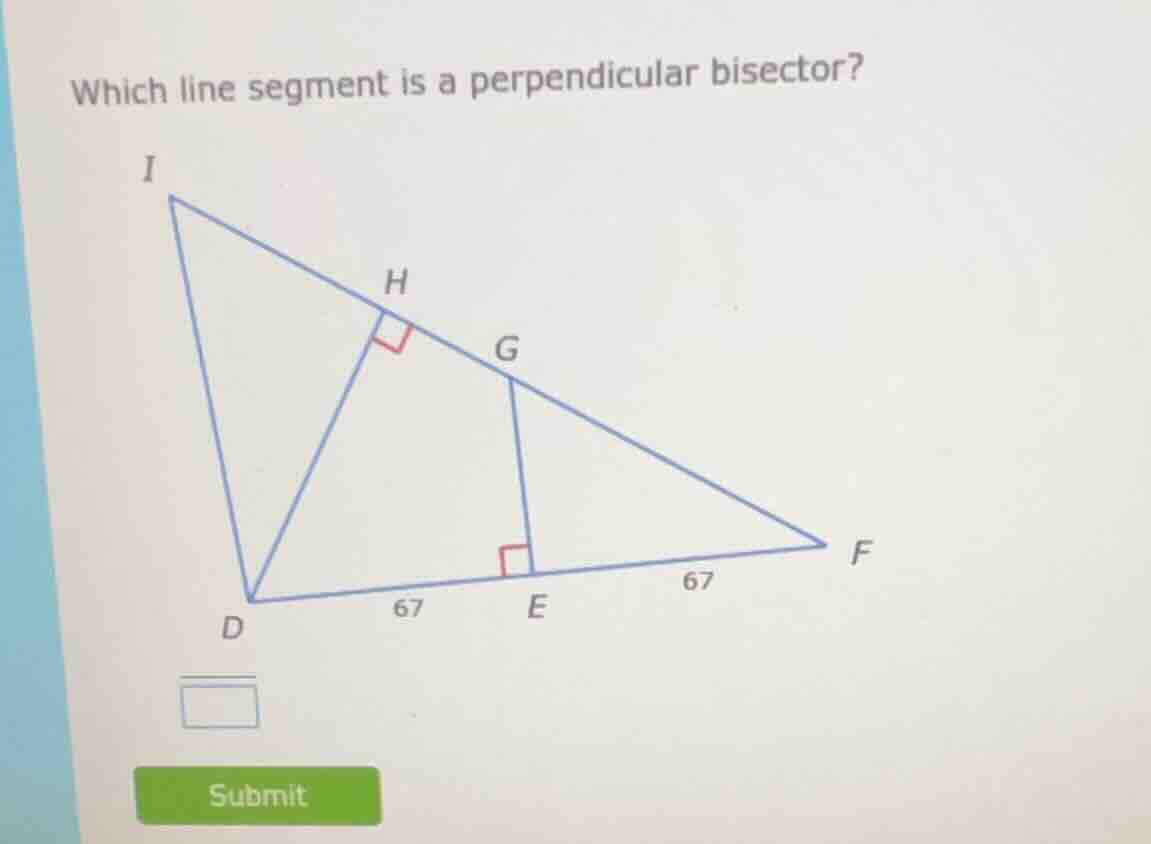
which line segment is a perpendicular bisector?
i
h
g
f
67
d
67
e
submit
Step1: Recall the definition of a perpendicular bisector
A perpendicular bisector of a segment is a line (or segment) that is perpendicular to the segment (forms a right angle) and divides it into two equal parts.
Step2: Analyze segment \( DE \) and \( EF \)
We see that \( DE = 67 \) and \( EF = 67 \), so \( E \) is the midpoint of \( DF \) (since \( DE + EF = DF \) and \( DE = EF \)). Also, the segment \( GE \) (wait, looking at the diagram, the segment with the right angle at \( E \) is \( GE \)? Wait, no, the segment from \( G \) to \( E \)? Wait, no, the diagram has \( D \), \( E \), \( F \) with \( DE = 67 \), \( EF = 67 \), and a right angle at \( E \) for segment \( GE \)? Wait, no, the segment that is perpendicular to \( DF \) at \( E \) (since \( \angle DEG \) or \( \angle FEG \) is right angle) and \( E \) is the midpoint (because \( DE = EF = 67 \)). Wait, the segment \( GE \)? Wait, no, the segment \( GE \) is perpendicular to \( DF \) and \( E \) is the midpoint of \( DF \) (since \( DE = EF \)). Wait, but looking at the labels, the segment from \( G \) to \( E \)? Wait, no, the segment \( GE \) (or \( GD \)? No, let's re-examine.
Wait, the problem is to find which line segment is a perpendicular bisector. A perpendicular bisector must be perpendicular to a segment and bisect it (divide into two equal parts).
Looking at segment \( DF \): \( DE = 67 \), \( EF = 67 \), so \( E \) is the midpoint of \( DF \). The segment \( GE \) (or \( EG \)) is perpendicular to \( DF \) (since there's a right angle at \( E \)). So \( GE \) is perpendicular to \( DF \) and bisects it (because \( E \) is the midpoint). Wait, but maybe the segment is \( GE \) or \( DG \)? No, let's check the other segment: \( DH \) is perpendicular to \( IF \) (or \( IH \)) but does it bisect? We don't know if \( H \) is the midpoint. But for \( DF \), \( E \) is the midpoint (since \( DE = EF \)) and \( GE \) is perpendicular to \( DF \), so \( GE \) is the perpendicular bisector of \( DF \). Wait, but maybe the segment is \( GE \) (or \( EG \)). Wait, the diagram shows \( D \), \( E \), \( F \) with \( DE = 67 \), \( EF = 67 \), and a right angle at \( E \) for the segment from \( G \) to \( E \). So that segment (let's call it \( GE \)) is perpendicular to \( DF \) and bisects \( DF \) (since \( E \) is the midpoint). So the perpendicular bisector is the segment that is perpendicular to \( DF \) and passes through its midpoint \( E \), which is \( GE \) (or \( EG \)). Wait, but maybe the label is \( GE \) or \( DG \)? No, let's confirm:
A perpendicular bisector of a segment \( AB \) is a line that is perpendicular to \( AB \) and intersects \( AB \) at its midpoint. Here, \( DF \) has midpoint \( E \) (since \( DE = EF = 67 \)), and the segment \( GE \) is perpendicular to \( DF \) (right angle at \( E \)). So \( GE \) is the perpendicular bisector of \( DF \).
Wait, but maybe the segment is \( GE \) (or \( EG \)). Alternatively, maybe the segment is \( DG \)? No, \( DG \) is not perpendicular to \( DF \). Wait, the segment with the right angle at \( E \) is \( GE \), so \( GE \) is perpendicular to \( DF \) and bisects \( DF \) (because \( E \) is the midpoint). So the perpendicular bisector is \( GE \) (or \( EG \)). But maybe the answer is \( GE \) (or the segment from \( G \) to \( E \)). Alternatively, maybe the segment is \( GE \).
Wait, let's re-express:
- For a segment to be a perpendicular bisector, it must:
- Be perpendicular to another segment (form a right angle).
- Bisect that segment (divide into two equal parts, i.e., pas…

Snap & solve any problem in the app
Get step-by-step solutions on Sovi AI
Photo-based solutions with guided steps
Explore more problems and detailed explanations
The line segment \( GE \) (or \( EG \)) is the perpendicular bisector (assuming the segment from \( G \) to \( E \) with the right angle at \( E \) and \( E \) as midpoint of \( DF \)).