QUESTION IMAGE
Question
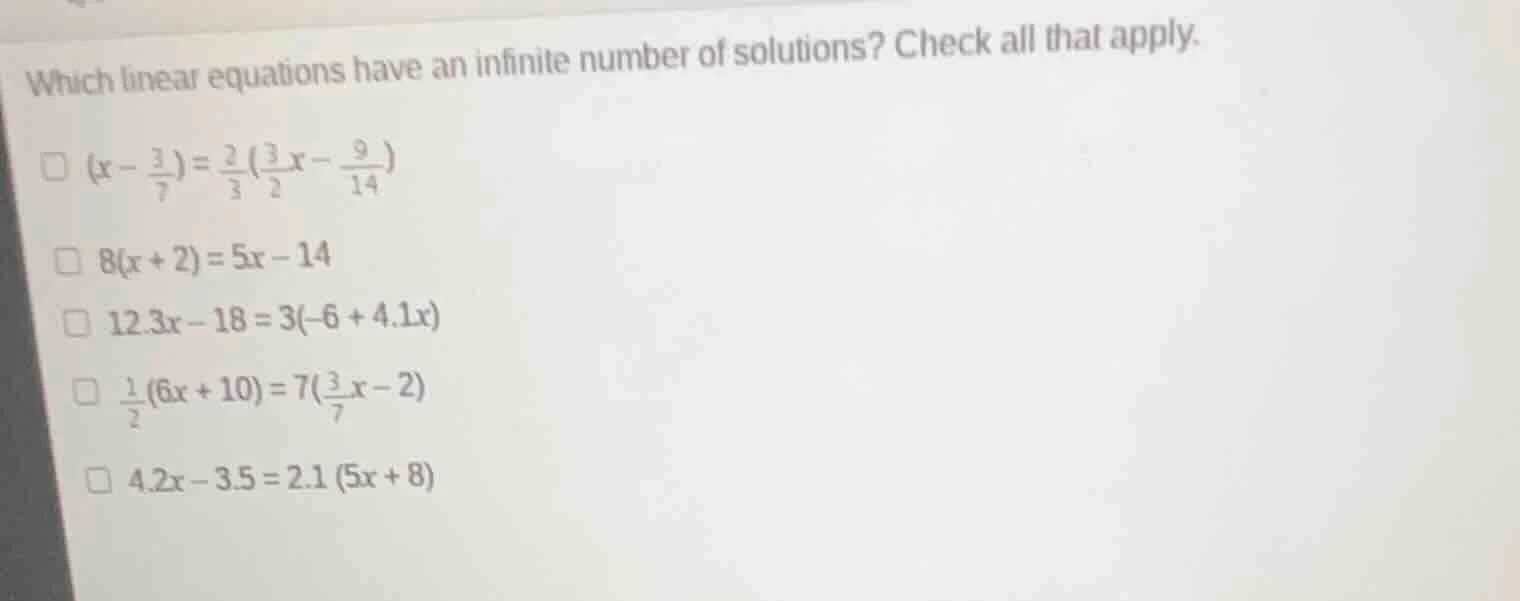
which linear equations have an infinite number of solutions? check all that apply.
$\left(x - \frac{3}{7}\
ight) = \frac{2}{3}\left(\frac{3}{2}x - \frac{9}{14}\
ight)$
$8(x + 2) = 5x - 14$
$12.3x - 18 = 3(-6 + 4.1x)$
$\frac{1}{2}(6x + 10) = 7\left(\frac{3}{7}x - 2\
ight)$
$4.2x - 3.5 = 2.1(5x + 8)$
Step1: Simplify first equation
Expand right-hand side:
$$\begin{align*}
x - \frac{3}{7} &= \frac{2}{3} \times \frac{3}{2}x - \frac{2}{3} \times \frac{9}{14} \\
x - \frac{3}{7} &= x - \frac{3}{7}
\end{align*}$$
Step2: Simplify second equation
Expand and rearrange terms:
$$\begin{align*}
8x + 16 &= 5x - 14 \\
8x - 5x &= -14 - 16 \\
3x &= -30
\end{align*}$$
Step3: Simplify third equation
Expand right-hand side:
$$\begin{align*}
12.3x - 18 &= 3\times(-6) + 3\times4.1x \\
12.3x - 18 &= -18 + 12.3x \\
12.3x - 18 &= 12.3x - 18
\end{align*}$$
Step4: Simplify fourth equation
Expand both sides:
$$\begin{align*}
\frac{1}{2}\times6x + \frac{1}{2}\times10 &= 7\times\frac{3}{7}x - 7\times2 \\
3x + 5 &= 3x - 14 \\
3x - 3x &= -14 -5 \\
0 &= -19
\end{align*}$$
Step5: Simplify fifth equation
Expand right-hand side:
$$\begin{align*}
4.2x - 3.5 &= 2.1\times5x + 2.1\times8 \\
4.2x - 3.5 &= 10.5x + 16.8 \\
4.2x - 10.5x &= 16.8 + 3.5 \\
-6.3x &= 20.3
\end{align*}$$

Snap & solve any problem in the app
Get step-by-step solutions on Sovi AI
Photo-based solutions with guided steps
Explore more problems and detailed explanations
$\boldsymbol{(x - \frac{3}{7}) = \frac{2}{3}(\frac{3}{2}x - \frac{9}{14})}$
$\boldsymbol{12.3x - 18 = 3(-6 + 4.1x)}$