QUESTION IMAGE
Question
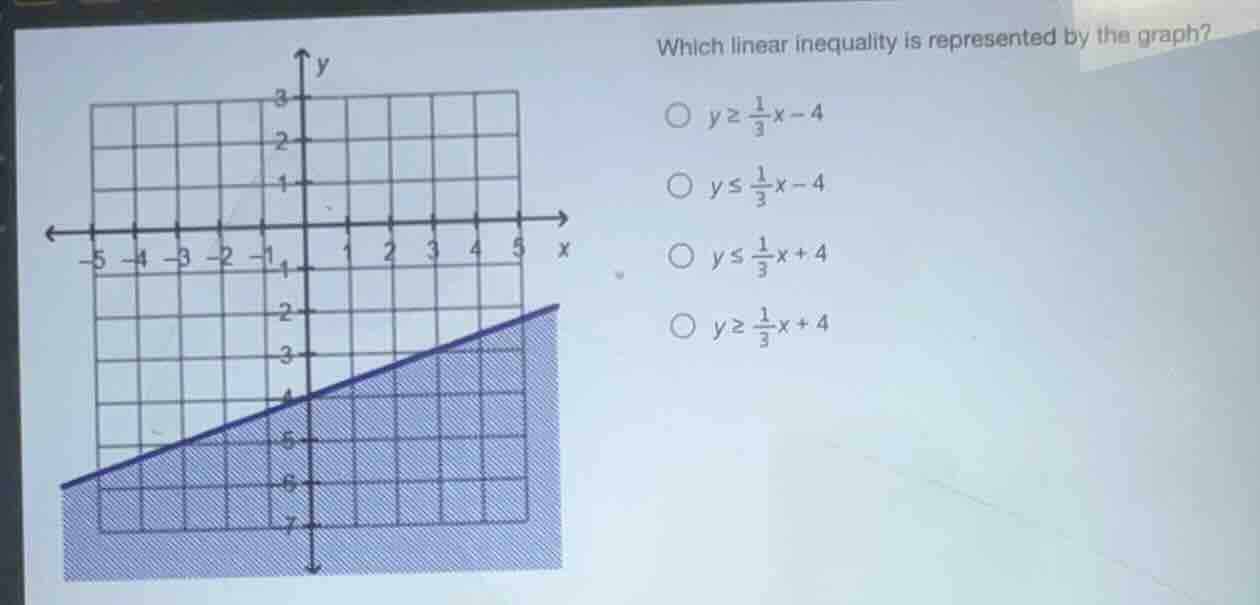
which linear inequality is represented by the graph?
$\bigcirc\\ y\geq \frac{1}{3}x - 4$
$\bigcirc\\ y\leq \frac{1}{3}x - 4$
$\bigcirc\\ y\leq \frac{1}{3}x + 4$
$\bigcirc\\ y\geq \frac{1}{3}x + 4$
Step1: Determine the slope and y - intercept of the boundary line
The equation of a line in slope - intercept form is \(y = mx + b\), where \(m\) is the slope and \(b\) is the y - intercept.
From the graph, the line crosses the y - axis at \(y=- 4\)? Wait, no, wait. Wait, looking at the graph again, the line crosses the y - axis at \(y = - 4\)? Wait, no, the blue line in the graph: wait, the y - intercept is at \((0,-4)\)? Wait, no, the options have \(y=\frac{1}{3}x - 4\) and \(y=\frac{1}{3}x + 4\). Wait, let's re - examine the graph. The line passes through \((0,-4)\)? No, wait, the shaded region and the line: let's calculate the slope. Let's take two points on the line. Let's say when \(x = 0\), \(y=-4\)? No, wait, the options: let's check the y - intercept. The line in the graph: when \(x = 0\), the line is at \(y=-4\)? Wait, no, the first two options have \(y=\frac{1}{3}x-4\), the next two have \(y=\frac{1}{3}x + 4\). Wait, looking at the graph, the line passes through \((0, - 4)\)? Wait, no, the shaded area is below or above? Wait, the line is solid (so the inequality includes equality), and the shading: let's see, the slope. Let's take two points. Let's say from \((0,-4)\) to \((3,-3)\)? Wait, no, if \(x = 3\), \(y=\frac{1}{3}(3)-4=1 - 4=-3\)? Wait, no, \(\frac{1}{3}x-4\) when \(x = 3\) is \(1 - 4=-3\), when \(x = 0\) is \(-4\). Now, the shading: is the shaded area above or below the line? Wait, the graph shows the shaded area is above the line? Wait, no, the options: \(y\geq\frac{1}{3}x - 4\) or \(y\leq\frac{1}{3}x - 4\). Wait, let's check the y - intercept. The line crosses the y - axis at \((0,-4)\), so \(b=-4\). The slope \(m=\frac{1}{3}\) (since for a run of 3, the rise is 1). Now, the line is solid, so the inequality is either \(\geq\) or \(\leq\). Now, to determine the direction of the inequality, we can test a point in the shaded region. Let's take the origin \((0,0)\)? Wait, no, the shaded region: looking at the graph, the shaded area is above the line \(y=\frac{1}{3}x - 4\)? Wait, no, let's take a point in the shaded area. Let's take \((0,0)\): plug into \(y\geq\frac{1}{3}x - 4\): \(0\geq\frac{1}{3}(0)-4\) which is \(0\geq - 4\), true. Plug into \(y\leq\frac{1}{3}x - 4\): \(0\leq - 4\), false. Now, check the line equation: the line has a y - intercept of \(-4\) and slope \(\frac{1}{3}\), so the equation of the line is \(y=\frac{1}{3}x - 4\). Since the line is solid, the inequality includes equality. And the shading is above the line, so \(y\geq\frac{1}{3}x - 4\). Wait, but wait, maybe I made a mistake. Wait, let's re - look at the graph. The y - axis: the line is at \(y=-4\) when \(x = 0\)? Wait, the graph shows the line passing through \((0, - 4)\) and \((3,-3)\) (since slope is \(\frac{1}{3}\), rise 1, run 3). The shaded area: if we take a point in the shaded area, say \((0,0)\), plug into \(y\geq\frac{1}{3}x - 4\): \(0\geq - 4\), which is true. Plug into \(y\leq\frac{1}{3}x - 4\): \(0\leq - 4\), false. So the inequality is \(y\geq\frac{1}{3}x - 4\).
Step2: Confirm the inequality direction
The line is \(y=\frac{1}{3}x - 4\) (solid line, so equality is included). The shaded region is above the line, which means \(y\) is greater than or equal to the value of the line at each \(x\), so the inequality is \(y\geq\frac{1}{3}x - 4\).

Snap & solve any problem in the app
Get step-by-step solutions on Sovi AI
Photo-based solutions with guided steps
Explore more problems and detailed explanations
\(y\geq\frac{1}{3}x - 4\) (the first option: \(y\geq\frac{1}{3}x - 4\))