QUESTION IMAGE
Question
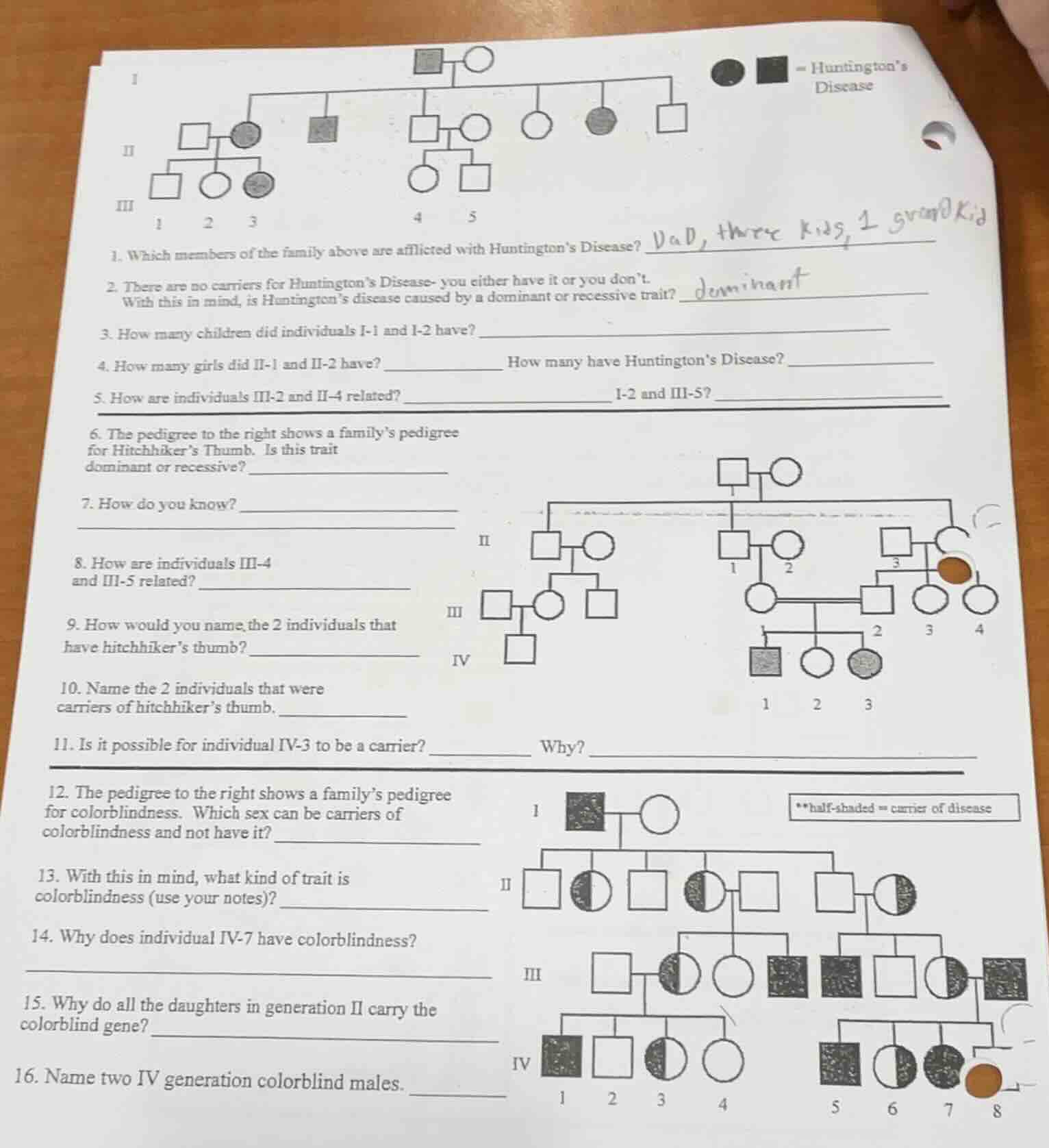
- which members of the family above are afflicted with huntington’s disease?
- there are no carriers for huntington’s disease- you either have it or you don’t. with this in mind, is huntington’s disease caused by a dominant or recessive trait?
- how many children did individuals i-1 and i-2 have?
- how many girls did ii-1 and ii-2 have? how many have huntington’s disease?
- how are individuals iii-2 and ii-4 related? i-2 and iii-5?
- the pedigree to the right shows a family’s pedigree for hitchhiker’s thumb. is this trait dominant or recessive?
- how do you know?
- how are individuals iii-4 and iii-5 related?
- how would you name the 2 individuals that have hitchhiker’s thumb?
- name the 2 individuals that were carriers of hitchhiker’s thumb.
- is it possible for individual iv-3 to be a carrier? why?
- the pedigree to the right shows a family’s pedigree for colorblindness. which sex can be carriers of colorblindness and not have it?
- with this in mind, what kind of trait is colorblindness (use your notes)?
- why does individual iv-7 have colorblindness?
- why do all the daughters in generation ii carry the colorblind gene?
- name two iv generation colorblind males.
Step1: Identify affected Huntington's members
From the first pedigree, shaded shapes = affected. Affected: I-1, II-2, II-3, II-5, III-3
Step2: Confirm Huntington's trait type
No carriers = dominant trait (dominant traits show in every generation, no hidden carriers)
Step3: Count I-1 & I-2 children
Count generation II offspring: II-1, II-2, II-3, II-4, II-5, II-6 → 6 children
Step4: Count II-1 & II-2's girls
Their children: III-1, III-2, III-3. Girls: III-2, III-3 → 2 girls. Affected girl: III-3 → 1
Step5: Determine relationships
III-2 & II-4: III-2 is II-4's niece; I-2 & III-5: I-2 is III-5's grandmother
Step6: Identify Hitchhiker's Thumb trait type
Unaffected parents (II-3 & II-4) have affected child (III-4) → recessive trait
Step7: Justify Hitchhiker's trait conclusion
Recessive traits skip generations; unaffected parents can have affected offspring if both are carriers
Step8: Relate III-4 & III-5
They are siblings (brother and sister)
Step9: Name affected Hitchhiker's Thumb individuals
Shaded shapes: III-4, IV-3
Step10: Name Hitchhiker's Thumb carriers
Unaffected parents of affected child: II-3, II-4
Step11: Assess IV-3 as carrier possibility
No; IV-3 shows the recessive trait, so has two recessive alleles (homozygous recessive), cannot be a carrier (carriers are heterozygous, unaffected)
Step12: Identify colorblind carrier sex
Colorblindness is X-linked; females (XX) can be carriers (one affected X, one normal X) without showing the trait
Step13: Classify colorblindness trait type
X-linked recessive trait (males show it with one affected X, females need two)
Step14: Explain IV-7's colorblindness
IV-7 inherited the affected X chromosome from her carrier mother (III-6) and no normal X from her father (who passes Y to sons, but here IV-7 is female? Correction: IV-7 is female, so she inherited two affected Xs: one from carrier mom III-6, one from affected dad III-8)
Step15: Explain generation II daughters' carrier status
Father I-1 is colorblind (has affected X), so he passes his only X to all daughters, making them carriers
Step16: Name IV generation colorblind males
Shaded males: IV-1, IV-5

Snap & solve any problem in the app
Get step-by-step solutions on Sovi AI
Photo-based solutions with guided steps
Explore more problems and detailed explanations
- I-1, II-2, II-3, II-5, III-3
- Dominant
- 6
- 2; 1
- Niece and aunt; Grandmother and grandson
- Recessive
- Unaffected parents have an affected child, which is a hallmark of recessive traits that can skip generations.
- They are brother and sister (siblings)
- III-4, IV-3
- II-3, II-4
- No; IV-3 has the recessive trait, so she is homozygous recessive for the allele and cannot be a heterozygous carrier.
- Females (XX)
- X-linked recessive trait
- She inherited two copies of the X chromosome with the colorblindness allele: one from her carrier mother (III-6) and one from her colorblind father (III-8).
- Their father (I-1) is colorblind, so he can only pass his affected X chromosome to his daughters, making all of them carriers.
- IV-1, IV-5