QUESTION IMAGE
Question
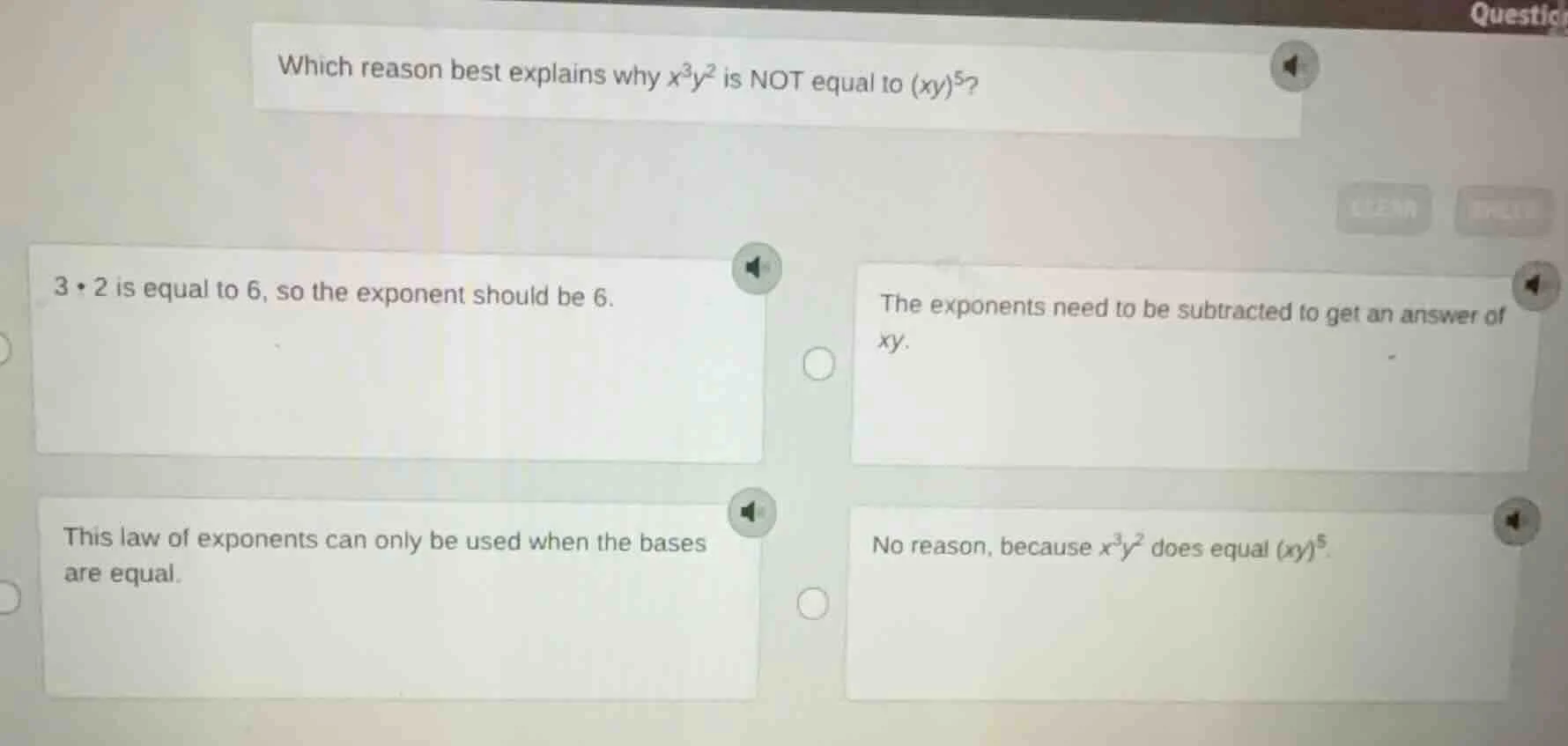
which reason best explains why $x^3y^2$ is not equal to $(xy)^5$?
- $3 \cdot 2$ is equal to 6, so the exponent should be 6.
- the exponents need to be subtracted to get an answer of $xy$.
- this law of exponents can only be used when the bases are equal.
- no reason, because $x^3y^2$ does equal $(xy)^5$.
To determine why \( x^3y^2
eq (xy)^5 \), we analyze the exponent rules. The power - of - a - product rule \((ab)^n=a^n b^n\) (and related exponent combination rules) apply when we are combining terms with the same operation (multiplication of bases with exponents). For the rule that combines exponents when multiplying terms with exponents (\(a^m\times a^n=a^{m + n}\)), the bases (\(a\)) must be equal. In \(x^3y^2\), the bases of the two terms are \(x\) and \(y\) (different bases), while \((xy)^5=x^5y^5\) (using the power - of - a - product rule). Let's analyze each option:
- Option 1: The idea that \(3\times2 = 6\) so the exponent should be 6 is incorrect. The exponent rules for multiplying terms with exponents (\(a^m\times a^n=a^{m + n}\)) require the same base, and \(x^3y^2\) is not a single base with exponents added in that way.
- Option 2: Subtracting exponents is for the rule \(a^m\div a^n=a^{m - n}\) (when bases are equal), which is not relevant here as we are dealing with multiplication, not division.
- Option 3: The law of exponents (like \(a^m\times a^n=a^{m + n}\)) can only be used when the bases are equal. In \(x^3y^2\), the bases \(x\) and \(y\) are different, so we can't combine the exponents as if they were the same base. To get \((xy)^n=x^n y^n\), when we expand \((xy)^5\) we get \(x^5y^5\), which is not equal to \(x^3y^2\) because the exponents on \(x\) and \(y\) are different.
- Option 4: Clearly, \(x^3y^2\) does not equal \((xy)^5\) (since \((xy)^5=x^5y^5\) and \(3
eq5\), \(2
eq5\)), so this option is wrong.

Snap & solve any problem in the app
Get step-by-step solutions on Sovi AI
Photo-based solutions with guided steps
Explore more problems and detailed explanations
This law of exponents can only be used when the bases are equal.