QUESTION IMAGE
Question
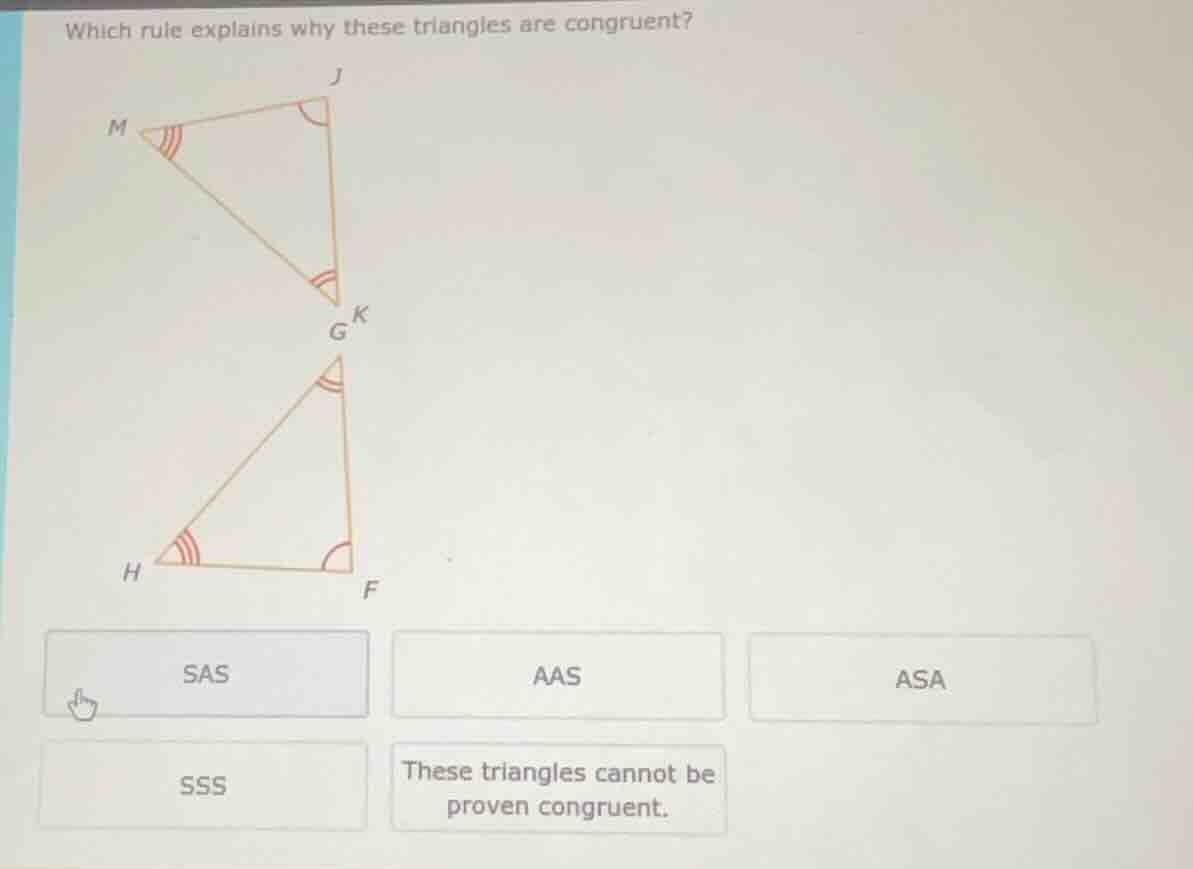
which rule explains why these triangles are congruent?
sas
aas
asa
sss
these triangles cannot be proven congruent.
Step1: Analyze given angles
From the diagram, we see that \(\angle M=\angle H\) (marked with two arcs), \(\angle K = \angle G\) (marked with one arc), and \(\angle J=\angle F\) (right - like angles, but let's focus on the non - right angle markings first). Wait, actually, let's check the AAS (Angle - Angle - Side) criterion. AAS states that if two angles and a non - included side of one triangle are congruent to the corresponding two angles and non - included side of another triangle, the triangles are congruent.
Looking at the triangles \(\triangle MJG\) (assuming the top triangle is \(\triangle MJG\)) and \(\triangle HFG\) (bottom triangle). We have two pairs of congruent angles: \(\angle M\cong\angle H\), \(\angle K\cong\angle G\), and the side between the non - corresponding angles? Wait, no. Wait, in AAS, we have two angles and a side that is not between them. Let's re - examine the markings. The top triangle has angles at \(M\) (two arcs), \(J\) (right angle), \(K\) (one arc). The bottom triangle has angles at \(H\) (two arcs), \(F\) (right angle), \(G\) (one arc). So we have two angles (\(\angle M=\angle H\), \(\angle K=\angle G\)) and the side opposite one of the angles. For example, if we consider the side opposite \(\angle K\) in the top triangle and the side opposite \(\angle G\) in the bottom triangle, or the side opposite \(\angle M\) and \(\angle H\). Since we have two angles and a non - included side (the side that is not between the two angles) congruent, this fits the AAS (Angle - Angle - Side) criterion.
Wait, let's check the other criteria:
- SAS: We need two sides and the included angle. We don't have information about two sides and the included angle.
- ASA: ASA requires two angles and the included side. We don't have the included side (the side between the two angles) marked as congruent.
- SSS: We don't have information about all three sides.
So, based on the two angles and a non - included side, the AAS criterion applies.
Step2: Confirm the congruence rule
Since we have two pairs of congruent angles and a non - included side (by the markings of the angles), the triangles satisfy the AAS (Angle - Angle - Side) congruence criterion.

Snap & solve any problem in the app
Get step-by-step solutions on Sovi AI
Photo-based solutions with guided steps
Explore more problems and detailed explanations
AAS