QUESTION IMAGE
Question
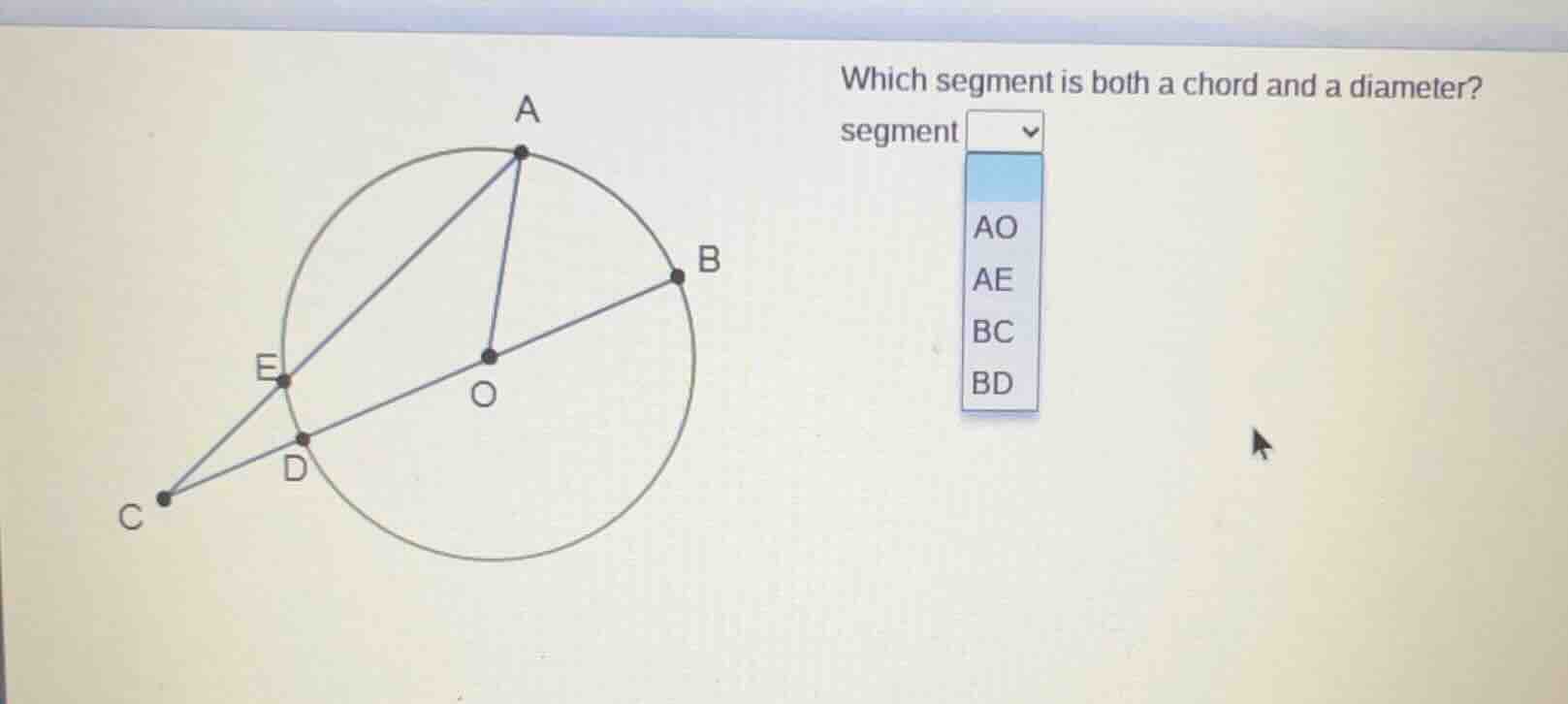
which segment is both a chord and a diameter? segment ao ae bc bd
Brief Explanations
- Recall the definitions: A chord is a segment with both endpoints on the circle. A diameter is a chord that passes through the center of the circle (so it's the longest chord, with the center as the midpoint).
- Analyze each option:
- \( AO \): \( O \) is the center, \( A \) is on the circle, but \( AO \) is a radius (one endpoint at center, one at circle), not a chord (needs both endpoints on circle) or diameter.
- \( AE \): Both \( A \) and \( E \) are on the circle, so it's a chord, but does it pass through the center? From the diagram, \( AE \) does not pass through \( O \), so not a diameter.
- \( BC \): \( C \) is outside the circle, so \( BC \) has one endpoint outside, not a chord (chord endpoints must be on circle).
- \( BD \): Wait, wait, looking at the diagram, the diameter should be a chord through the center. Wait, the segment \( BD \)? Wait, no, wait the center is \( O \), and the line through \( O \) with endpoints on the circle: \( B \) and \( D \)? Wait, no, maybe I misread. Wait, the segment \( BD \)? Wait, no, the correct one: Wait, the diameter is a chord passing through the center. Let's check again. Wait, the options: Wait, maybe a typo, but looking at the diagram, the segment that is a diameter (passes through \( O \)) and has both endpoints on the circle. Wait, \( BD \): Wait, \( B \) is on the circle, \( D \)? Wait, no, maybe \( BD \) is actually the diameter. Wait, no, let's re-express: A diameter is a chord that contains the center. So the segment must have both endpoints on the circle and pass through \( O \). Looking at the options: \( BD \): If \( B \) and \( D \) are on the circle, and the line \( BD \) passes through \( O \) (the center), then \( BD \) is a diameter (hence a chord). Wait, but let's check the other options again:
- \( AO \): radius, not chord.
- \( AE \): chord, not diameter.
- \( BC \): not a chord (C outside).
- \( BD \): both endpoints on circle, passes through center (since \( O \) is on \( BD \) as per diagram), so it's a chord (both endpoints on circle) and a diameter (passes through center). Wait, maybe I made a mistake earlier. Wait, the correct answer should be \( BD \)? Wait, no, wait the diagram: the center is \( O \), and the segment \( BD \) (or maybe \( AB \)? No, the options are \( AO, AE, BC, BD \). Wait, maybe the intended segment is \( BD \), as it's the chord passing through the center (diameter). So \( BD \) is both a chord (endpoints \( B \) and \( D \) on circle) and a diameter (passes through center \( O \)).

Snap & solve any problem in the app
Get step-by-step solutions on Sovi AI
Photo-based solutions with guided steps
Explore more problems and detailed explanations
D. BD (Wait, no, the options are labeled as \( AO, AE, BC, BD \), so the correct option is \( BD \), so the answer is BD (the segment BD). Wait, but in the options, it's "BD" as the option. So the correct option is BD.