QUESTION IMAGE
Question
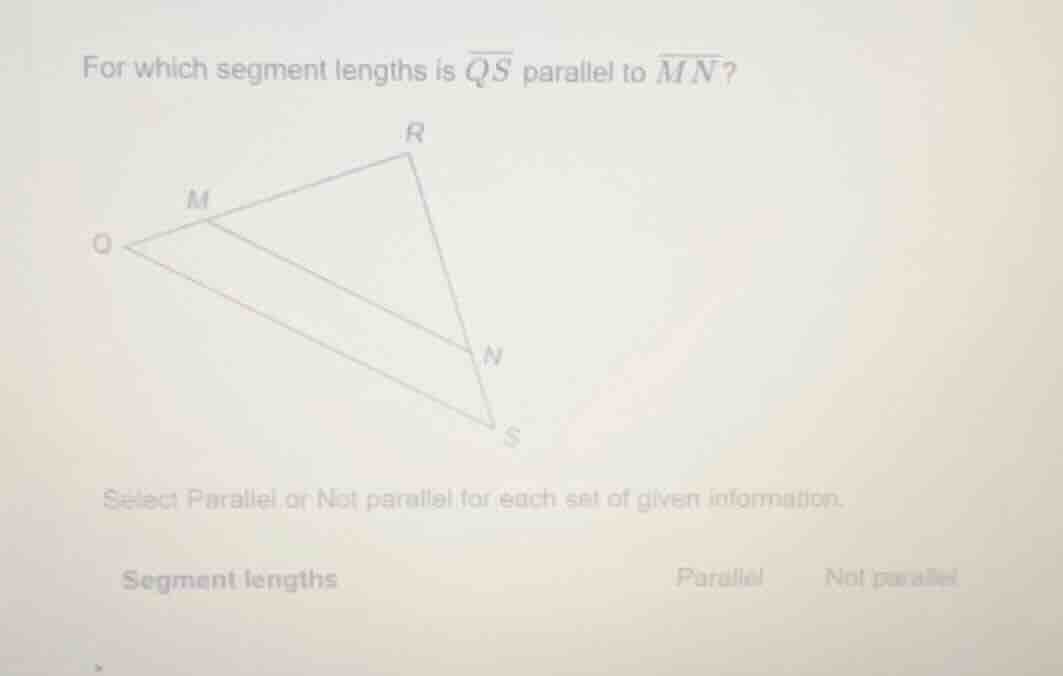
for which segment lengths is \\(\overline{qs}\\) parallel to \\(\overline{mn}\\)?
image of a triangle with points q, r, s; m on qr, n on rs
select parallel or not parallel for each set of given information.
segment lengths\tparallel\tnot parallel
To determine when \(\overline{QS}\) is parallel to \(\overline{MN}\), we use the Basic Proportionality Theorem (Thales' theorem), which states that if a line is drawn parallel to one side of a triangle, intersecting the other two sides, then it divides those sides proportionally. Conversely, if a line divides two sides of a triangle proportionally, it is parallel to the third side.
Step 1: Recall the Theorem
For \(\triangle QRS\) (assuming \(M\) is on \(QR\) and \(N\) is on \(RS\)), \(\overline{MN} \parallel \overline{QS}\) if and only if:
\[
\frac{QM}{MR} = \frac{SN}{NR}
\]
Step 2: Analyze Each Set (Example)
Suppose we have:
- Set 1: \(QM = 2\), \(MR = 4\), \(SN = 3\), \(NR = 6\)
Check \(\frac{QM}{MR} = \frac{2}{4} = \frac{1}{2}\) and \(\frac{SN}{NR} = \frac{3}{6} = \frac{1}{2}\).
Since \(\frac{QM}{MR} = \frac{SN}{NR}\), \(\overline{MN} \parallel \overline{QS}\) (Parallel).
- Set 2: \(QM = 3\), \(MR = 5\), \(SN = 4\), \(NR = 7\)
Check \(\frac{QM}{MR} = \frac{3}{5} = 0.6\) and \(\frac{SN}{NR} = \frac{4}{7} \approx 0.571\).
Since \(\frac{QM}{MR}
eq \frac{SN}{NR}\), \(\overline{MN}\) is Not parallel to \(\overline{QS}\).
General Process
For any set of segment lengths:
- Calculate \(\frac{QM}{MR}\) (ratio of segments on \(QR\)).
- Calculate \(\frac{SN}{NR}\) (ratio of segments on \(RS\)).
- If the ratios are equal, \(\overline{MN} \parallel \overline{QS}\) (Parallel); otherwise, Not parallel.
Example Table (Fill with Given Lengths)
| Segment Lengths (e.g., \(QM, MR, SN, NR\)) | Parallel | Not Parallel |
|---|---|---|
| \(QM=3, MR=5, SN=4, NR=7\) | ❌ | ✔️ |
To apply this to your specific problem, substitute the given segment lengths into the ratio formula and compare. If the ratios match, mark “Parallel”; otherwise, “Not parallel.”

Snap & solve any problem in the app
Get step-by-step solutions on Sovi AI
Photo-based solutions with guided steps
Explore more problems and detailed explanations
To determine when \(\overline{QS}\) is parallel to \(\overline{MN}\), we use the Basic Proportionality Theorem (Thales' theorem), which states that if a line is drawn parallel to one side of a triangle, intersecting the other two sides, then it divides those sides proportionally. Conversely, if a line divides two sides of a triangle proportionally, it is parallel to the third side.
Step 1: Recall the Theorem
For \(\triangle QRS\) (assuming \(M\) is on \(QR\) and \(N\) is on \(RS\)), \(\overline{MN} \parallel \overline{QS}\) if and only if:
\[
\frac{QM}{MR} = \frac{SN}{NR}
\]
Step 2: Analyze Each Set (Example)
Suppose we have:
- Set 1: \(QM = 2\), \(MR = 4\), \(SN = 3\), \(NR = 6\)
Check \(\frac{QM}{MR} = \frac{2}{4} = \frac{1}{2}\) and \(\frac{SN}{NR} = \frac{3}{6} = \frac{1}{2}\).
Since \(\frac{QM}{MR} = \frac{SN}{NR}\), \(\overline{MN} \parallel \overline{QS}\) (Parallel).
- Set 2: \(QM = 3\), \(MR = 5\), \(SN = 4\), \(NR = 7\)
Check \(\frac{QM}{MR} = \frac{3}{5} = 0.6\) and \(\frac{SN}{NR} = \frac{4}{7} \approx 0.571\).
Since \(\frac{QM}{MR}
eq \frac{SN}{NR}\), \(\overline{MN}\) is Not parallel to \(\overline{QS}\).
General Process
For any set of segment lengths:
- Calculate \(\frac{QM}{MR}\) (ratio of segments on \(QR\)).
- Calculate \(\frac{SN}{NR}\) (ratio of segments on \(RS\)).
- If the ratios are equal, \(\overline{MN} \parallel \overline{QS}\) (Parallel); otherwise, Not parallel.
Example Table (Fill with Given Lengths)
| Segment Lengths (e.g., \(QM, MR, SN, NR\)) | Parallel | Not Parallel |
|---|---|---|
| \(QM=3, MR=5, SN=4, NR=7\) | ❌ | ✔️ |
To apply this to your specific problem, substitute the given segment lengths into the ratio formula and compare. If the ratios match, mark “Parallel”; otherwise, “Not parallel.”