QUESTION IMAGE
Question
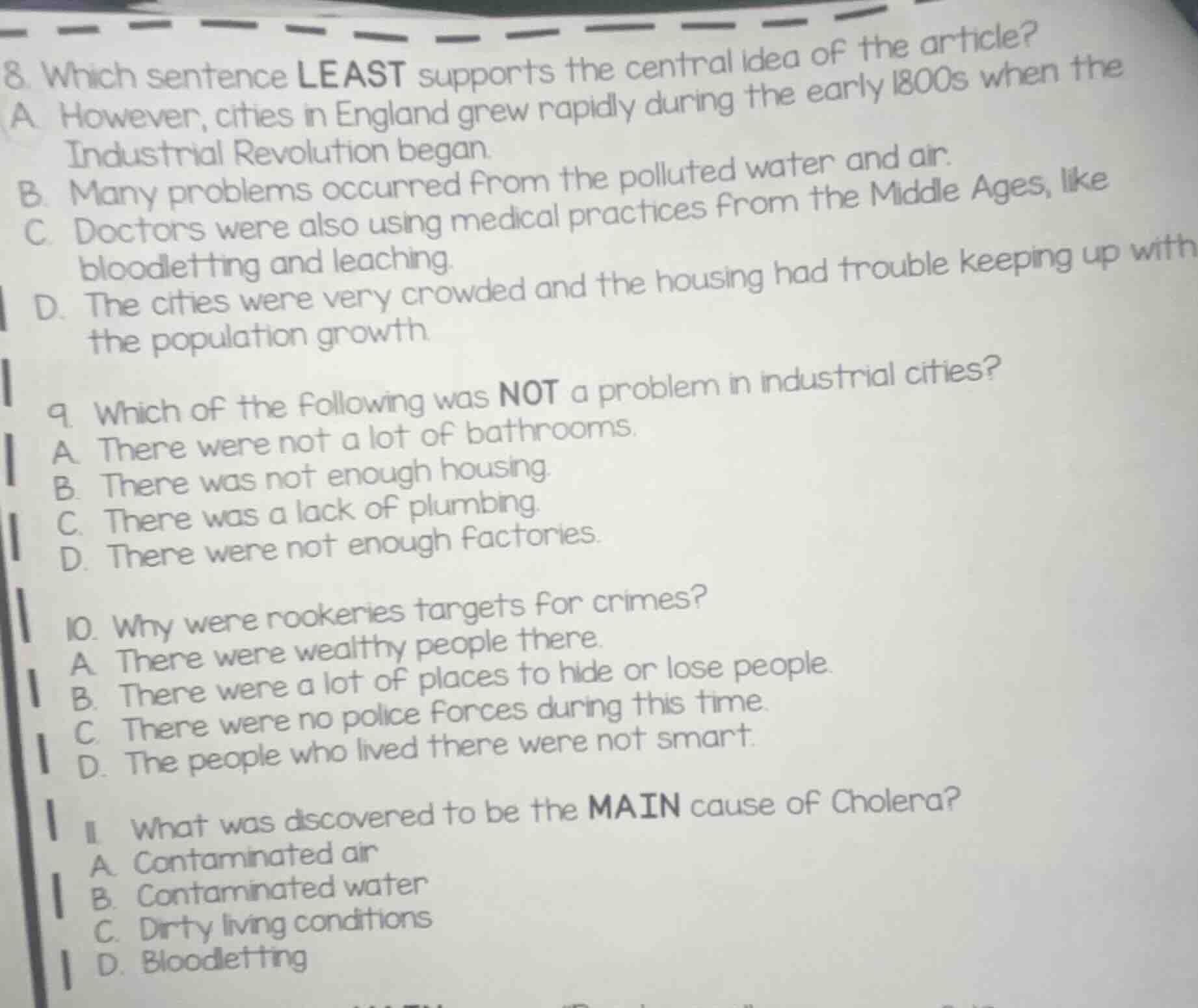
- which sentence least supports the central idea of the article?
a. however, cities in england grew rapidly during the early 1800s when the industrial revolution began.
b. many problems occurred from the polluted water and air.
c. doctors were also using medical practices from the middle ages, like bloodletting and leaching.
d. the cities were very crowded and the housing had trouble keeping up with the population growth.
- which of the following was not a problem in industrial cities?
a. there were not a lot of bathrooms.
b. there was not enough housing.
c. there was a lack of plumbing.
d. there were not enough factories.
- why were rookeries targets for crimes?
a. there were wealthy people there.
b. there were a lot of places to hide or lose people.
c. there were no police forces during this time.
d. the people who lived there were not smart.
- what was discovered to be the main cause of cholera?
a. contaminated air
b. contaminated water
c. dirty living conditions
d. bloodletting
Question 8
To determine which sentence least supports the central idea (likely about problems in industrial cities), we analyze each option:
- Option A talks about city growth during the Industrial Revolution, not problems.
- Options B, C, D discuss pollution, outdated medical practices, and overcrowding/housing issues, which are problems. So A is the least supportive.
Industrial cities had issues like insufficient bathrooms (A), housing (B), and plumbing (C) due to rapid growth. Factories were abundant (or being built) during industrialization, so "not enough factories" (D) was not a problem.
Rookeries (slum areas) had many hiding places (B), making them crime targets. Wealthy people didn't live there (A), police forces existed (C is wrong), and "not smart" (D) is irrelevant.

Snap & solve any problem in the app
Get step-by-step solutions on Sovi AI
Photo-based solutions with guided steps
Explore more problems and detailed explanations
A. However, cities in England grew rapidly during the early 1800s when the Industrial Revolution began.