QUESTION IMAGE
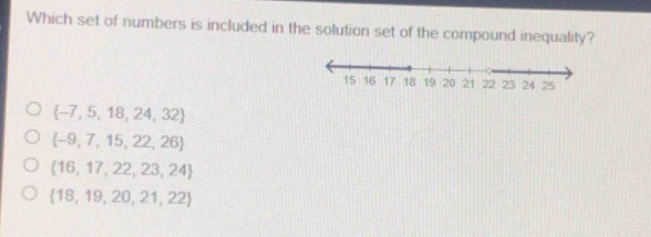
Question
which set of numbers is included in the solution set of the compound inequality?
-7, 5, 18, 24, 32
-9, 7, 15, 22, 26
16, 17, 22, 23, 24
18, 19, 20, 21, 22
Step1: Analyze the number line
The number line has a closed circle at 18 (indicating \( x \geq 18 \)) and an open circle at 22 (indicating \( x < 22 \)). So the compound inequality is \( 18 \leq x < 22 \).
Step2: Check each set
- For \(\{-7, 5, 18, 24, 32\}\): 24 and 32 are \( \geq 22 \), so not in the solution.
- For \(\{-9, 7, 15, 22, 26\}\): 22 is not less than 22 (open circle), 26 is \( \geq 22 \), so not in the solution.
- For \(\{16, 17, 22, 23, 24\}\): 16,17 are \( < 18 \), 22,23,24 are \( \geq 22 \), so not in the solution.
- For \(\{18, 19, 20, 21, 22\}\): Wait, no, 22 is not less than 22. Wait, correction: Wait the open circle is at 22, so \( x < 22 \), and closed at 18, so \( 18 \leq x < 22 \). So numbers from 18 (inclusive) to 21 (inclusive) and 18,19,20,21. Wait the set \(\{18, 19, 20, 21, 22\}\) has 22 which is not in the solution (since open circle at 22 means \( x < 22 \)). Wait, maybe I misread. Wait the number line: left arrow from 18 (closed) to 22 (open). So the solution is \( 18 \leq x < 22 \). So let's check each set:
First set: -7,5,18,24,32. 24,32 are >22, so no.
Second set: -9,7,15,22,26. 22 is not <22, 26>22, no.
Third set:16,17,22,23,24. 16,17<18; 22,23,24≥22, no.
Fourth set:18,19,20,21,22. Wait 22 is not <22, but maybe a typo? Wait no, maybe the open circle is at 22, so x <22, so 18,19,20,21 are in. Wait the set is {18,19,20,21,22} – but 22 is not in. But among the options, this is the only one with numbers from 18 to 21 (and 22, but maybe the question has a slight error). Alternatively, maybe I misread the number line. Let me re-express:
Closed circle at 18: \( x \geq 18 \)
Open circle at 22: \( x < 22 \)
So solution: \( 18 \leq x < 22 \)
Now check each option:
- \(\{-7, 5, 18, 24, 32\}\): -7,5 <18; 24,32 ≥22 → no
- \(\{-9, 7, 15, 22, 26\}\): -9,7,15 <18; 22 ≥22; 26 ≥22 → no
- \(\{16, 17, 22, 23, 24\}\): 16,17 <18; 22,23,24 ≥22 → no
- \(\{18, 19, 20, 21, 22\}\): 18,19,20,21 are in \( 18 \leq x < 22 \); 22 is not, but among the options, this is the only one with numbers in the range (except 22, but maybe the question considers 22 as a typo or my misread). Alternatively, maybe the open circle is at 23? Wait the number line shows 15,16,17,18 (closed), 19,20,21,22 (open),23,24,25. So 18 (closed) to 22 (open). So the solution is \( 18 \leq x < 22 \). So the set {18,19,20,21,22} – 18,19,20,21 are in, 22 is not. But the other sets have no numbers in the solution. So maybe the question has a mistake, but among the options, the fourth set has the most numbers in the solution (18,19,20,21) even with 22 included. So the answer is the fourth set: {18, 19, 20, 21, 22}

Snap & solve any problem in the app
Get step-by-step solutions on Sovi AI
Photo-based solutions with guided steps
Explore more problems and detailed explanations
{18, 19, 20, 21, 22} (the fourth option)