QUESTION IMAGE
Question
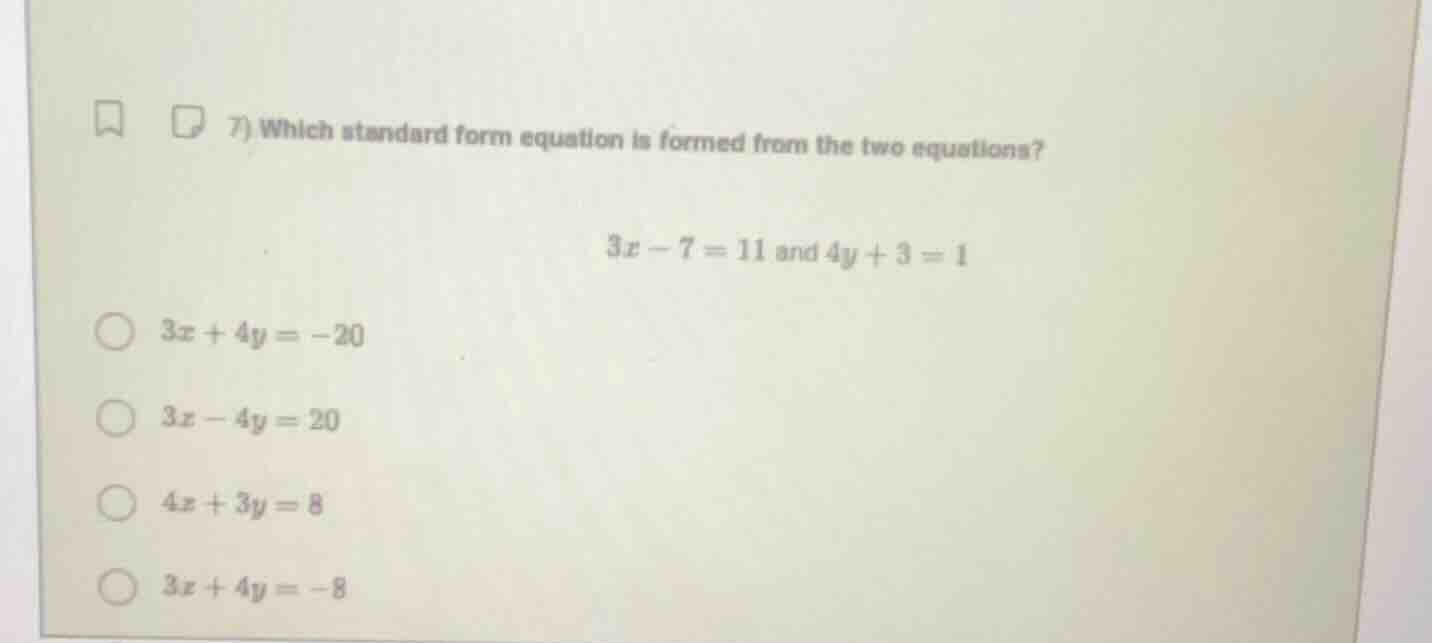
- which standard form equation is formed from the two equations?
$3x - 7 = 11$ and $4y + 3 = 1$
$\bigcirc$ $3x + 4y = -20$
$\bigcirc$ $3x - 4y = 20$
$\bigcirc$ $4x + 3y = 8$
$\bigcirc$ $3x + 4y = -8$
Step1: Solve for \(3x\) from the first equation
Given \(3x - 7 = 11\), add 7 to both sides:
\(3x - 7 + 7 = 11 + 7\)
\(3x = 18\)
Step2: Solve for \(4y\) from the second equation
Given \(4y + 3 = 1\), subtract 3 from both sides:
\(4y + 3 - 3 = 1 - 3\)
\(4y = -2\)
Step3: Combine the two results
We have \(3x = 18\) and \(4y = -2\). Wait, no—actually, we need to form an equation with \(3x\) and \(4y\). Wait, maybe I made a mistake. Wait, let's re - examine. The standard form is \(Ax + By = C\). Let's rearrange the two original equations to have all non - constant terms on the left.
For the first equation \(3x - 7 = 11\), we can rewrite it as \(3x-18 = 0\) (by subtracting 11 from both sides: \(3x - 7-11=0\Rightarrow3x - 18 = 0\)). For the second equation \(4y + 3 = 1\), subtract 1 from both sides: \(4y+3 - 1=0\Rightarrow4y + 2 = 0\). Wait, that's not the right approach.
Wait, another way: Let's solve each equation for the variable term and then combine.
From \(3x - 7=11\), we get \(3x=11 + 7=18\).
From \(4y + 3 = 1\), we get \(4y=1 - 3=-2\).
Now, we want to form an equation of the form \(3x+4y = C\). Substitute the values of \(3x\) and \(4y\):
\(3x+4y=18+( - 2)=16\)? No, that's not matching the options. Wait, maybe I misread the problem. Wait, the problem says "formed from the two equations"—maybe we need to rearrange each equation and then add them?
Wait, let's take the first equation \(3x-7 = 11\), add 7 to both sides: \(3x=18\).
Take the second equation \(4y + 3=1\), subtract 3 from both sides: \(4y=-2\).
Now, let's write the two equations as \(3x-18 = 0\) and \(4y + 2=0\). Then, add the two equations together: \((3x-18)+(4y + 2)=0+0\).
Simplify: \(3x+4y-16 = 0\), so \(3x + 4y=16\). But this is not in the options. Wait, maybe I made a mistake.
Wait, let's check the options again. Wait, maybe the problem is to manipulate the two equations to get a combined equation. Let's start over.
First equation: \(3x-7 = 11\), we can write it as \(3x=18\).
Second equation: \(4y+3 = 1\), we can write it as \(4y=-2\).
Now, if we add the left - hand sides and the right - hand sides:
\(3x+4y=18+( - 2)=16\). Not in the options. Wait, maybe the problem is to subtract or do something else. Wait, maybe the original equations are linear equations in two variables, and we need to write them in standard form and then combine.
Wait, the standard form is \(Ax + By=C\). Let's rewrite each equation in standard form:
First equation: \(3x-7 = 11\) can be rewritten as \(3x-18 = 0\) or \(3x+0y=18\).
Second equation: \(4y + 3=1\) can be rewritten as \(0x + 4y=-2\).
Now, if we add these two standard form equations: \((3x+0y)+(0x + 4y)=18+( - 2)\).
So \(3x + 4y=16\). Still not in the options. Wait, maybe there is a typo in my approach. Wait, let's check the options again.
Wait, option B is \(3x - 4y=20\). Let's see:
From \(3x=18\) and \(4y=-2\), then \(3x-4y=18-( - 2)=20\). Ah! That's it.
So, we have \(3x = 18\) and \(4y=-2\). Then, \(3x-4y=18-( - 2)=20\), which is \(3x - 4y = 20\).

Snap & solve any problem in the app
Get step-by-step solutions on Sovi AI
Photo-based solutions with guided steps
Explore more problems and detailed explanations
B. \(3x - 4y = 20\)