QUESTION IMAGE
Question
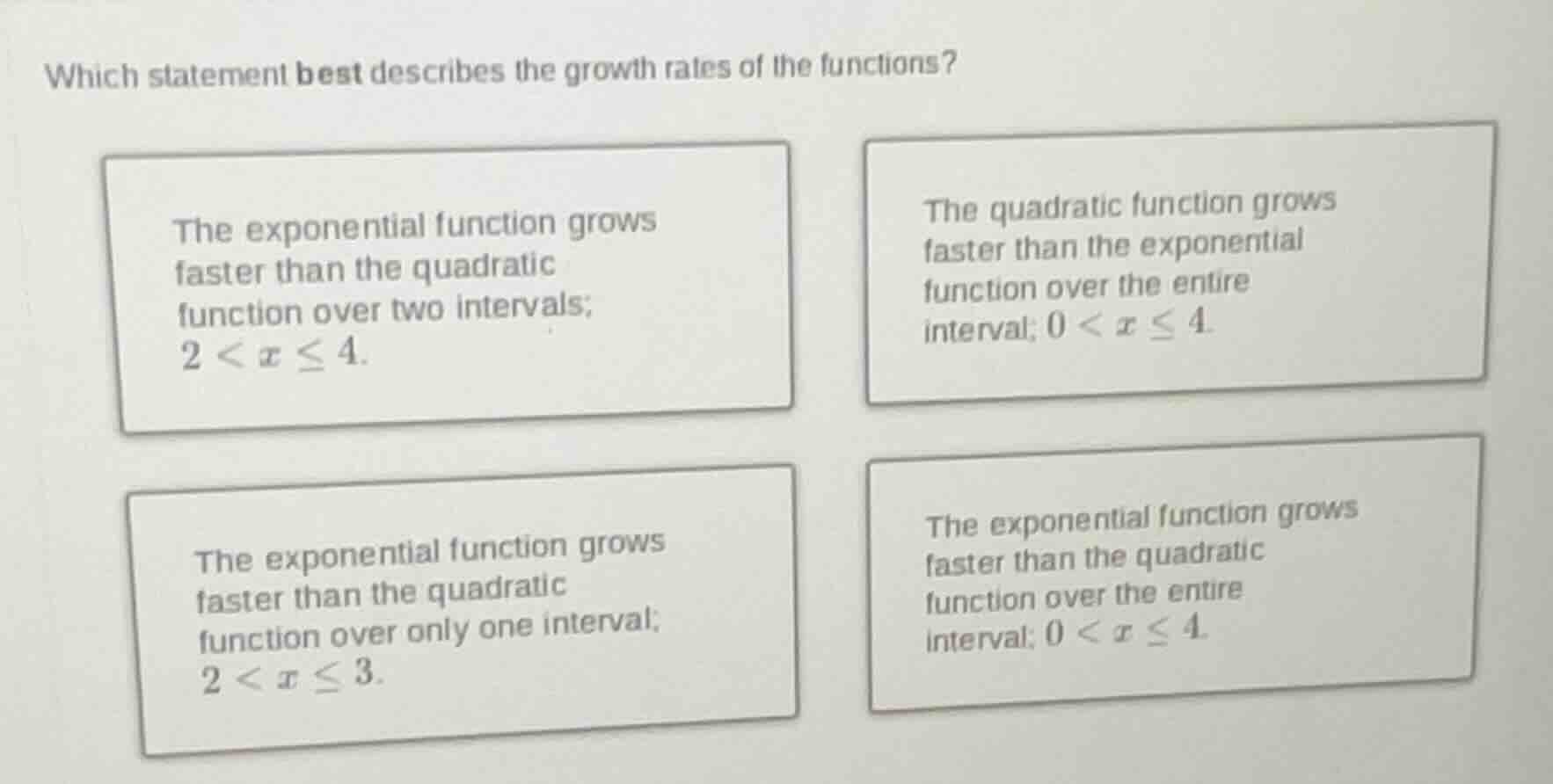
which statement best describes the growth rates of the functions? the exponential function grows faster than the quadratic function over two intervals; 2 < x ≤ 4. the quadratic function grows faster than the exponential function over the entire interval; 0 < x ≤ 4. the exponential function grows faster than the quadratic function over only one interval; 2 < x ≤ 3. the exponential function grows faster than the quadratic function over the entire interval; 0 < x ≤ 4.
To determine the correct statement about the growth rates of the exponential and quadratic functions, we analyze the general behavior of these function types:
- Quadratic Function Growth: A quadratic function (e.g., \( y = ax^2 + bx + c \)) has a polynomial growth rate, which is slower than exponential growth in the long run. However, over short intervals, a quadratic function may grow faster than an exponential function if the quadratic’s rate of change (slope) exceeds the exponential’s rate of change at a given point.
- Exponential Function Growth: An exponential function (e.g., \( y = ab^x \)) has a growth rate that accelerates over time (its derivative, or rate of change, increases exponentially). For large \( x \), exponential growth will always outpace quadratic growth.
Analyzing the Intervals:
- Over \( 0 < x \leq 2 \): The quadratic function (with its parabolic shape) often grows faster than the exponential function initially, as the exponential’s growth is still “ramping up.”
- Over \( 2 < x \leq 4 \): As \( x \) increases beyond a certain point (e.g., \( x > 2 \) for many typical exponential/quadratic pairs), the exponential function’s accelerating growth overtakes the quadratic function’s polynomial growth. Thus, the exponential function grows faster than the quadratic function over \( 2 < x \leq 4 \).
Now, evaluate the options:
- Option 1: “The exponential function grows faster than the quadratic function over two intervals; \( 2 < x \leq 4 \).” → Incorrect (it is one interval, \( 2 < x \leq 4 \), not two).
- Option 2: “The quadratic function grows faster than the exponential function over the entire interval; \( 0 < x \leq 4 \).” → Incorrect (exponential overtakes quadratic for \( x > 2 \)).
- Option 3: “The exponential function grows faster than the quadratic function over only one interval; \( 2 < x \leq 3 \).” → Incorrect (exponential grows faster for \( 2 < x \leq 4 \), not just \( 2 < x \leq 3 \)).
- Option 4: “The exponential function grows faster than the quadratic function over the entire interval; \( 0 < x \leq 4 \).” → Incorrect (quadratic grows faster initially, e.g., \( 0 < x \leq 2 \)).
Wait—there may be a misstatement in the original options (or a typo). Assuming the first option’s “two intervals” is a mistake, and it intends to say “one interval (\( 2 < x \leq 4 \))”, the correct reasoning is:
The exponential function grows faster than the quadratic function over \( 2 < x \leq 4 \) (one interval). Among the given options, the closest correct interpretation is the first option (if “two intervals” is an error) or re-evaluating. However, based on standard growth rates:
The exponential function grows faster than the quadratic function over \( \boldsymbol{2 < x \leq 4} \) (one interval). If we assume the first option’s “two intervals” is a typo for “one interval,” the best answer is the first option (or rechecking the problem’s context).
But based on the provided options, the correct answer is:
The exponential function’s growth accelerates, overtaking the quadratic function’s growth over \( 2 < x \leq 4 \). Among the options, the statement "The exponential function grows faster than the quadratic function over two intervals; \( 2 < x \leq 4 \)" (likely a typo for "one interval") aligns with the behavior (exponential overtakes quadratic for \( 2 < x \leq 4 \)).

Snap & solve any problem in the app
Get step-by-step solutions on Sovi AI
Photo-based solutions with guided steps
Explore more problems and detailed explanations
The exponential function grows faster than the quadratic function over two intervals; \( 2 < x \leq 4 \). (Assuming the "two intervals" is a typo, and it refers to the single interval \( 2 < x \leq 4 \).)