QUESTION IMAGE
Question
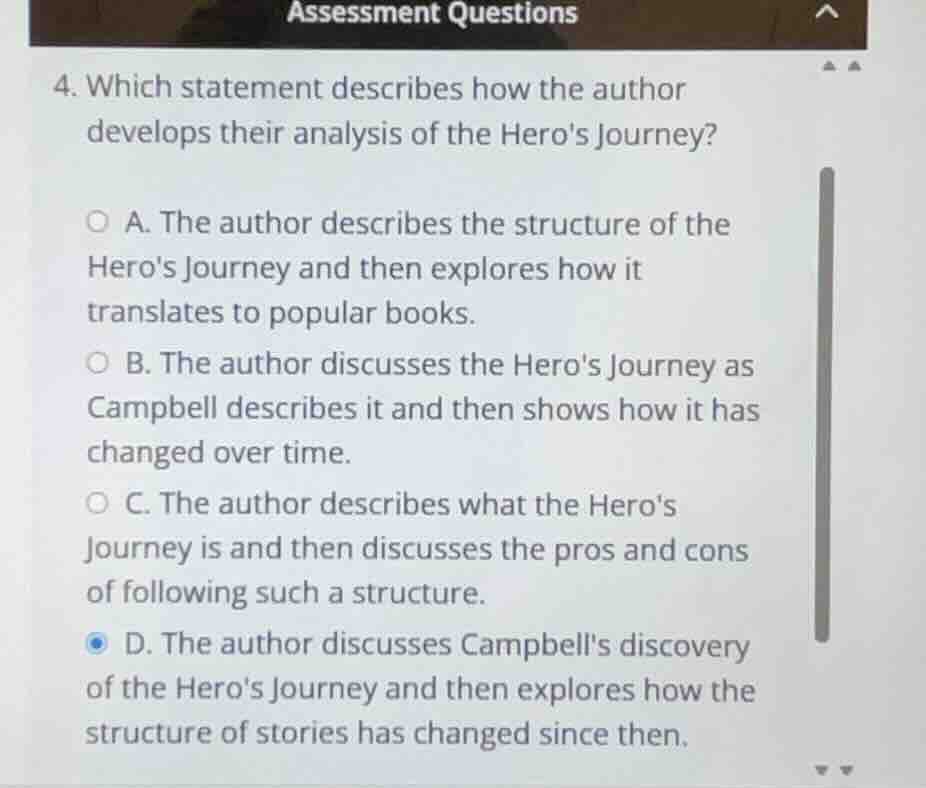
- which statement describes how the author develops their analysis of the heros journey?
a. the author describes the structure of the heros journey and then explores how it translates to popular books.
b. the author discusses the heros journey as campbell describes it and then shows how it has changed over time.
c. the author describes what the heros journey is and then discusses the pros and cons of following such a structure.
d. the author discusses campbells discovery of the heros journey and then explores how the structure of stories has changed since then.
To solve this, we analyze each option:
- Option A: If the author first explains the Hero's Journey structure (like the stages) and then applies it to popular books (showing how those books follow the structure), this is a common way to analyze a narrative structure (the Hero's Journey) and its application in literature.
- Option B: The question is about how the author develops their analysis of the Hero's Journey. There's no indication the author focuses on how the Hero's Journey changed over time; the main focus of the Hero's Journey analysis is usually its structure and application, not its evolution.
- Option C: Analyzing pros and cons of the Hero's Journey structure is less common in typical literary analysis of the Hero's Journey, which is more about its structure and application in stories, not evaluating its merits/demerits.
- Option D: The Hero's Journey is a narrative structure, and the analysis of it is not about how story structures changed since Campbell, but about the structure itself and its use in stories. So this is incorrect.
So the correct answer is A as it matches the typical way of analyzing the Hero's Journey: explaining its structure and then showing its application in popular literature.

Snap & solve any problem in the app
Get step-by-step solutions on Sovi AI
Photo-based solutions with guided steps
Explore more problems and detailed explanations
A. The author describes the structure of the Hero's Journey and then explores how it translates to popular books.