QUESTION IMAGE
Question
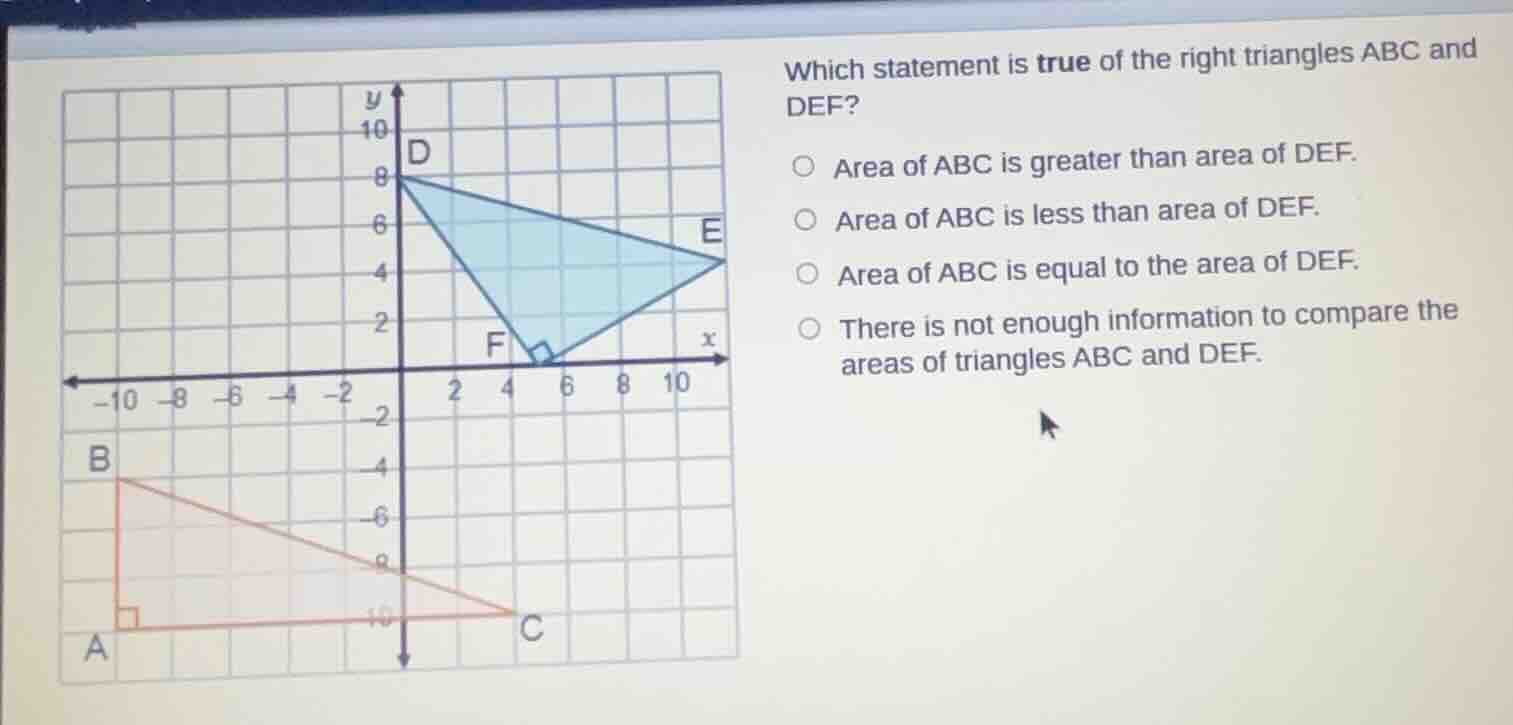
which statement is true of the right triangles abc and def? area of abc is greater than area of def. area of abc is less than area of def. area of abc is equal to the area of def. there is not enough information to compare the areas of triangles abc and def.
Step1: Find legs of ABC
From graph, A is at (-10, -10)? Wait, no, looking at coordinates: Let's find coordinates. For triangle ABC: A seems to be at (-10, -10)? Wait, no, better to see grid. Let's check ABC: A is at (-10, -10)? Wait, no, the red triangle: A is on x-axis? Wait, A is at (-10, -10)? Wait, maybe better to calculate base and height. For right triangle, area is $\frac{1}{2} \times base \times height$.
For triangle DEF: D is (0,8), F is (5,0)? Wait, F is at (5,0)? Wait, the blue triangle: F is at (5,0)? Wait, D(0,8), F(5,0), E(10,4)? Wait, no, E is at (10,4)? Wait, let's get coordinates:
DEF: D(0,8), F(5,0), E(10,4). Wait, no, F is the right angle, so DF and EF? Wait, no, F is the right angle, so legs are DF and EF? Wait, no, F is (5,0), D is (0,8), E is (10,4). Wait, distance from D to F: base? Wait, maybe better to find length of legs.
Wait, ABC: A is at (-10, -10)? No, A is at (-10, -10)? Wait, the red triangle: A is at (-10, -10), B at (-10, -4), C at (10, -10)? Wait, no, let's count grid squares.
Wait, ABC: A is at (-10, -10), B at (-10, -4) (so height is 6 units: from y=-10 to y=-4 is 6), and base is from x=-10 to x=10, so length 20? No, that can't be. Wait, maybe I misread. Wait, A is at (-10, -10), C is at (10, -10), so base AC is 20 units (from x=-10 to x=10, y=-10). B is at (-10, -4), so height is 6 units (from y=-10 to y=-4). So area of ABC is $\frac{1}{2} \times 20 \times 6 = 60$? No, that seems too big. Wait, maybe coordinates are different.
Wait, DEF: D(0,8), F(5,0), E(10,4). Wait, F is (5,0), D(0,8), E(10,4). Let's find legs: DF: from (0,8) to (5,0): length? Wait, no, F is the right angle, so legs are DF and EF? Wait, F(5,0), D(0,8): horizontal distance? No, vertical and horizontal. Wait, F is (5,0), D is (0,8): the horizontal distance from F to D is 5 (x from 5 to 0), vertical distance is 8 (y from 0 to 8). Wait, no, F is (5,0), E is (10,4): horizontal distance 5 (x from 5 to 10), vertical distance 4 (y from 0 to 4). Wait, no, F is the right angle, so legs are DF and EF. Wait, DF: from D(0,8) to F(5,0): the length is $\sqrt{(5-0)^2 + (0-8)^2} = \sqrt{25 + 64} = \sqrt{89}$. No, that's not right. Wait, maybe F is (5,0), D is (0,8), so the horizontal leg is 5 (from x=0 to x=5) and vertical leg is 8 (from y=0 to y=8). Wait, no, F is (5,0), so the legs are along x and y? Wait, F is at (5,0), D is at (0,8), E is at (10,4). Wait, maybe the legs are DF and EF, but F is the right angle, so vector DF is (5-0, 0-8) = (5, -8), vector EF is (5-10, 0-4) = (-5, -4). Dot product: 5(-5) + (-8)(-4) = -25 + 32 = 7 ≠ 0, so not perpendicular. Wait, maybe I made a mistake.
Wait, maybe ABC: A is at (-10, -10), B at (-10, -4), C at (10, -10). So base AC: length 20 (from x=-10 to x=10, y=-10), height AB: 6 (from y=-10 to y=-4). Area: 0.5206=60.
DEF: D(0,8), F(5,0), E(10,4). Let's find the base and height. Wait, maybe DEF is a right triangle with legs: from D(0,8) to F(5,0): length? Wait, distance between D(0,8) and F(5,0): $\sqrt{(5-0)^2 + (0-8)^2} = \sqrt{25 + 64} = \sqrt{89} ≈ 9.43$. Distance between F(5,0) and E(10,4): $\sqrt{(10-5)^2 + (4-0)^2} = \sqrt{25 + 16} = \sqrt{41} ≈ 6.40$. Distance between D(0,8) and E(10,4): $\sqrt{(10-0)^2 + (4-8)^2} = \sqrt{100 + 16} = \sqrt{116} ≈ 10.77$. Wait, that's not a right triangle. Wait, maybe F is (5,0), D is (0,8), E is (10,4), but F is not the right angle? Wait, the graph shows F with a right angle symbol. So F is the right angle, so DF and EF are legs. Wait, maybe coordinates are D(0,8), F(5,0), E(10,4). Then vector DF is (5, -8), vector EF is (-5, -4). Dot product: 5*(-5)…

Snap & solve any problem in the app
Get step-by-step solutions on Sovi AI
Photo-based solutions with guided steps
Explore more problems and detailed explanations
Area of ABC is greater than area of DEF.