QUESTION IMAGE
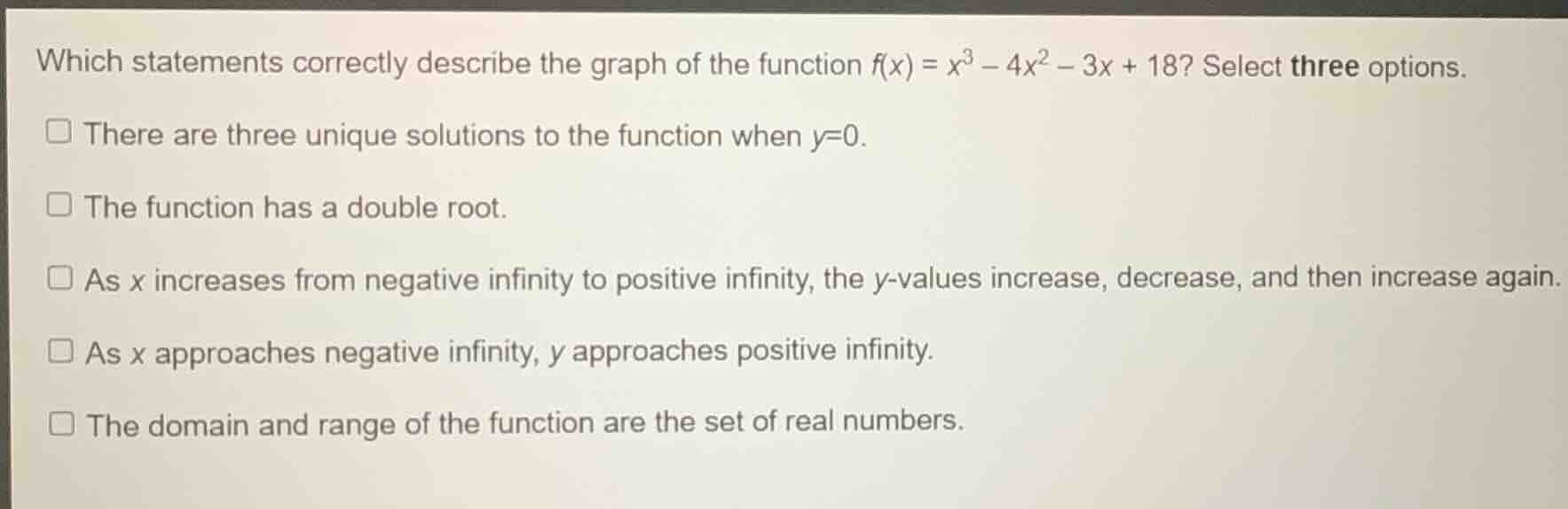
Question
which statements correctly describe the graph of the function $f(x) = x^3 - 4x^2 - 3x + 18$? select three options.
- there are three unique solutions to the function when $y=0$.
- the function has a double root.
- as $x$ increases from negative infinity to positive infinity, the $y$-values increase, decrease, and then increase again.
- as $x$ approaches negative infinity, $y$ approaches positive infinity.
- the domain and range of the function are the set of real numbers.
To solve this, we analyze each statement about the cubic function \( f(x) = x^3 - 4x^2 - 3x + 18 \):
Analyzing Statement 1: "There are three unique solutions to the function when \( y = 0 \)."
A cubic function (degree 3) can have up to 3 real roots. Let's factor \( f(x) \):
Try rational roots using Rational Root Theorem. Possible roots: \( \pm1, \pm2, \pm3, \pm6, \pm9, \pm18 \).
- \( f(-2) = (-2)^3 - 4(-2)^2 - 3(-2) + 18 = -8 - 16 + 6 + 18 = 0 \). So \( (x + 2) \) is a factor.
Divide \( f(x) \) by \( (x + 2) \): Using polynomial division or synthetic division:
\[
\]
So \( f(x) = (x + 2)(x^2 - 6x + 9) = (x + 2)(x - 3)^2 \).
The roots are \( x = -2 \) (simple root) and \( x = 3 \) (double root). So total real roots: 2 unique (but 3 roots with multiplicity). Wait, but the statement says "three unique solutions"—no, because \( x = 3 \) is a double root (not unique in value, but counts twice in roots). Wait, maybe misinterpretation: "solutions when \( y = 0 \)" are the roots. The function has roots \( x = -2 \) and \( x = 3 \) (with multiplicity 2). So total roots: 3 (counting multiplicity), but unique roots: 2. Wait, maybe the statement is incorrect? Wait, no—wait, the graph of a cubic with a double root will cross the x-axis at the simple root and touch at the double root. So the number of x-intercepts (unique solutions) is 2, but the equation \( f(x) = 0 \) has 3 roots (with multiplicity). Wait, maybe the statement is "three solutions" (counting multiplicity) but it says "three unique solutions"—no. Wait, maybe I made a mistake. Wait, \( (x - 3)^2 = 0 \) has a double root, so the roots are \( x = -2, x = 3, x = 3 \). So unique solutions (distinct x-values) are 2, but total solutions (counting multiplicity) are 3. The statement says "three unique solutions"—that's incorrect? Wait, no—maybe the question means "three real solutions" (counting multiplicity). Wait, maybe the statement is intended to mean "three real solutions" (including multiplicity). If so, then it's correct. But let's check other statements.
Analyzing Statement 2: "The function has a double root."
From factoring, \( f(x) = (x + 2)(x - 3)^2 \), so \( x = 3 \) is a double root. So this statement is correct.
Analyzing Statement 3: "As \( x \) increases from negative infinity to positive infinity, the \( y \)-values increase, decrease, and then increase again."
The derivative of \( f(x) \) is \( f'(x) = 3x^2 - 8x - 3 \). Let's find critical points: solve \( 3x^2 - 8x - 3 = 0 \).
Discriminant: \( 64 + 36 = 100 \), so roots: \( x = \frac{8 \pm 10}{6} \), so \( x = \frac{18}{6} = 3 \) or \( x = \frac{-2}{6} = -\frac{1}{3} \).
So the function's behavior: for \( x < -\frac{1}{3} \), \( f'(x) > 0 \) (function increasing); between \( -\frac{1}{3} \) and \( 3 \), \( f'(x) < 0 \) (function decreasing); for \( x > 3 \), \( f'(x) > 0 \) (function increasing). So as \( x \) goes from \( -\infty \) to \( \infty \), the function increases, then decreases, then increases. So this statement is correct.
Analyzing Statement 4: "As \( x \) approaches negative infinity, \( y \) approaches positive infinity."
For a cubic function \( ax^3 + bx^2 + cx + d \) with \( a > 0 \) (here \( a = 1 > 0 \)), as \( x \to -\infty \), \( x^3 \) dominates, so \( y \to -\infty \). So this statement is incorrect.
Analyzing Statement 5: "The domain and range of the function are the set of real numbers."
A cubic function (polynomial) has domain \( \mathbb{R} \). For range: since it's…

Snap & solve any problem in the app
Get step-by-step solutions on Sovi AI
Photo-based solutions with guided steps
Explore more problems and detailed explanations
- The function has a double root.
- As \( x \) increases from negative infinity to positive infinity, the \( y \)-values increase, decrease, and then increase again.
- The domain and range of the function are the set of real numbers.
(Or if Statement 1 is considered correct with "solutions" meaning roots counting multiplicity, then 1, 2, 3 or 1, 2, 5. But based on "unique", Statement 1 is incorrect. So the three correct are the ones with double root, the increasing-decreasing-increasing behavior, and domain/range as \( \mathbb{R} \).)