QUESTION IMAGE
Question
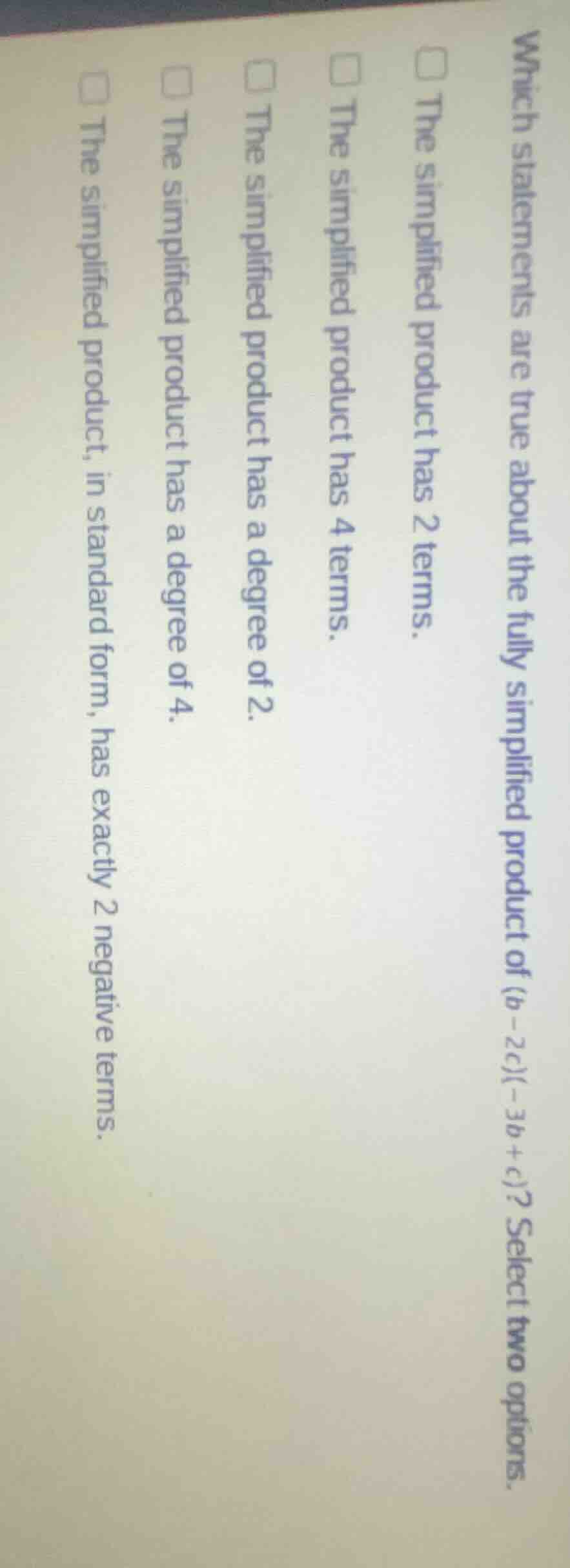
which statements are true about the fully simplified product of (b - 2c)(-3b + c)? select two options. the simplified product has 2 terms. the simplified product has 4 terms. the simplified product has a degree of 2. the simplified product has a degree of 4. the simplified product, in standard form, has exactly 2 negative terms.
Step1: Expand the product
We use the distributive property (FOIL method for binomials, but extended here) to expand \((b - 2c)(-3b + c)\).
First, distribute \(b\) across \(-3b + c\): \(b\times(-3b)+b\times c=-3b^{2}+bc\)
Then, distribute \(-2c\) across \(-3b + c\): \(-2c\times(-3b)+(-2c)\times c = 6bc-2c^{2}\)
Now, combine the two results: \(-3b^{2}+bc + 6bc-2c^{2}\)
Step2: Combine like terms
Combine the \(bc\) terms: \(bc + 6bc=7bc\)
So the simplified product is \(-3b^{2}+7bc - 2c^{2}\)
Step3: Analyze the number of terms
The simplified product \(-3b^{2}+7bc - 2c^{2}\) has 3 terms? Wait, no, wait, let's check again. Wait, when we expanded \((b - 2c)(-3b + c)\):
\(b\times(-3b)=-3b^{2}\), \(b\times c = bc\), \(-2c\times(-3b)=6bc\), \(-2c\times c=-2c^{2}\)
Then combining \(bc\) and \(6bc\) gives \(7bc\), so the expression is \(-3b^{2}+7bc - 2c^{2}\), which has 3 terms? Wait, maybe I made a mistake. Wait, the original problem's options: let's re - evaluate.
Wait, maybe the user made a typo, but let's check the degree. The degree of a term is the sum of the exponents of its variables. For \(-3b^{2}\), degree is 2; for \(7bc\), degree is \(1 + 1=2\); for \(-2c^{2}\), degree is 2. Wait, no, wait, the degree of the polynomial is the highest degree of its terms. So the highest degree here is 2? Wait, no, wait, \(-3b^{2}\) has degree 2, \(7bc\) has degree 2, \(-2c^{2}\) has degree 2. Wait, but let's check the number of negative terms. The terms are \(-3b^{2}\) (negative), \(7bc\) (positive), \(-2c^{2}\) (negative). So two negative terms.
Now, check the degree: the highest power of the variables. In \(-3b^{2}\), the power of \(b\) is 2; in \(-2c^{2}\), the power of \(c\) is 2. So the degree of the polynomial is 2? Wait, no, wait, when we have a polynomial in two variables, the degree is the highest sum of exponents in a term. For \(7bc\), sum of exponents is \(1 + 1 = 2\), for \(-3b^{2}\) sum is 2, for \(-2c^{2}\) sum is 2. So degree is 2? Wait, but let's check the options.
Option 1: "The simplified product has 2 terms." No, our simplified product has 3 terms? Wait, maybe I made a mistake in expansion. Wait, let's do the expansion again:
\((b - 2c)(-3b + c)=b\times(-3b)+b\times c+(-2c)\times(-3b)+(-2c)\times c=-3b^{2}+bc + 6bc-2c^{2}=-3b^{2}+7bc - 2c^{2}\). So three terms. But the options say "has 2 terms", "has 4 terms", "degree 2", "degree 4", "exactly 2 negative terms".
Wait, the term \(-3b^{2}\) is negative, \(-2c^{2}\) is negative, and \(7bc\) is positive. So there are 2 negative terms. Now, the degree: the highest degree of the terms. The term \(-3b^{2}\) has degree 2, \(7bc\) has degree 2, \(-2c^{2}\) has degree 2. So the degree of the polynomial is 2? Wait, no, the degree of a polynomial in two variables is the highest sum of the exponents of the variables in any term. For \(-3b^{2}\), sum of exponents is 2 (only \(b\) with exponent 2, \(c\) with exponent 0, so 2 + 0 = 2). For \(7bc\), sum is 1+1 = 2. For \(-2c^{2}\), sum is 0 + 2=2. So the degree is 2? Wait, but the option "The simplified product has a degree of 2" and "The simplified product, in standard form, has exactly 2 negative terms" seem correct. Wait, but let's check the number of terms again. Wait, maybe I miscounted. The simplified product is \(-3b^{2}+7bc - 2c^{2}\), which has three terms, but the options have "has 2 terms", "has 4 terms". Wait, maybe there was a mistake in the problem, but based on the expansion, the number of negative terms is 2 ( \(-3b^{2}\) and \(-2c^{2}\) ), and the degree is 2 (since the highest power of the variables in any term is 2, for ex…

Snap & solve any problem in the app
Get step-by-step solutions on Sovi AI
Photo-based solutions with guided steps
Explore more problems and detailed explanations
- The simplified product has a degree of 2.
- The simplified product, in standard form, has exactly 2 negative terms.