QUESTION IMAGE
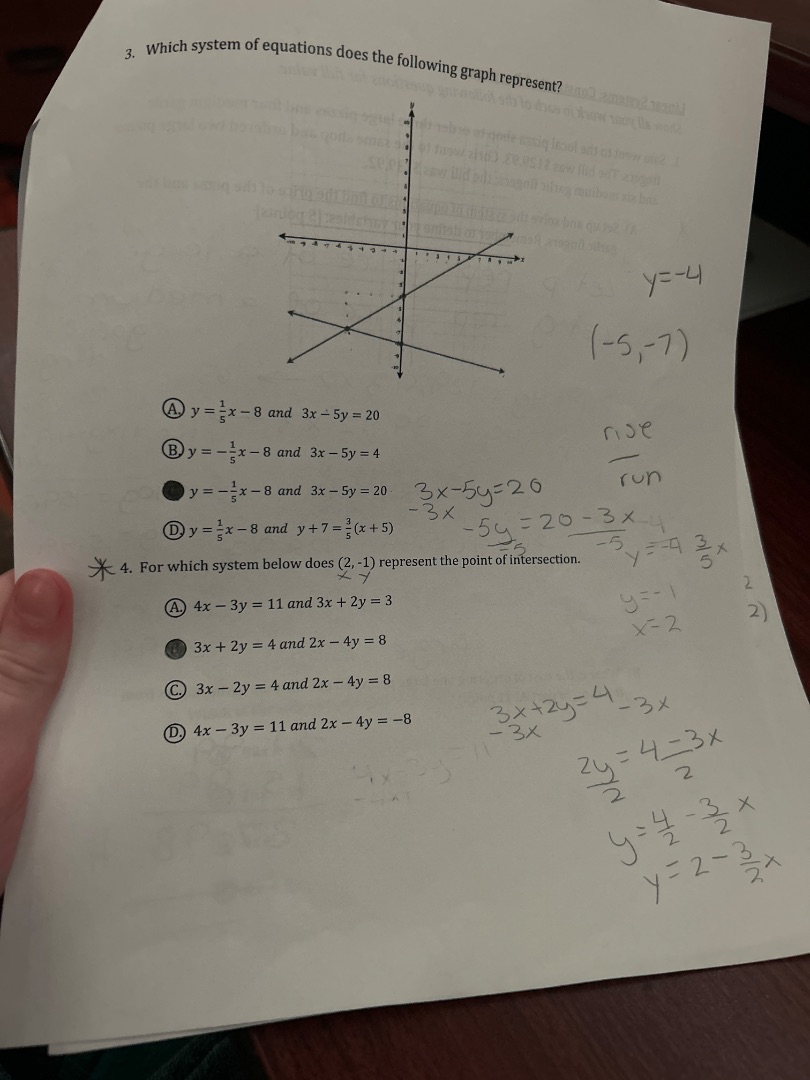
Question
- which system of equations does the following graph represent?
a) $y = \frac{1}{5}x - 8$ and $3x - 5y = 20$
b) $y = -\frac{1}{5}x - 8$ and $3x - 5y = 4$
c) $y = -\frac{1}{5}x - 8$ and $3x - 5y = 20$
d) $y = \frac{1}{5}x - 8$ and $y + 7 = \frac{3}{5}(x + 5)$
- for which system below does $(2, -1)$ represent the point of intersection.
a) $4x - 3y = 11$ and $3x + 2y = 3$
b) $3x + 2y = 4$ and $2x - 4y = 8$
c) $3x - 2y = 4$ and $2x - 4y = 8$
d) $4x - 3y = 11$ and $2x - 4y = -8$
Question 3
Step1: Analyze the slope of the line
From the graph, we can see that one line has a negative slope. Let's check the slope of each equation. For the equation \(y = mx + b\), \(m\) is the slope. Option A and D have positive slopes (\(\frac{1}{5}\)), so we can eliminate them. Now we have B and C left.
Step2: Check the second equation
Let's rewrite the second equation in slope - intercept form (\(y=mx + b\)). For \(3x-5y = 20\), we have \(- 5y=-3x + 20\), then \(y=\frac{3}{5}x-4\). For \(3x - 5y=4\), we have \(-5y=-3x + 4\), then \(y=\frac{3}{5}x-\frac{4}{5}\). Now we check the point \((-5,-7)\) in the equations of option C. First equation: \(y =-\frac{1}{5}x-8\), substitute \(x = - 5\), we get \(y=-\frac{1}{5}\times(-5)-8=1 - 8=-7\), which matches. Second equation: \(3x-5y = 20\), substitute \(x=-5,y = - 7\), we have \(3\times(-5)-5\times(-7)=-15 + 35 = 20\), which matches. For option B, the second equation \(3x-5y = 4\), substitute \(x=-5,y=-7\), we get \(3\times(-5)-5\times(-7)=-15 + 35 = 20
eq4\). So option C is correct.
To check if \((2,-1)\) is the intersection point, we substitute \(x = 2\) and \(y=-1\) into each system of equations.
- Option A: First equation \(4x-3y=4\times2-3\times(-1)=8 + 3=11\) (matches), second equation \(3x + 2y=3\times2+2\times(-1)=6 - 2 = 4
eq3\) (does not match).
- Option B: First equation \(3x + 2y=3\times2+2\times(-1)=6 - 2 = 4\) (matches), second equation \(2x-4y=2\times2-4\times(-1)=4 + 4 = 8\) (matches).
- Option C: First equation \(3x-2y=3\times2-2\times(-1)=6 + 2 = 8
eq4\) (does not match).
- Option D: First equation \(4x-3y=4\times2-3\times(-1)=8 + 3=11\) (matches), second equation \(2x-4y=2\times2-4\times(-1)=4 + 4 = 8
eq - 8\) (does not match).
So option B is correct.

Snap & solve any problem in the app
Get step-by-step solutions on Sovi AI
Photo-based solutions with guided steps
Explore more problems and detailed explanations
C. \(y =-\frac{1}{5}x - 8\) and \(3x - 5y=20\)