QUESTION IMAGE
Question
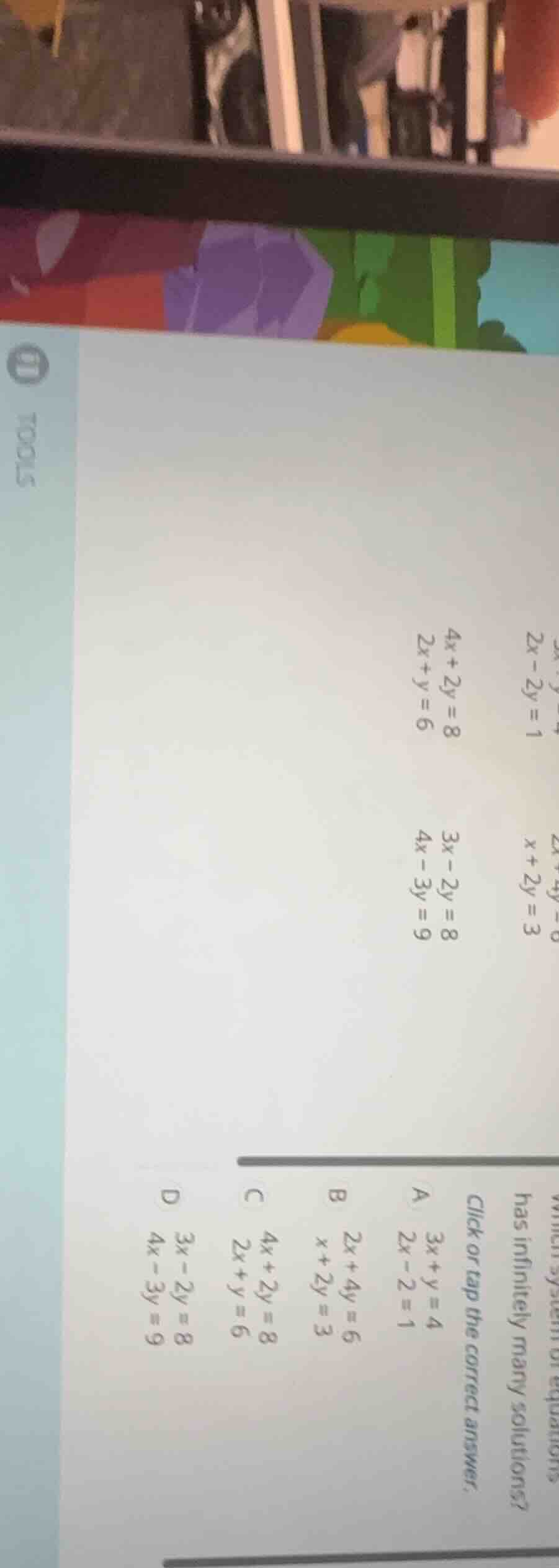
which system of equations has infinitely many solutions? click or tap the correct answer. a ( \begin{cases} 3x + y = 4 \\ 2x - 2 = 1 end{cases} ) b ( \begin{cases} 2x + 4y = 6 \\ x + 2y = 3 end{cases} ) c ( \begin{cases} 4x + 2y = 8 \\ 2x + y = 6 end{cases} ) d ( \begin{cases} 3x - 2y = 8 \\ 4x - 3y = 9 end{cases} ) also there are some other equations like ( 2x - 2y = 1 ), ( x + 2y = 3 ), ( 4x + 2y = 8 ), ( 2x + y = 6 ), ( 3x - 2y = 8 ), ( 4x - 3y = 9 ) above the options.
Step1: Recall infinite solutions condition
A system of linear equations $a_1x + b_1y = c_1$ and $a_2x + b_2y = c_2$ has infinitely many solutions if $\frac{a_1}{a_2} = \frac{b_1}{b_2} = \frac{c_1}{c_2}$.
Step2: Test Option A
Check ratios: $\frac{3}{2}
eq \frac{1}{-2}
eq \frac{4}{1}$. No infinite solutions.
Step3: Test Option B
Check ratios: $\frac{2}{1} = \frac{4}{2} = \frac{6}{3} = 2$. All ratios are equal.
Step4: Verify remaining options (optional)
Option C: $\frac{4}{2} = \frac{2}{1}
eq \frac{8}{6}$. Option D: $\frac{3}{4}
eq \frac{-2}{-3}
eq \frac{8}{9}$. Only B satisfies the condition.

Snap & solve any problem in the app
Get step-by-step solutions on Sovi AI
Photo-based solutions with guided steps
Explore more problems and detailed explanations
B. $2x + 4y = 6$; $x + 2y = 3$